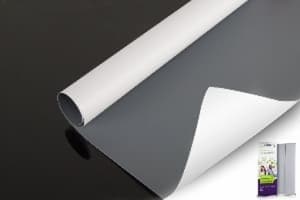
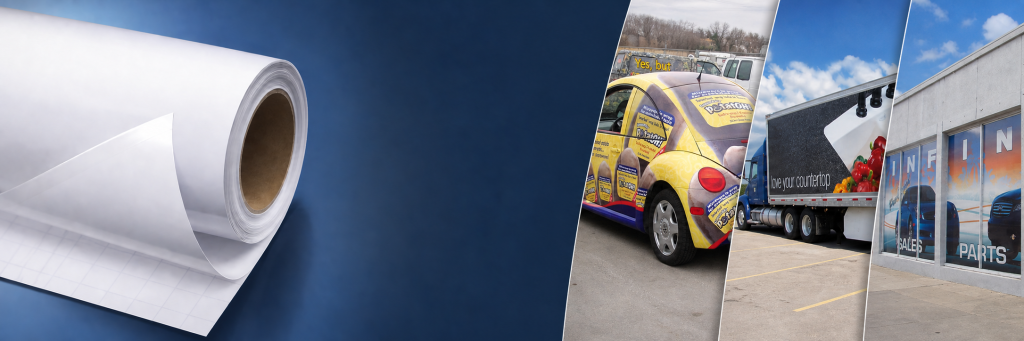
100 micron printable self adhesive vinyl is large-format roll media with a 100µm / 0.10mm / 3.94mil PVC face film. A 140gsm release liner supports the film during printing, cutting and handling. The two numbers measure different parts of the material.
UNISIGN offers 100 micron options with clear, grey, black, removable, high-tack, opaque and anti-curl features. Start with the surface, ink, width and adhesive—not thickness alone.

| Specification | Value |
|---|---|
| Face Film | 100 micron / 0.10mm / 3.94mil |
| Release Liner | 140gsm |
| Width Range | 0.914–2.02m / 36–79.5in |
| Standard Length | 50m / 164ft |
| Other Lengths | 25m / 30m / 75m / 100m |
| Listed Ink Options | Solvent / Eco-Solvent / UV / Latex |
| Finish Options | Glossy / Matte |
| Adhesive Options | Clear / Grey / Black / Removable / High Tack |
| Primary Uses | Vehicle and Truck Ads / Glass and Storefront Graphics / Flat Promotions / Short-Term Outdoor Ads |
Quick buying answer
- General flat signs: start with SAV12/140.
- Need better hiding: compare grey-glue SAV12G/140 and black-glue SAV12B/140.
- Need easy removal: test SAV12/140R.
- Hard-to-stick surface: test SAV12HT/140 high tack.
- Need less edge curl: test SAV12DP/140 with double-PE liner.
Data scope: this page summarizes current public information for the listed UNISIGN models. Confirm the latest tolerance, finish, adhesive, ink compatibility, MOQ, lead time and technical document for the exact product and order.
What Does 100 Micron Self Adhesive Vinyl Mean?
100 micron refers to the nominal thickness of the face film. It may also be written as 100 mic, 100µm, 0.10mm or about 3.94mil. It does not include the adhesive and release liner unless a supplier clearly says so.
| Number | Part Measured | What It Helps Describe |
|---|---|---|
| 100 micron / 0.10mm / 3.94mil | Printable face film | Film thickness and handling |
| 140gsm | Release liner | Paper weight per square meter |
| 10140 | Common short specification | 100 micron film + 140gsm liner |
Important: a thicker film is not always a longer-lasting film. Material construction—such as monomeric, polymeric or cast—plus adhesive, laminate, climate, surface and installation can matter more than 80 or 100 micron alone.
Choose a 100 Micron Product by Model
A real product list helps you confirm the material before asking for a sample. These five cards show the main visual and adhesive choices. Use the full model table below for more options.
SAV12/140
- 100 micron film
- 140gsm liner
- Up to 2.02m wide
- General flat graphics

SAV12G/140
- Grey adhesive
- Helps hide the base color
- Up to 2.02m wide
- Signs and display graphics

SAV12B/140
- Black adhesive
- Stronger blockout starting point
- Up to 2.02m wide
- Covering old graphics

SAV12T/140
- Transparent film option
- Up to 1.52m wide
- Glass and clear graphics
- Test white ink or backing needs
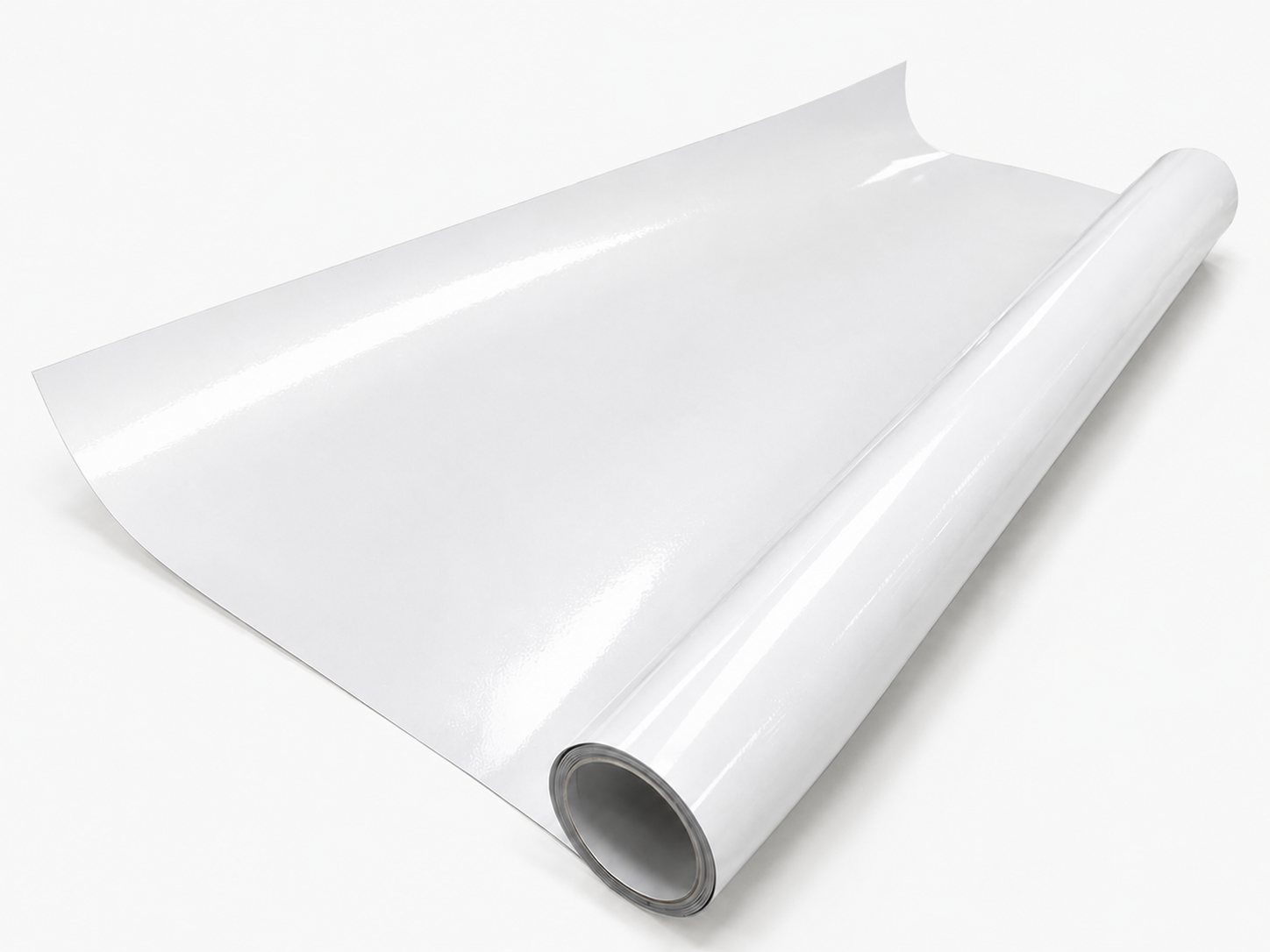
SAV12HG/140
- High-gloss surface
- 100 micron film + 140gsm liner
- Up to 1.52m wide
- Glossy flat signs and promotional graphics after testing
Compare the 100 Micron + 140gsm Product Range
The same film thickness can be paired with different adhesives, liners and surface features. Select by the job, then test the exact model.
| Model | Main Difference | Maximum Listed Width | Best Starting Use |
|---|---|---|---|
| SAV12/140 | Standard option | 2.02m / 79.5in | General flat signs and graphics |
| SAV12G/140 | Grey adhesive | 2.02m / 79.5in | Better hiding over a colored base |
| SAV12B/140 | Black adhesive | 2.02m / 79.5in | Blockout and covering old graphics |
| SAV12T/140 | Transparent film | 1.52m / 60in | Windows and clear graphics |
| SAV12/140R | Removable adhesive | 2.02m / 79.5in | Short-term graphics and planned removal |
| SAV12HT/140 | High-tack adhesive | 2.02m / 79.5in | More difficult surfaces after testing |
| SAV12DP/140 | Double-PE anti-curl liner | 1.52m / 60in | Jobs where liner flatness matters |
| SAV12OP/140 | Opaque option | 1.52m / 60in | Higher hiding requirement |
| SAV12HG/140 | High-gloss finish | 1.52m / 60in | Glossy promotional graphics |
| UV1101 | Premium 100 micron option | 1.52m / 60in | Projects that need a higher specification review |
| UV1301 | Monomeric 100 micron option | 1.52m / 60in | Flat or simple-curve vehicle advertising after testing |
Do not assume every row has every finish, adhesive or ink option. Ask for the current model-specific TDS and a representative sample.
A related model uses a different liner system: SAV10ST/125 Ultra Clear has a 100µm clear film and a 125µm PET liner. The “125” is liner thickness, not 125gsm, so it is not part of the 100 micron + 140gsm / 10140 comparison above.
What Are the Complete Base Specifications?
| Item | Current Range | What to Confirm |
|---|---|---|
| Face Film | 100 micron / 0.10mm / 3.94mil | Nominal value and tolerance |
| Release Liner | 140gsm | Paper type, coating and flatness |
| Finish | Glossy / matte / high gloss options | Exact finish for the model |
| Adhesive | Clear / grey / black / removable / high tack | Color, tack, removal need and surface |
| Width | 0.914 / 1.07 / 1.27 / 1.37 / 1.52 / 1.60 / 1.82 / 2.02m | Available width for the exact model |
| Standard Length | 50m / 164ft | Core, packing and roll tolerance |
| Other Lengths | 25m / 30m / 75m / 100m | Availability and MOQ |
| Printing | Solvent / Eco-Solvent / UV / Latex options listed | Printer, ink, profile and model |
| Application | Vehicle and truck ads / glass and storefront graphics / flat promotions / short-term outdoor ads | Surface, shape, exposure and required life |
80 Micron vs 100 Micron Printable Vinyl
100 micron film is 25% thicker than 80 micron film by nominal thickness. It may feel easier to handle on some flat applications, but it is not automatically more durable or better for curves.
| Question | 80 Micron | 100 Micron |
|---|---|---|
| Nominal Thickness | 0.08mm / 3.15mil | 0.10mm / 3.94mil |
| Difference | Baseline | 25% thicker than 80 micron |
| Handling | Can feel more flexible | Can feel more substantial |
| Flat Signs | Can be suitable | Common starting point |
| Curves | Choose by monomeric, polymeric or cast construction and the real curve—not thickness alone. | |
| Durability | Depends on film class, adhesive, laminate, climate, surface and installation. | |
120gsm vs 140gsm Release Liner
GSM describes liner mass per square meter. A 140gsm liner is heavier than a 120gsm liner, but GSM alone does not prove better flatness, cutting or printer feeding.
| Check | 120gsm Liner | 140gsm Liner |
|---|---|---|
| Paper Mass | 120g/m² | 140g/m² |
| Theoretical Difference | Baseline | 16.7% higher paper mass |
| Possible Handling | Lighter | More body |
| What GSM Does Not Prove | Moisture stability, silicone release, PE coating, flatness, cutting quality or printer feeding. | |
| Best Test | Print, contour-cut, weed, store and apply the real roll format. | |
Should You Choose Clear, Grey or Black Adhesive?
| Adhesive Color | Choose It When | Test First |
|---|---|---|
| Clear | The base color is clean and show-through is not a problem. | Final color, edge view and the original surface. |
| Grey | You need more hiding over a colored or printed base. | Opacity, color shift and removal. |
| Black | You need a stronger blockout starting point or must cover an old graphic. | Edge appearance, opacity and adhesive residue. |
Adhesive color is not the same as adhesive strength. A grey or black adhesive can improve hiding, while tack and removal behavior still need separate confirmation.
Permanent, Removable or High Tack?
| Type | Best Starting Use | Main Risk to Test |
|---|---|---|
| Permanent | General signs intended to stay in place | Removal damage or residue |
| Removable | Promotions, events and graphics with planned removal | Edge lift during the required use period |
| High Tack | More difficult or slightly textured surfaces | Whether the surface is suitable and whether removal is possible |
Always test on the real substrate. “High tack” does not make dusty, oily, wet, loose or very low-energy surfaces safe to use.
Which Printing Inks Can Be Used?
The current UNISIGN range lists solvent, eco-solvent, UV and Latex options. Compatibility must be checked for the exact model, printer, ink and finishing process.
| Ink | Check During the Sample Test |
|---|---|
| Solvent | Drying, odor, ink load, surface and lamination time |
| Eco-Solvent | Profile, drying, color density and outgassing before lamination |
| UV | Ink adhesion, cracking during bending and surface feel |
| Latex | Heat, liner flatness, curing, color and adhesive behavior |
Use one test file with CMYK blocks, deep black, gradients, small text and large solid colors. Do not approve a roll from one small logo.
Does 100 Micron Printable Vinyl Need Lamination?
Lamination depends on the job. Outdoor exposure, cleaning, abrasion, vehicle use and required life may make a matched laminate useful. A short indoor graphic with little handling may not need the same protection.
- Match the laminate to the face film construction and flexibility.
- Allow the required drying or outgassing time before lamination.
- Test color, adhesion, edge lift and bending after lamination.
- Do not use a laminate to make an unsuitable film safe for deep channels or compound curves.
- Ask for the current model-specific film and laminate recommendation.
What Widths and Roll Lengths Are Available?
| Metric Width | Approx. Inches | Check |
|---|---|---|
| 0.914m | 36in | Exact printer and trim width |
| 1.07m | 42.1in | Model availability |
| 1.27m | 50in | Model availability |
| 1.37m | 53.9in | Common 54in workflow |
| 1.52m | 59.8in | Common 60in workflow |
| 1.60m | 63in | Printer clearance |
| 1.82m | 71.7in | Model availability |
| 2.02m | 79.5in | Only selected models |
The standard roll length is 50m / 164ft. Listed alternatives include 25m, 30m, 75m and 100m. Ask for the current core size, packing, rolls per pallet, MOQ and lead time for the exact width and model. These values can change with the order.
Where Is 100 Micron Printable Vinyl Used?


| Application | Good Starting Option | Critical Check |
|---|---|---|
| Vehicle Advertising | Choose by panel shape and required life | Film class, laminate, simple curves and removal |
| Truck Advertising | Standard, grey or black adhesive after testing | Panel joints, rivets, edges, seams and outdoor exposure |
| Glass / Storefront | Clear, standard or removable | Daylight view, opacity, privacy and clean removal |
| Flat Promotional Graphic | Standard, grey, black or high-gloss option | Base color, surface energy and show-through |
| Short-Term Outdoor Advertising | Standard or removable, with laminate where needed | Weather, cleaning, edge lift, required period and removal |
Which Surfaces Need Extra Care?
Do not apply the film until the real surface has passed an adhesion test.
- Dusty, oily, wet or waxed surfaces
- Loose, peeling or uncured paint
- Rough or porous walls
- Silicone, rubber and some low-surface-energy plastics
- Sharp edges, deep channels and compound curves without a suitable film class
- Very hot, very cold or damp surfaces outside the model instructions
- Old graphics that may react with the new adhesive
What Causes Common Vinyl Failures?
| Problem | Possible Cause | What to Do |
|---|---|---|
| Edge lift | Low tack, dirty surface, tension or sharp edge | Clean, test high tack, reduce tension and follow edge instructions |
| Bubbles | Poor cleaning, trapped air or fast application | Use the right squeegee method and test an air-release option if needed |
| Old graphic shows through | Clear adhesive or low opacity | Compare grey, black or opaque options |
| Liner curls | Heat, moisture or liner construction | Check storage, printer heat and double-PE anti-curl liner |
| Ink scratches or cracks | Wrong profile, curing or bend radius | Test the exact ink, drying and finishing process |
| Residue after removal | Wrong adhesive, long exposure or heat | Use a removable model and test the full planned use time |
How Should You Test a Sample?
- Record the model: note SKU, batch, width and roll number.
- Check the roll: measure width, surface, liner flatness and visible defects.
- Print the same file: include colors, deep black, gradients, fine text and solid areas.
- Finish it: allow the correct drying or curing time, then laminate and contour-cut if required.
- Apply it: use the real substrate, cleaner and application method.
- Observe it: check edges, bubbles, color, opacity and adhesion during the planned test period.
- Remove it if required: check residue, surface damage and clean removal.
Approve the exact model and representative production sample before a large order.
What Factory and Technical Evidence Should You Request?


- Current product TDS with revision date
- Face film thickness and tolerance
- Release liner weight and construction
- Adhesive color, tack and removal type
- Peel adhesion, shrinkage or other test data where available
- Application and service temperature where available
- Shelf life and storage instructions
- Ink and printer compatibility
- Batch and roll traceability
- Model-specific compliance documents required by your market
One certificate or test report does not automatically cover every adhesive, finish or product code. Check the document scope.
What Information Should You Send for a Quote?
- Application
- Surface material and shape
- Printer and ink
- Required width and roll length
- Glossy or matte finish
- Clear, grey or black adhesive
- Permanent, removable or high-tack need
- Expected indoor or outdoor use period
- Order quantity and destination country
See the full UNISIGN self adhesive vinyl range, compare the broader printable vinyl roll options, or visit the vinyl sticker material guide if 100 micron is not required.
- Permanent vs removable adhesive vinyl
- Glossy vs matte vinyl sticker material
- Anti-curl vinyl guide
- Self adhesive vinyl film guide
Frequently Asked Questions
What is 100 micron printable self adhesive vinyl?
It is printable roll material with a nominal 100µm / 0.10mm / 3.94mil face film and pressure-sensitive adhesive. The UNISIGN options on this page use a 140gsm release liner and are listed for solvent, eco-solvent, UV or Latex workflows depending on the exact model.
Is 100 micron the total thickness?
No. On this page, 100 micron describes the face film. It does not mean the combined thickness of film, adhesive and liner.
What does 140gsm liner mean?
It means the release paper has a nominal mass of 140 grams per square meter. It is not the film thickness and it is not the total roll weight.
Is 100 micron vinyl more durable than 80 micron vinyl?
Not automatically. A 100 micron film is 25% thicker than an 80 micron film, but film class, adhesive, laminate, exposure, surface and installation have more effect on service life.
What is 10140 self adhesive vinyl?
In supplier shorthand, 10140 often means a 100 micron face film with a 140gsm release liner. Always check the written TDS because naming systems can vary.
Which adhesive color should I choose?
Choose clear adhesive for clean bases where hiding is not needed. Choose grey for better hiding. Choose black when stronger blockout is the main need. Test color, opacity and removal on the real surface.
Can it print with eco-solvent ink?
Eco-solvent is listed for the current range. Confirm the exact model, printer profile, drying time and laminate process with a representative sample.
Can it print with Latex ink?
Latex is listed as an option. Test curing heat, liner flatness, color, adhesive behavior and finishing on the exact model before production.
What is the widest 100 micron roll?
Selected UNISIGN models list widths up to 2.02m / 79.5in. Other models stop at 1.52m / 60in, so confirm the width for the exact product code.
What is the standard roll length?
The standard length is 50m / 164ft. Listed alternatives include 25m, 30m, 75m and 100m, subject to model and order confirmation.
Can I use it on a vehicle?
It can be used for some bus and truck advertising, but flat panels, simple curves and compound curves need different film performance. Confirm the material class, laminate, application method, expected life and removal requirement.
Can I apply it to a rough wall?
Do not assume a standard adhesive will work. Clean the real surface and test a high-tack option. Very rough, porous, dusty or loose surfaces may still be unsuitable.
Should I request a sample before a bulk order?
Yes. Print, finish, apply and remove the exact model on the real substrate. Check color, opacity, liner flatness, edge lift, bubbles, adhesion and residue.
Request a 100 Micron Printable Vinyl Sample
Send UNISIGN your application + surface + printer and ink + width + length + finish + adhesive color + removal need + quantity. The team can recommend the right 100 micron models for testing.
![Top 10 Vinyl Tarp Manufacturers in the World [2026 Guide]](https://unisignflex.com/wp-content/uploads/2026/04/pvc-tarpaulin-product-line.jpg)