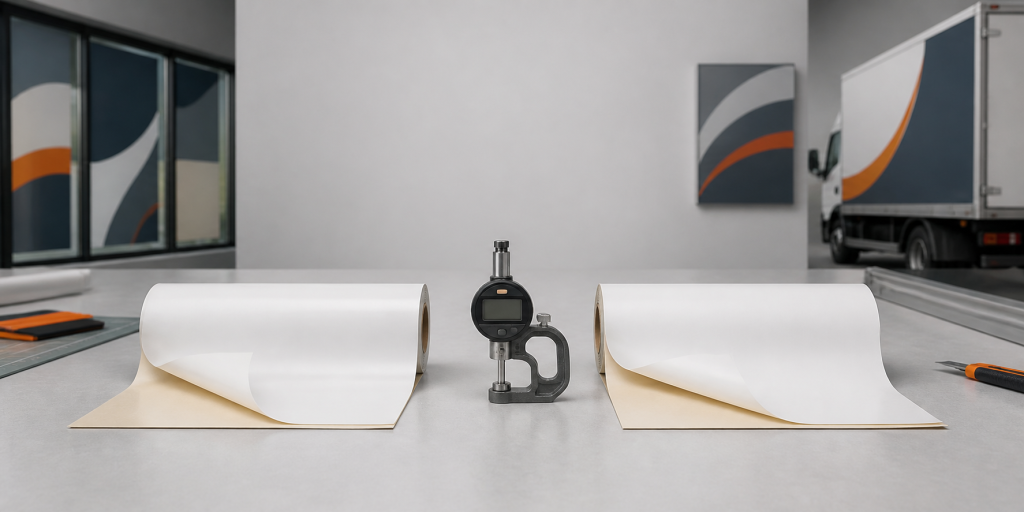
80 micron vs 100 micron self adhesive vinyl is mainly a comparison of face-film thickness, handling and product construction—not a simple quality ranking. An 80µm face film is 0.08mm / 3.15mil. A 100µm face film is 0.10mm / 3.94mil, so it is 25% thicker. Under the same film class, adhesive and finish, 100µm usually has more body during handling, while 80µm usually feels more flexible. However, thicker vinyl is not automatically more durable, more adhesive or better for vehicles.
30-second buying answer
- Choose 80 micron when the exact 80µm model fits your flat or light-curve job, printer and budget, and the sample passes your test.
- Choose 100 micron when you want more handling stiffness or need a 100µm model with grey, black, removable, high-tack, opaque or anti-curl options.
- Choose neither by thickness alone for deep channels, compound curves, rivets, rough surfaces or long-life wraps. Start with the correct film class and adhesive.
| Quick Check | 80 Micron | 100 Micron |
|---|---|---|
| Face Film | 80µm / 0.08mm / 3.15mil | 100µm / 0.10mm / 3.94mil |
| Difference | Baseline | 20µm / 0.02mm / 0.79mil thicker |
| Relative Thickness | 20% thinner than 100µm | 25% thicker than 80µm |
| UNISIGN Standard Pair | SAV10/120 | SAV12/140 |
| Standard Pair Liner | 120gsm | 140gsm |
| Typical Handling | More flexible under equal conditions | More body under equal conditions |
| Durability | Cannot be decided by thickness. Check film class, adhesive, laminate, surface, climate and installation. | |
Data scope: this comparison uses nominal face-film values and current public information for the listed UNISIGN models, reviewed on August 30, 2026. Confirm the current TDS, tolerance, film class, adhesive, finish, width, ink compatibility, MOQ and lead time for the exact product and order.
What Do 80 Micron and 100 Micron Mean?
Micron normally describes the nominal thickness of the printable face film. It does not normally include the adhesive or release liner unless a technical data sheet says so.
| Written Value | Metric | Approx. Imperial | Part Measured |
|---|---|---|---|
| 80 micron / 80µm | 0.08mm | 3.15mil | Printable face film |
| 100 micron / 100µm | 0.10mm | 3.94mil | Printable face film |
| 20 micron difference | 0.02mm | 0.79mil | Nominal face-film difference |
| 120gsm / 140gsm | 120 / 140g per m² | Not a mil conversion | Release liner mass |
Do not compare a face-film micron value with a liner GSM value. They measure different parts in different ways.
80 Micron vs 100 Micron: What Really Changes?
The table below assumes that the film class, PVC formula, adhesive, finish, liner and application are otherwise similar. If those items change, thickness may no longer be the main difference.
| Item | 80 Micron | 100 Micron | Important Limit |
|---|---|---|---|
| Nominal Face Film | Thinner | 25% thicker | Nominal thickness has a production tolerance. |
| Hand Feel | Usually more flexible | Usually more substantial | Film formula and temperature also change feel. |
| Manual Handling | May need more care on large loose pieces | May be easier to hold on flat work | Application tape and liner support matter. |
| Cutting and Weeding | Can cut cleanly with the correct setting | May need a different blade setting | Adhesive, liner and blade condition are critical. |
| Simple Curves | May feel more flexible | May feel stiffer | Use a model approved for the curve. |
| Print Quality | Coating, surface, ink, profile and curing matter more than 20µm of thickness. | Test the exact printer and ink. | |
| Adhesion | Adhesive chemistry and surface preparation decide adhesion. | Thickness does not show tack. | |
| Outdoor Life | Film class, UV exposure, ink, laminate, climate and installation decide service life. | Check the model-specific TDS. | |
Thickness Does Not Equal Durability
Fact check: a thinner high-grade film can outlast or conform better than a thicker basic film.
- ORAJET 3164 is a 100µm PVC film for short- to medium-term graphics.
- ORAJET 3551 is a thinner 70µm polymeric PVC film for more demanding outdoor and vehicle marking work.
- 3M IJ180mC is a cast wrap film at about 2mil / 51µm and is designed for complex vehicle surfaces.
These are not direct substitutes for UNISIGN products. They show why film construction and approved application matter more than the largest micron number. Surface shape, required life and film construction should be checked before comparing micron thickness.
Choose a UNISIGN Product Path
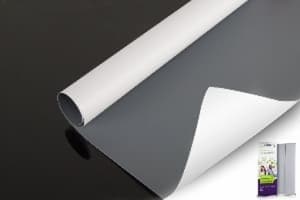
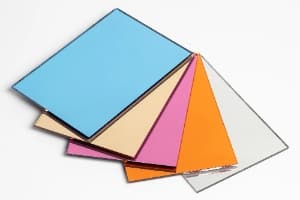
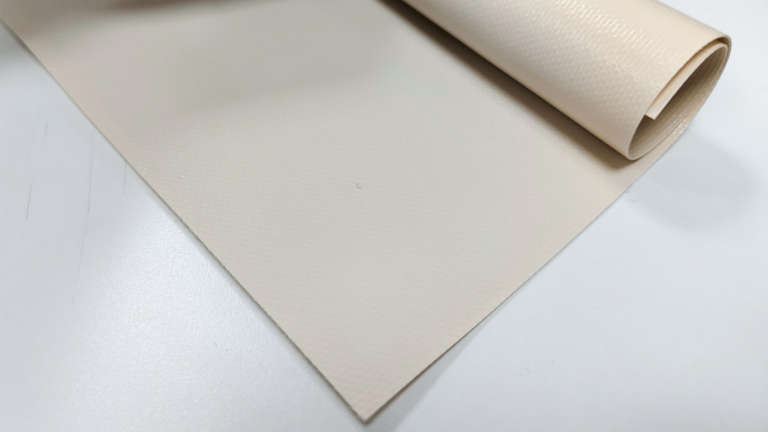
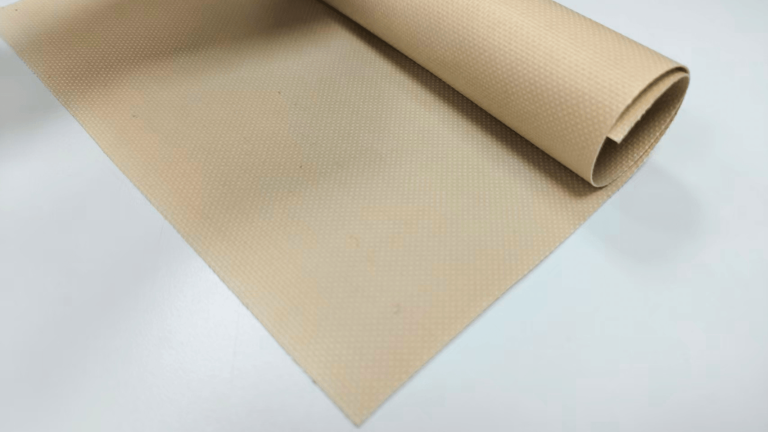
A product list with real photos belongs near the top of this comparison. Thickness describes one property, not one finished product. The cards below group current UNISIGN models by the job they serve. Photos help identify the construction, but only the model code and current TDS can confirm the specification.

Standard White Pair
- SAV10/120: 80µm face film + 120gsm liner
- SAV12/140: 100µm face film + 140gsm liner
- Starting use: general flat signs and promotional graphics
- Check: film class, adhesive, finish, opacity and required life


Transparent Pair
- SAV10T/120: 80µm transparent film + 120gsm liner
- SAV12T/140: 100µm transparent film + 140gsm liner
- Starting use: glass, windows and clear graphic effects
- Check: white ink, backing, viewing side, opacity and removal

80 Micron Polymeric Path
- UV1501: 80µm polymeric film
- 140gsm liner and bubble-free feature are currently listed
- Starting use: flat panels and simple curves after testing
- This model shows why 80µm does not always mean 120gsm or basic film

100 Micron Specialty Path
- SAV12G/140: grey adhesive
- SAV12B/140: black adhesive
- SAV12/140R: removable adhesive
- SAV12HT/140: high-tack adhesive
- Choose by hiding, removal, tack and surface—not thickness alone
UNISIGN 80 Micron and 100 Micron Model Comparison
| Model | Face Film / Liner | Main Difference | Starting Use |
|---|---|---|---|
| SAV10/120 | 80µm / 120gsm | Standard white path | Flat signs and promotions |
| SAV10T/120 | 80µm transparent / 120gsm | Clear graphic path | Windows and glass |
| UV1501 | 80µm polymeric / 140gsm | Bubble-free feature | Flat work and simple curves after testing |
| SAV12/140 | 100µm / 140gsm | Standard 100µm path | General flat graphics |
| SAV12T/140 | 100µm transparent / 140gsm | Clear graphic path | Windows and glass |
| SAV12G/140 | 100µm / 140gsm | Grey adhesive | Better hiding over colored bases |
| SAV12B/140 | 100µm / 140gsm | Black adhesive | Blockout and old graphic coverage |
| SAV12/140R | 100µm / 140gsm | Removable adhesive | Planned short-term removal |
| SAV12HT/140 | 100µm / 140gsm | High-tack adhesive | More difficult surfaces after testing |
| SAV12DP/140 | 100µm / 140gsm | Double-PE anti-curl liner | Jobs where liner flatness matters |
Width note: public UNISIGN pages do not show every width in exactly the same way. Common listed widths depend on the model and may range from 0.914m to 2.02m. Confirm the available width for the exact SKU, quantity and production date.
Which Thickness Fits Each Application?


| Application | 80 Micron Starting Point | 100 Micron Starting Point | Deciding Check |
|---|---|---|---|
| Flat Promotional Board | Can be suitable | Can be suitable | Price, handling, opacity, liner and sample result |
| Glass / Storefront | White or transparent model | White, transparent or removable model | Day/night view, clean removal and white-ink need |
| Short-Term Outdoor Sign | Possible with approved model | Possible with approved model | Outdoor rating, ink, laminate, edges and climate |
| Flat Vehicle or Truck Panel | Possible with approved model | Possible with approved model | Film class, panel seams, rivets, laminate and removal |
| Simple Curve | Polymeric model is a better starting point | Use a model approved for the curve | Shrinkage, conformability and lift test |
| Compound Curve / Deep Channel | Do not choose by 80 or 100µm. Evaluate a suitable cast wrap film. | Manufacturer approval for recesses, curves and removal | |
| Rough or Low-Energy Surface | Use a verified high-tack or specialty adhesive after a real-surface test. | Surface energy, texture, cleaning and removal risk | |
120gsm vs 140gsm Release Liner
The liner is removed during installation. It supports printing, cutting, storage and handling, but it does not become part of the applied graphic. A 140gsm liner has 16.7% more paper mass per square meter than a 120gsm liner. This does not prove that it is flatter, more moisture stable or easier to feed.
| Check | 120gsm Liner | 140gsm Liner |
|---|---|---|
| Mass | 120g/m² | 140g/m² |
| Relative Mass | Baseline | 16.7% higher |
| UNISIGN Examples | SAV10/120 and SAV10T/120 | SAV12 family and UV1501 |
| Possible Handling | Lighter support | More paper body under similar construction |
| What GSM Does Not Prove | Paper thickness, PE coating, moisture stability, lay-flat, silicone release, cutting quality or printer feeding | |
| Best Test | Print, contour-cut, weed, store and apply the real roll in your production conditions | |
Avery product data also shows that an 80µm film can use a 135gsm or 140gsm liner. The 80/120 and 100/140 combinations are common UNISIGN model constructions, not a universal industry rule.
Monomeric, Polymeric or Cast: Check This First
| Film Class | Good Starting Use | Shape | Main Buying Check |
|---|---|---|---|
| Monomeric Calendered | Cost-controlled short-term signs and promotions | Flat, stable surfaces | Shrinkage, expected life, surface and removal |
| Polymeric Calendered | More demanding flat work and simple curves | Flat or gently curved surfaces | Model approval, laminate and curve test |
| Cast | Vehicle wraps and demanding long-term graphics | Compound curves, channels and complex shapes | Approved surface, adhesive system and installer method |
An 80µm polymeric film can be a better choice than a 100µm monomeric film for a simple curve. A 51µm cast film can be a better choice than both for a complex wrap. Compare the product class first, then compare thickness inside the same class.
Deciding on the film class first? Compare monomeric vs polymeric self adhesive vinyl by surface shape, print life and the UNISIGN models available for each path.
Clear, Grey, Black, Removable or High Tack?
| Option | Choose It When | Test First |
|---|---|---|
| Clear Adhesive | The base is clean and show-through is acceptable | Final color, opacity and edge view |
| Grey Adhesive | You need better hiding over a colored base | Opacity, color shift and removal |
| Black Adhesive | You need a stronger blockout starting point | Edge appearance, full coverage and residue |
| Removable Adhesive | The graphic has a planned removal date | Edge lift and clean removal after the full use period |
| High-Tack Adhesive | The surface is more difficult to bond | Real surface energy, texture, damage and removal |
Adhesive color is not adhesive strength. Grey and black describe hiding color. Permanent, removable and high tack describe use. For more detail, see permanent vs removable adhesive vinyl.
Once you choose the film thickness, compare grey, black and clear adhesive vinyl for the background and finish your job needs.
If removability matters more than film thickness, use this removable self adhesive vinyl selection guide to compare surfaces, use periods and residue tests.
Does Thickness Change Printing?
Both thicknesses can work in solvent, eco-solvent, UV and Latex workflows when the exact model is listed for that ink. Print quality depends more on the printable coating, ink, profile, drying or curing, liner flatness and finishing.
| Production Step | What to Compare |
|---|---|
| Printer Feeding | Roll tracking, liner flatness, heat response and head-strike risk |
| Color | CMYK blocks, deep black, neutral grey, gradients and large solid areas |
| Drying / Curing | Ink load, outgassing, surface strength and curl |
| Contour Cutting | Blade depth, small text, corners, liner damage and registration |
| Weeding | Small details, adhesive stringing and liner release |
| Lamination | Matched flexibility, silvering, edge lift and required drying time |
| Installation | Positioning, bubbles, stretch, edges, curves and final adhesion |
Use the same printer, ink, profile, image, laminate and substrate when comparing 80µm and 100µm. Otherwise, the test does not isolate thickness.
What Widths, Lengths and Order Details Should You Check?
- Common widths: 0.914 / 1.07 / 1.27 / 1.37 / 1.52m; selected 100µm models list 1.60 / 1.82 / 2.02m.
- Standard roll length: 50m / 164ft.
- Other listed lengths: 25m / 30m / 75m / 100m, subject to model and MOQ.
- Confirm: core size, width tolerance, roll length tolerance, finish, adhesive, packing, rolls per pallet and lead time.
- Do not assume: every model is available in every width, adhesive or finish.
See the full UNISIGN self adhesive vinyl range and the broader printable vinyl roll guide.
8-Step Sample Test Before a Bulk Order
- Record both models: write the SKU, batch, width and roll number.
- Measure the face film: use the agreed method and do not include the liner by mistake.
- Print the same file: use the same printer, ink, profile and production speed.
- Check feeding: record tracking, curl, heat response and head clearance.
- Finish both samples: use the same drying, laminate and contour-cut process.
- Apply to the real surface: include flat areas, edges, seams and curves found in the job.
- Observe performance: check bubbles, lift, shrinkage, color, scratching and adhesion.
- Remove if required: check residue, paint damage and clean removal after the planned test period.
What Technical Evidence Should You Request?


- Current product TDS and revision date
- Face-film thickness and tolerance
- Monomeric, polymeric or cast construction
- Adhesive color, chemistry, tack and removal type
- Liner mass, PE coating and release information
- Peel adhesion, shrinkage and dimensional-stability data where available
- Application and service temperature where available
- Ink, printer and laminate compatibility
- Shelf life, storage and batch traceability
Common Buying Mistakes
- Calling 100µm “higher quality” without checking film class.
- Assuming 80µm is automatically better for every curve.
- Reading 120gsm or 140gsm as film thickness.
- Comparing two models with different adhesives as if thickness were the only change.
- Using a flat-sign film in deep vehicle channels.
- Approving a roll from one small print sample.
- Ignoring liner curl, cutting and removal tests.
- Ordering by a general family page without checking the exact SKU and width.
Frequently Asked Questions
Is 100 micron self adhesive vinyl better than 80 micron?
No thickness is always better. A 100µm film is 25% thicker and normally has more body under equal conditions. An 80µm film normally feels more flexible. Film class, adhesive, surface, ink, laminate and required life decide which product is better for the job.
Is 100 micron vinyl more durable?
Not automatically. A thinner polymeric or cast film can last longer and work on more demanding curves than a thicker monomeric film. Read the model-specific TDS and its test conditions.
Is 80 micron vinyl suitable for vehicle advertising?
It can be suitable for some flat vehicle or truck panels if the exact model is approved and tested. For simple curves, start with a suitable polymeric model. For compound curves, deep channels or a full wrap, use a film designed for that shape.
Which thickness is easier to install?
A 100µm film may feel easier to hold on flat work because it has more body. An 80µm film may feel more flexible. Liner support, air-release features, adhesive, application tape, panel size and installer skill can matter more than the 20µm difference.
Does 140gsm liner make the vinyl more durable?
No. The liner is removed during installation. It can affect feeding, cutting, storage and handling, but it does not add outdoor life to the applied graphic.
Is 80 micron always paired with 120gsm liner?
No. SAV10/120 and SAV10T/120 use that combination, but UV1501 is an 80µm option with a 140gsm liner. Other manufacturers also use different liner weights.
Can both thicknesses print with eco-solvent, UV and Latex ink?
Options are listed for these printing methods, but compatibility is model-specific. Test the exact printer, ink, heat, profile, drying, cutting and laminate process before a bulk order.
Which thickness should I use on glass?
Start with the visual result and removal need. Choose white or transparent film, then clear, grey or removable adhesive. Test daylight appearance, white ink, opacity, viewing direction and clean removal. Thickness is a secondary choice.
Which thickness should I use for a short-term outdoor sign?
Both can work if the exact model is approved for the exposure. Compare outdoor rating, ink, laminate, edge design, climate and removal need. Do not choose from thickness alone.
Should I laminate printable self adhesive vinyl?
Use a matched laminate when abrasion, cleaning, outdoor exposure, vehicle use or the required service life needs more protection. A laminate cannot make an unsuitable flat-sign film safe for deep channels or compound curves.
Should I request both samples?
Yes. A controlled side-by-side test is the best way to compare feeding, color, cutting, handling, application and removal in your production environment.
Request an 80 Micron and 100 Micron Sample Set
Send UNISIGN your application + surface + shape + printer and ink + width + finish + adhesive + required life + quantity + destination. The team can recommend an 80µm and 100µm model for a controlled comparison.
For specification-level detail, review 80 Micron Printable Self Adhesive Vinyl and 100 Micron Printable Self Adhesive Vinyl.
![Top 10 Vinyl Tarp Manufacturers in the World [2026 Guide]](https://unisignflex.com/wp-content/uploads/2026/04/pvc-tarpaulin-product-line.jpg)