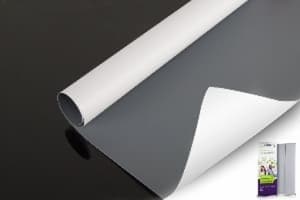

A 260gsm black back dye sublimation fabric is made for opaque backdrops, pop-up graphics, frames and display systems. UNISIGN DSP-BLK-01 is this type of fabric.
DSP-BLK-01 is one warp-knitted example. Compare its structure with woven display options in the woven vs knitted sublimation fabric guide.
It has a white print face and a black back. The black side helps stop light and objects behind the display from showing through.
- Printing: Direct or paper-transfer dye sublimation
- Maximum width: 5.0m / 197 inches
- Standard roll: 100m / 110 yards
- Listed shrinkage: ≤2%
Do not compare only price and GSM. Test light blocking, print quality, shrinkage, stretch, width, finishing and required FR documents before a bulk order.
260gsm Black Back Fabric at a Glance

DSP-BLK-01 / Nox
- Weight: 260gsm / 7.6oz
- Construction: Warp knitted
- Structure: White printable face / black reverse
- Printing: Direct or paper-transfer dye sublimation
- Maximum width: 5.0m / 197 inches
- Standard roll: 100m / 110 yards
- Listed shrinkage: ≤2%
- Listed performance: 100% obscuring rate
- Handling: Slight stretch and wrinkle resistance
- Applications: Backdrops, pop-ups, frames, exhibitions and display systems
Selection priority: Use a black-back textile when one white printable face must remain visually independent from whatever is behind the graphic.
DSP-BLK-01 Technical Specifications
The values below summarize UNISIGN’s current DSP-BLK-01 product information. Confirm the current tolerance, available roll size and applicable documents for the exact order.
| Specification | UNISIGN DSP-BLK-01 | What the Buyer Should Confirm |
|---|---|---|
| Product Code | DSP-BLK-01 | The quotation, sample and production roll use the same code |
| Product Name | Nox Black Back Backdrops Fabric | Current technical data sheet and sample label |
| Product Type | Black-back blockout / backdrop fabric | One primary white printable face with a black reverse |
| Weight | 260gsm / 7.6oz | Production tolerance for the ordered roll |
| Construction | Warp knitted | Stretch, surface, drape and finishing behavior |
| Printing | Direct / paper-transfer dye sublimation | Printer, ink, paper, profile and heat workflow |
| Maximum Width | 5.0m / 197 inches | Available stock width and guaranteed usable printable width |
| Standard Roll Length | 100m / 110 yards | Available width/length combination, packaging and usable length |
| Listed Shrinkage | ≤2% | Temperature, time, machine direction and cross direction |
| Listed Opacity | 100% obscuring rate | Finished sample under the project’s actual rear light and background |
| Listed FR Options | B1 / NFPA 701 / AS 1530 / JIS L 1091 | Exact product, test report, destination, venue and current applicability |
| Applications | Backdrops, pop-ups, frames, exhibitions, display systems | Installed dimensions, viewing distance, lighting and finishing |
What Is 260gsm Black Back Dye Sublimation Fabric?
It is a 260gsm polyester fabric with a white print face and a black reverse.
- The white face receives the full-color dye-sublimation print.
- The black side helps block rear light and objects behind the graphic.
- 260gsm means the fabric weighs about 260 grams per square meter.
Black back describes the fabric structure. It has a white front and a black reverse.
Blockout describes the job the fabric does. It reduces light and show-through. The two terms are related, but not every blockout fabric has a black back.
Two 260gsm fabrics can still behave differently. Compare:
- Opacity under the actual rear light and background
- White point and surface uniformity on the printable face
- Reverse-side durability during rolling, folding and installation
- Print density, sharpness and color consistency
- Heat shrinkage and installed dimensions
- Stretch, recovery and wrinkle behavior
- Available width and relevant FR documentation
How Does Black Back Fabric Block Light?
The black reverse absorbs and blocks light that would otherwise pass through a standard white display textile. It also helps prevent a wall, frame, hardware or another graphic behind the fabric from influencing the printed image.
Conceptual DSP-BLK-01 display structure
Dye-sublimation graphic viewed from the front
Helps block rear light and background interference
Diagram is illustrative. Inspect the physical cross-section and test a production sample for the exact construction.
A standard black-back textile is a frontlit/blockout material. It should not be chosen for a backlit lightbox, because backlit fabric is designed to transmit and diffuse light rather than block it.
Black Back Fabric vs Blockout Fabric
| Term | What It Describes | Buyer Question |
|---|---|---|
| Black Back | A white printable face with a black reverse/backing | Is one white face printed while the reverse remains black? |
| Blockout | The performance goal of reducing transmitted light and show-through | What opacity is achieved under the real project conditions? |
| Double-Sided Printable Blockout | Two white printable faces separated by a blocking structure | Do both viewing directions need different graphics? |
| Black-Back Blockout | A black-back construction used to provide opacity | Does a black reverse suit the visible back side of the display? |
Choose DSP-BLK-01 when the project needs one white printable face plus a black reverse. If both sides must remain white and printable, compare it with a double-sided printable blockout fabric.
To compare black-, grey-, white- and silver-back options with double-sided models, see the complete blockout fabric roll range.
For the wider terminology comparison, read how blockout, blackout and blackback fabric differ, including when two printable faces are needed.
Where Is 260gsm Black Back Fabric Used?
| Application | Why Black Back Helps | What to Test |
|---|---|---|
| Event Backdrops | Reduces light and objects showing through the graphic | Opacity, wrinkles, seams and stage lighting |
| Exhibition Walls | Separates printed artwork from booth hardware and adjacent graphics | FR documents, close-view print quality and installation |
| Pop-Up Displays | Provides a printable face with a light-blocking reverse | Folding, edge finishing, reverse durability and recovery |
| Frame Systems | Slight stretch can support a smooth front-facing graphic | Cutting allowance, tension, edge fit and print distortion |
| SEG Frames | Can reduce rear-light and frame interference in compatible frontlit systems | Silicone size, channel fit, stretch and final opacity |
| Retail Displays | Helps maintain image consistency against mixed backgrounds | White point, brand color, surface and repeated handling |
| Grand-Format Backdrops | 5m width can reduce seams in large graphics | Usable width, printer capacity, shrinkage and finishing |
| Backlit Lightboxes | Not suitable for the optical objective | Use dedicated light-transmitting backlit fabric |


Why Does Opacity Matter for Backdrops?
A standard white fabric may allow light, frame components, wall colors or another graphic to influence the front image. This can reduce color consistency, reveal unwanted shapes or wash out the artwork under strong rear lighting.
DSP-BLK-01 is currently described with a 100% obscuring rate. For a commercial order, translate that claim into an approval test:
- Print a sample containing deep black, saturated colors, gradients and neutral grey.
- Place a high-contrast black/white target behind the fabric.
- Evaluate under the project’s normal ambient lighting.
- Add a strong rear light to reveal edge cases.
- Stretch or finish the sample exactly as it will be installed.
- Check seams, corners, cut edges and high-tension areas.
- Record the viewing distance and agree a pass/fail requirement.
“100% obscuring” should be approved in the finished display, not only by holding an unprinted swatch against a window.
How Should the White Face and Black Reverse Be Inspected?
| Side | What to Check | Common Production Risk |
|---|---|---|
| White Printable Face | White point, uniformity, defects, color density and sharpness | Visible variation, weak color or surface marks |
| Black Reverse | Even coverage, scratches, cracking, flaking and transfer marks | Reduced opacity or visible damage after handling |
| Cut Edge | Fraying, exposed structure and reverse visibility | Untidy finishing or visible black edge |
| Folded/Rolled Sample | Creases, sticking, face-to-back transfer and recovery | Damage during transport and storage |
| Tensioned Sample | Opacity, flatness, stretch and edge stress | Show-through or distortion in installed areas |
If the reverse construction uses a coating or treatment, ask for the current technical description and handling guidance. Do not assume that every black-back fabric uses the same coating chemistry or durability.
Can DSP-BLK-01 Be Used for Direct and Transfer Sublimation?
Yes. UNISIGN currently lists DSP-BLK-01 for direct dye sublimation and paper-transfer dye sublimation. The two workflows should be tested separately because ink placement, heat history, feeding and color profiling differ.
| Printing Method | DSP-BLK-01 | Primary Controls |
|---|---|---|
| Direct Dye Sublimation | Supported | Feeding, strike-through, fixation, face quality and reverse protection |
| Paper-Transfer Dye Sublimation | Supported | Paper stability, pressure, temperature, ghosting and face-to-back handling |
The final result depends on printer + ink + profile + paper where used + fabric + temperature + time + pressure + finishing. Always protect the black reverse and printed face from contamination during production.
How Should Shrinkage and Frame Fit Be Tested?
DSP-BLK-01 is currently listed with shrinkage of ≤2%. Verify that value under the planned temperature, dwell time and pressure. A 5m-wide backdrop or SEG graphic can accumulate a meaningful dimensional difference even when the percentage appears small.
- Mark and measure a square in both fabric directions.
- Record original width, length and diagonals.
- Run the complete direct or transfer sublimation process.
- Allow the sample to cool and condition before measuring again.
- Finish it using the real silicone, seam, zipper, sleeve or hem.
- Install it in the intended frame or backdrop structure.
- Record final dimensions, surface tension and visual fit.
For repeat orders, keep the same measurement method and trace the result to the production batch.
What Is the Value of a 5m / 197-Inch Width?
DSP-BLK-01 is currently listed in widths up to 5.0m / 197 inches. Super-wide material can reduce seams in large exhibition walls, event backdrops and frame graphics. Fewer seams may improve appearance, reduce sewing and shorten finishing time.
Before ordering, confirm:
- The available width for the exact production batch
- Guaranteed usable printable width, not only total roll width
- Printer and heat-setting equipment capacity
- Which width/length combinations are supplied
- Core size, packed-roll weight and handling equipment
- Edge allowance and final finished dimensions
260gsm Black Back vs Other Blockout Fabrics
UNISIGN lists several backdrop blockout constructions. They are not interchangeable solely because their weights are close.
| Product | Listed Weight | Reverse / Structure | Choose It When |
|---|---|---|---|
| DSP-BLK-01 / Nox | 260gsm | White printable face / black reverse | You need one printed face, black-back opacity and widths up to 5m |
| DSP-BLK-D / Ares | 250gsm | Two white printable faces with black internal blocking structure | Both sides need separate printed artwork |
| DSP-BLK-DTR | 270gsm | Super-white double-sided blockout | White appearance and double-sided positioning are priorities |
| DSP-BLK-02 | 280gsm | Grey-back blockout | A grey reverse suits the display system |
| DSP-BLK-W | 310gsm | White-back blockout | A heavier white reverse is required |
The correct order of comparison is usually visible sides → opacity → application → construction → printing → shrinkage → width → FR → GSM → price.
What FR Options Are Listed for DSP-BLK-01?
The current DSP-BLK-01 information lists FR options including B1, NFPA 701, AS 1530 and JIS L 1091. Buyers should confirm the current test document for the exact fabric, order and destination project.
A list of standards is not proof that every roll automatically complies with all of them. Ask for the product description covered, test organization, report number, test result and current applicability.
How Should Buyers Test a Black Back Fabric Sample?
| Test Stage | What to Check | Record |
|---|---|---|
| Before Printing | GSM, width, white face, black reverse, defects and roll ID | Batch, dimensions and photos |
| During Printing | Feeding, flatness, ink behavior, reverse protection and transfer release | Printer, ink, profile and paper |
| After Heat | Color, sharpness, shrinkage, wrinkles and reverse condition | Temperature, time, MD/CD change |
| Opacity Test | High-contrast target and strong rear light | Lighting, distance and pass/fail photos |
| Finishing | Cold cut, sewing, silicone, hem, zipper or sleeve | Edge quality and dimensions |
| Installation | Frame fit, stretch, flatness, corners, seams and background show-through | Final approval and cutting allowance |
| Repeat Handling | Rolling/folding, scratches, transfer marks and recovery | Reuse cycles and storage method |
Should I Choose 260gsm Black Back Fabric?
Choose DSP-BLK-01 When
- You need one white printable face and a black reverse.
- Rear light or background interference must be blocked.
- The project is a backdrop, pop-up, exhibition or frame display.
- You use direct or paper-transfer dye sublimation.
- You need wide rolls up to 5m to reduce seams.
- Slight stretch and wrinkle resistance suit the system.
Consider Another Fabric When
- Both sides must remain white and printable.
- The display must transmit light in a backlit lightbox.
- A black reverse will remain visible and is unacceptable.
- The system requires a different stretch or finishing behavior.
- The project requires a measured property or certificate not verified for the exact order.
260gsm Black Back Fabric from UNISIGN
DSP-BLK-01 Nox Black Back Backdrops Fabric is a 260gsm warp-knitted textile.
- Direct or paper-transfer dye sublimation
- Widths up to 5.0m / 197 inches
- Standard 100m / 110-yard rolls
- For backdrops, pop-ups, frames, exhibitions and display systems
Compare it with the broader UNISIGN backdrop fabric range. For application background, read what sublimation fabric is used for backdrops. For supplier-level evaluation, use the dye sublimation fabric manufacturer checklist.
Before Ordering 260gsm Black Back Fabric
| Requirement | Buyer Should Confirm |
|---|---|
| Application | Backdrop / pop-up / frame / SEG / exhibition / display system |
| Product | DSP-BLK-01 Nox Black Back Backdrops Fabric |
| Visible Sides | One white printable face; black reverse acceptable |
| Weight / Construction | 260gsm warp knitted |
| Printing | Direct or paper-transfer dye sublimation |
| Required Width | _____ m |
| Roll Length | _____ m |
| Opacity Requirement | Approved under defined rear light and background |
| Shrinkage Requirement | _____ % under defined heat conditions |
| Finishing | Silicone / seam / zipper / hem / sleeve / other |
| FR Standard | _____ and product-specific document required |
| Destination Market | _____ |
| Quantity | _____ m² / rolls |
Frequently Asked Questions
What is 260gsm black back dye sublimation fabric?
It is a 260-gram-per-square-meter polyester display textile with a white dye-sublimation print face and a black reverse designed to block rear light and background show-through.
What is black back fabric used for?
Common uses include opaque backdrops, exhibition walls, pop-ups, frame graphics, retail displays and compatible frontlit SEG systems.
Is black back fabric the same as blockout fabric?
Not exactly. Black back describes a construction with a black reverse. Blockout describes the opacity performance. Many black-back display textiles are blockout fabrics, but not every blockout fabric has a black reverse.
Can the black side be dye-sublimation printed?
DSP-BLK-01 is positioned with one white printable face and a black reverse. Dye-sublimation graphics should be approved on the intended white face.
Is 260gsm black back fabric suitable for SEG frames?
It can be tested for compatible frontlit SEG systems. Approve the silicone edge, channel, shrinkage, slight stretch, final tension and opacity in the actual frame.
Can DSP-BLK-01 be used for direct dye sublimation?
Yes. UNISIGN currently lists DSP-BLK-01 for direct and paper-transfer dye sublimation.
How wide is DSP-BLK-01 black back fabric?
UNISIGN currently lists a maximum width of 5.0m / 197 inches. Confirm the stocked width and guaranteed usable printable width when ordering.
How should opacity be tested?
Print and finish a representative sample, place a high-contrast target and strong light behind it, then inspect the face, seams, edges and tensioned areas at the intended viewing distance.
What is the difference between black-back and double-sided blockout fabric?
Black-back fabric normally has one white printable face and a black reverse. Double-sided printable blockout fabric keeps both exterior faces white so each side can carry different artwork.
What documents should I request before a bulk order?
Request the current technical specification, representative sample, product-specific FR document where required, batch identification and agreed opacity/shrinkage test results.
Request a 260gsm Black Back Fabric Sample
Send UNISIGN your application + printer + printing method + required width + opacity requirement + finishing + FR standard + quantity. Test DSP-BLK-01 with the actual artwork, heat process, rear lighting and display frame before bulk production.
![Top 10 Vinyl Tarp Manufacturers in the World [2026 Guide]](https://unisignflex.com/wp-content/uploads/2026/04/pvc-tarpaulin-product-line.jpg)