


UNISIGN · PRINTABLE POLYESTER SELECTION GUIDE
Woven vs Knitted Sublimation Fabric
Choose woven or knitted sublimation fabric by the finished display. Woven polyester usually starts firmer and with less mechanical stretch. Warp-knitted polyester usually starts with more controlled stretch and recovery.
Both can print well. The exact model, yarn, density, finish, heat setting and hardware decide the result.
Which Is Better: Woven or Knitted Sublimation Fabric?
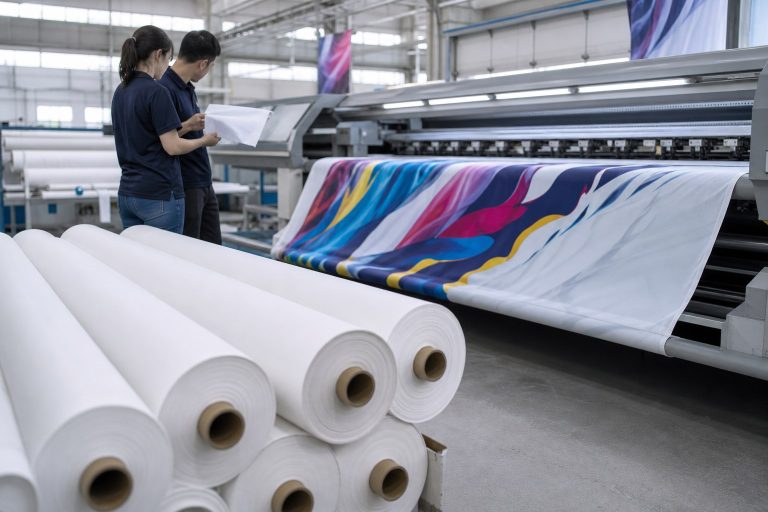
Neither is better for every job. Start with woven polyester when you want a firm, low-stretch graphic, a crisp table cover or a woven backlit media. Start with warp-knitted polyester when a tension display, pop-up, shaped frame or backdrop needs controlled stretch and recovery.
Use the construction as a filter—not as the final specification. Approve the exact model after printing, heating, cutting, sewing and fitting it to the real hardware.
Woven vs Knitted Polyester: 6-Factor Comparison
The table shows common starting behavior in printable display textiles. It is not a claim that every woven or knitted product behaves the same way.
| Factor | Woven polyester: common starting point | Warp-knitted polyester: common starting point | What to test |
|---|---|---|---|
| Stretch | Usually lower and more controlled across straight yarn directions. | Usually more mechanical stretch. The knit can be made for slight stretch or strong multi-direction stretch. | Measure both directions before and after heat. Record recovery after a set load. |
| Cut-edge behavior | A plain cut edge may fray because yarn ends are exposed. | Many warp knits resist simple fraying, but the exact knit may run, curl or distort. | Use the real cold cut, hot knife, laser, hem, silicone edge or sewing method. |
| Flatness | Firm structure can support a flat hanging or table-cover graphic. | Stretch and recovery can pull a graphic smooth inside a compatible frame. | Print a large solid area. Pack, unfold, hang or fit, then inspect wrinkles and edge waves. |
| Dimensional stability | Often stable before heat, but heat and finishing can still change length and width. | Can be stable in one direction and more elastic in another. Tension can also change finished size. | Mark a 1,000 × 1,000mm square. Measure after print, heat, rest and installation. |
| Light diffusion | Can be engineered for backlit use. Density, yarn and finish are critical. | Can also be engineered for backlit use. Knit structure alone does not guarantee diffusion. | View the printed sample in the final lightbox. Check hotspots, pinholes, white point, black and gradients. |
| Print method | Can support direct or paper-transfer sublimation when the exact product lists it. | Can support direct or paper-transfer sublimation when the exact product lists it. | Confirm the model’s approved route, print side, profile, temperature, time, pressure and web tension. |
Choose in 30 Seconds
Woven starting point
- Table cover
- Flat hanging panel
- Low-stretch graphic
- Selected backlit lightbox
Warp-knit starting point
- SEG or tension frame
- Pop-up display
- Backdrop
- Wrinkle recovery is important
Power-stretch starting point
- Curved frame
- Irregular shape
- Strong two-direction stretch
- Artwork distortion must be tested
Use a backlit model
- Do not choose by weave alone
- Test with LEDs on
- Check black density
- Check light diffusion
Use a blockout model
- Background must not show
- Check reverse colour
- Test folds and edges
- Use the correct print face
Compare two samples
- Same artwork
- Same print route
- Same finished size
- Same display hardware
What Do Woven and Warp-Knitted Mean?
| Construction | Simple definition | What buyers normally notice | Common printable-display use |
|---|---|---|---|
| Woven | Two yarn systems cross over and under each other. | Firm hand, lower mechanical stretch and a cut edge that may need finishing. | Table covers, banners, hanging panels and selected backlit textiles. |
| Warp knitted | Yarns form linked loops mainly along the fabric length. | Controlled stretch, recovery and useful resistance to simple edge fraying on many display knits. | SEG, pop-ups, backdrops, flags, tension displays and selected backlit textiles. |
| Power stretch | An engineered elastic construction. The exact yarn and knit must be confirmed. | Higher stretch, often in two directions, for shaped systems. | Curved, geometric and strongly tensioned displays. |
6 UNISIGN Fabric Options to Compare
A short product list belongs on this page. It helps buyers connect the structure to a real print process and application. Images also make it easier to request the correct sample.

DSP05A Table-Cloth Fabric
- Woven 300D Oxford
- 150 or 175gsm
- Direct or paper-transfer sublimation
- Up to 3.2m / 126in
- Table covers and display use

SDB250 Triple-White Backlit
- Woven, matte, triple-white
- 250gsm
- Direct / transfer sublimation or latex
- Up to 3.2m / 126in
- 50m / 55yd standard roll

DSP09 Mars Display Fabric
- Knitted with slight stretch
- 230gsm
- Direct or paper-transfer sublimation
- Up to 3.2m / 126in
- Displays, pop-ups and backdrops

DSP08-T Venus Display Fabric
- Spandex; two-direction power stretch
- 250gsm
- Direct or paper-transfer sublimation
- Up to 3.2m / 126in
- Curved and shaped displays

SDB270 Meteor Backlit
- Warp knitted, matte
- 270gsm
- Direct / transfer sublimation or latex
- Up to 3.2m / 126in
- Backlit displays

DSP-BLK-01 Nox Black Back
- Warp knitted; white face / black reverse
- 260gsm
- Direct or paper-transfer sublimation
- Up to 5.0m / 197in
- Opaque backdrops and frames
Product information reviewed September 12, 2026. Values apply only to the named model. Ask for the current technical data, tolerance and production sample for the exact order.
Light Diffusion: Woven vs Warp-Knitted Backlit Fabric
Woven does not automatically mean better diffusion, and warp knitted does not automatically mean more hotspots. UNISIGN lists both constructions for backlit work.
| Model | Construction | Weight | Print routes listed | Roll format | Approve with lights on |
|---|---|---|---|---|---|
| SDB250 | Woven, matte, triple white | 250gsm | Direct / transfer sublimation; latex | Up to 3.2m × 50m | White point, black, colour, gradients, pinholes and hotspots |
| SDB270 | Warp knitted, matte | 270gsm | Direct / transfer sublimation; latex | Up to 3.2m × 100m | White point, black, colour, gradients, pinholes and hotspots |
Use the same artwork and lightbox for both samples. Compare the fabric unlit and lit. A small unlit swatch cannot show the final diffusion result.

Backlit Lightbox
Test diffusion, black density and the lit white point. Compare SDB250 woven with SDB270 warp knitted.

Tension Display
Check installed stretch, recovery, corner fit and artwork distortion. Start with DSP09 or DSP08-T.

Backdrop or Display Wall
Check flatness, folds, glare and background show-through. Use a blockout model when opacity is required.
5 Tests Before You Choose
- PrintUse the real printer, ink, profile and artwork. Include black, gradients, fine text and solid colour.
- HeatUse the planned fixation or transfer settings. Record temperature, time, pressure and tension.
- MeasureMark 1,000 × 1,000mm. Measure both directions after heat and after the fabric rests.
- FinishCold cut, heat cut, sew or add silicone edge with the real tools. Inspect fray, curl and distortion.
- InstallFit the real table, frame or lightbox. Check flatness, recovery, corners, light and final size.
Direct vs Paper-Transfer Sublimation
Woven and knitted polyester can use either route only when the exact model supports it. Fabric construction changes feeding, tension and heat response, but it does not choose the workflow by itself.
| Workflow | Main controls | Woven fabric check | Knitted fabric check |
|---|---|---|---|
| Direct dye sublimation | Feeding, web tension, ink load, drying and heat fixation | Watch edge fray, skew and heat change. | Watch stretch under feed tension, edge curl and strike-through. |
| Paper-transfer sublimation | Paper stability, temperature, dwell time, pressure and ghosting | Watch yarn movement, surface marks and shrinkage. | Keep fabric and paper stable so stretch does not blur or distort the image. |
| Both routes | Colour target, finished size and application test | Run separate profiles and tests. A good result with one route does not approve the other. | |
See the full direct dye sublimation fabric guide and paper-transfer sublimation fabric guide.
Application and Product Match
| Application | Useful starting structure | Selected UNISIGN model | First approval test |
|---|---|---|---|
| Standard or fitted table cover | Firm woven | DSP05A | Drape, corner fold, seam and wash/handling method |
| Flat display, pop-up or backdrop | Knitted with slight stretch | DSP09 | Flatness, shrinkage and finished frame fit |
| Curved or irregular tension display | Two-direction power stretch | DSP08-T | Stretch, recovery and artwork distortion |
| Woven backlit lightbox | Dedicated woven backlit | SDB250 | Printed result with LEDs on |
| Warp-knit backlit lightbox | Dedicated warp-knitted backlit | SDB270 | Printed result with LEDs on |
| Opaque backdrop or frame | Warp-knitted blockout | DSP-BLK-01 | Show-through, reverse appearance and edge finish |
Construction can matter more than a small GSM difference. Compare the separate 230gsm vs 250gsm display fabric guide, the 250gsm power-stretch guide and SEG fabric rolls.
What to Send for a Fast Model Match
| Detail | Example | Why it matters |
|---|---|---|
| Application | SEG lightbox, pop-up, table cover or backdrop | Sets the main performance target. |
| Hardware | Frame size, profile, silicone edge or table size | Controls stretch, cut and finished size. |
| Print route | Direct or paper transfer | Changes feeding and heat controls. |
| Printer and ink | Brand, model and disperse ink | Helps select and test the correct media. |
| Required behavior | Low stretch, slight stretch or two-direction stretch | Separates woven, standard knit and power stretch. |
| Light / opacity | Frontlit, backlit or blockout | Prevents the wrong fabric family. |
| Roll size | Width, length and quantity | Confirms available format and logistics. |
| Timing | Sample date and production deadline | Helps plan testing and supply. |
Woven vs Knitted Sublimation Fabric FAQs
Which is better for sublimation printing, woven or knitted polyester?
Neither is better for every job. Woven polyester is often a useful starting point for a firm, low-stretch graphic. Warp-knitted polyester is often a useful starting point for controlled stretch, recovery and tension displays.
Can both woven and knitted fabric be sublimated?
Yes, when the exact polyester model is prepared for direct dye sublimation, paper-transfer dye sublimation or the stated workflow. Confirm the model, print side, heat settings and dimensional change.
Which construction stretches more?
A knitted construction normally has more mechanical stretch than a woven construction. Yarn, knit type and finish can change the result, so measure both directions on the exact model.
Which fabric frays less when cut?
Many warp-knitted display fabrics resist simple edge fraying better than a basic woven fabric. The exact knit, coating and cutting method still matter. Test the real cold cut, heat cut, hem or sewn edge.
Which fabric stays flatter?
A firm woven fabric can hang flat with low stretch. A knitted display fabric can pull smooth under the correct tension. The better result depends on the frame, finishing and installed load.
Is woven fabric always better for light diffusion?
No. Light diffusion depends on yarn, density, weight, whitening, coating, finish and the lightbox. UNISIGN lists both woven SDB250 and warp-knitted SDB270 for backlit use.
Which fabric is better for an SEG or tension frame?
Start with a fabric engineered for controlled stretch and recovery, then test it in the exact frame. DSP09 suits many standard displays. DSP08-T is the stronger starting point for two-direction power stretch and shaped displays.
What is warp-knitted display fabric?
It is a fabric made from linked yarn loops that mainly run along the fabric length. Display-grade warp knits are often designed for controlled stretch, recovery and stable large-format printing.
Does 250gsm tell me whether a fabric is woven or knitted?
No. GSM is weight per square metre. It does not state the construction, stretch, opacity or print method. Read the exact model data.
Should I test direct and transfer printing separately?
Yes. Feeding, ink load, heat, pressure, shrinkage and colour control are different. A good result with one route does not approve the other.
Compare the Right Two Samples
Send these 8 details and ask UNISIGN to match one woven and one knitted starting option where useful:
- Application and hardware
- Woven / knitted preference
- Direct or transfer printing
- Printer and ink
- Stretch direction
- Width and quantity
- Frontlit / backlit / blockout
- Project deadline
Related Textile Guides
- Printable Textile Solutions
- SEG Fabric Rolls
- Direct Dye Sublimation Fabric
- Transfer Sublimation Fabric
- Blockout Fabric
- PVC Vinyl vs Fabric Banner Material
Product information: UNISIGN · Reviewed September 12, 2026. About UNISIGN · Contact the textile team.
Request Fabric Samples or a Model Match
Or email info@unisignflex.com.