


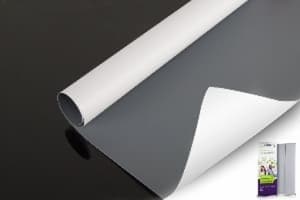
Unprinted SEG Fabric Rolls for Silicone Edge Graphics
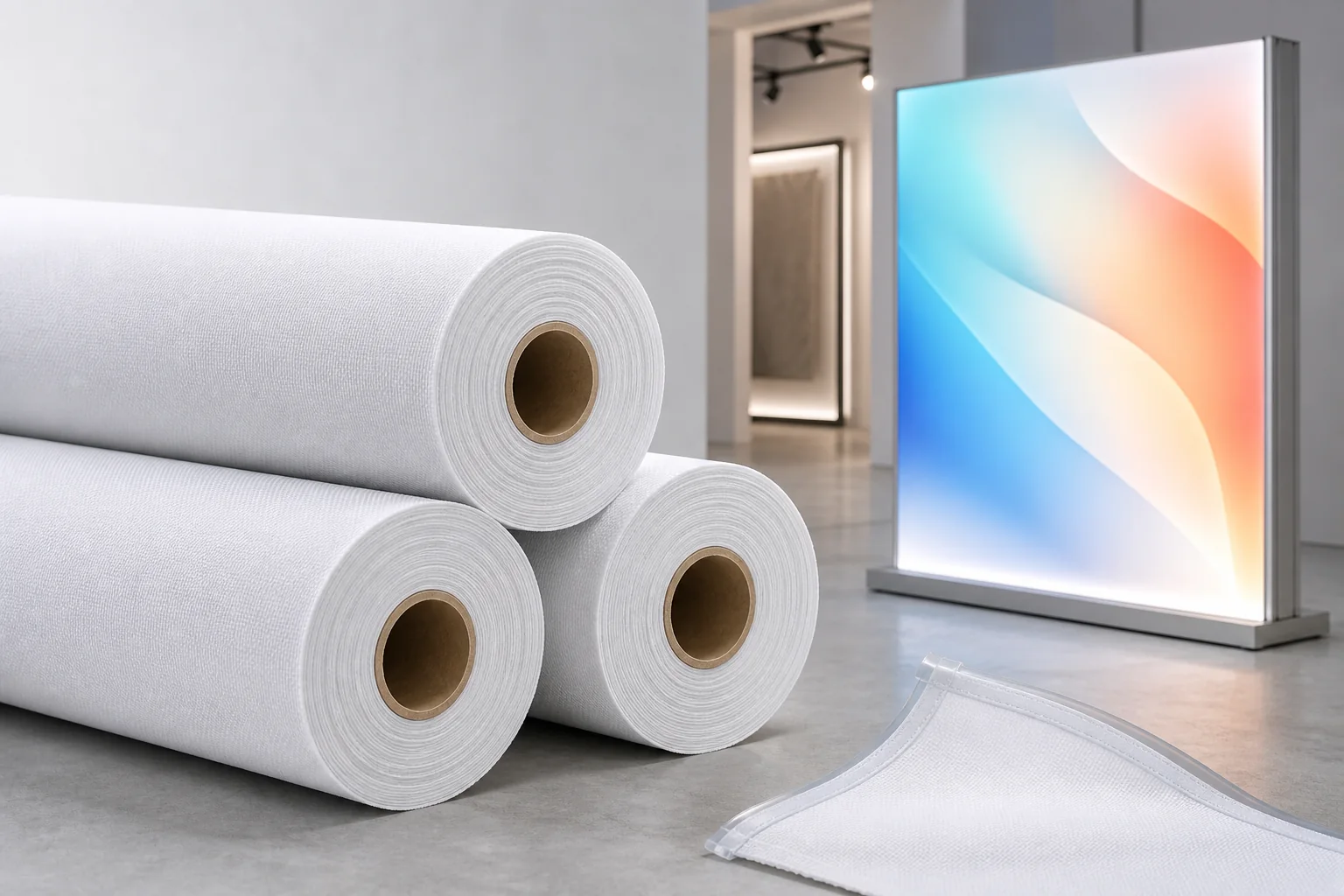
UNISIGN supplies unprinted polyester fabric rolls for producing silicone edge graphics. Finished printed SEG graphics and aluminum frames are not the primary products offered on this page.
Use this page to compare backlit, frontlit, blockout, stretch, woven and knitted SEG fabric starting points. Then test the exact fabric with your printer, heat cycle, silicone edge and aluminum extrusion.
Choose by application | Compare products | Check stretch | Measure shrinkage | Plan a frame test | Request samples
What Does UNISIGN Supply on This Page?
Primary products
- Unprinted polyester SEG fabric rolls
- Backlit, frontlit and blockout fabric options
- Woven, warp-knitted and stretch constructions
- Roll material for printers, distributors and display producers
- Samples and model-specific technical data on request
Not the primary products here
- Finished printed SEG graphics
- Graphics with silicone edge already sewn
- Complete aluminum frames
- Complete LED lightboxes
- On-site installation service
SEG Fabric Quick Selection Guide
Short answer: use backlit fabric when light must pass through the graphic, frontlit fabric when light comes from the room, and blockout fabric when rear light or hardware must not show through. Choose stretch and construction only after the application is clear.
| If You Need | Start With | UNISIGN Models to Evaluate | Approve First |
|---|---|---|---|
| Even light in an LED lightbox | Backlit SEG fabric | SDB190, SDB270 or SDB280 | Diffusion, hotspot control, white point, black density and final frame fit |
| A matte graphic in a non-lit frame | Frontlit / non-lit SEG fabric | DSP09 or DSP06N | Surface, opacity, slight stretch, heat shrinkage and wrinkle recovery |
| A black back that hides the wall or hardware | Blockout SEG fabric candidate | DSP-BLK-01 | Opacity, visible black edges, stretch, sewing and channel fit |
| Two-direction stretch for an irregular shape | Power-stretch fabric | DSP08-T | Artwork distortion, recovery, shrinkage and current FR requirement |
| A crisp, stable surface | Woven SEG fabric | SDB190 or SDB280 | Directional stretch, fold marks and the actual finished size |
| More natural give and wrinkle recovery | Warp-knitted SEG fabric | SDB270, DSP09, DSP06N or DSP-BLK-01 | Elongation and recovery in both directions under a defined load |
Important: A product listed here is a practical starting point, not an automatic fit for every SEG frame. The fabric, print process, heat, stitch line, silicone edge and frame channel form one system.
Need a step-by-step way to compare these factors? Read our SEG fabric selection guide for backlit and non-lit frames, including stretch, shrinkage, keder and finished-frame tests.
What Is SEG Fabric Material?
SEG fabric material is a printable textile used to produce Silicone Edge Graphics. After printing and heat setting, a narrow flexible edge is sewn around the graphic. The edge is inserted into the channel of an aluminum frame, which tensions the fabric surface.
| Part | Simple Function | Why It Changes Fit |
|---|---|---|
| Polyester fabric | Receives the printed image and forms the visible face | Construction, stretch, recovery and heat shrinkage vary by model |
| Printed and heat-set graphic | Creates the final color and can change the fabric dimensions | Temperature, dwell time, pressure and web tension affect size |
| Silicone / TPE edge | Holds the graphic in the frame channel | Width, thickness, hardness and stretch affect insertion and holding force |
| Stitch line | Joins the edge to the fabric | Distance from the fabric edge and sewing tension change the finished perimeter |
| Aluminum extrusion | Forms the frame and receiving channel | Channel opening, depth and corner design are not universal |
Industry guidance from the PRINTING United Alliance also treats fabric thickness, opacity, stretch, shrinkage, edge dimensions and extrusion fit as connected factors. That is why a generic cut percentage cannot replace a finished frame test.
Planning a first-size test? Use the free SEG fabric cut size and shrinkage calculator to compare MD/CD shrinkage, installation stretch, keder/channel allowance and roll direction before sewing the first finished sample.
UNISIGN SEG Fabric Roll Starting Range
The product list below uses real UNISIGN product images and current published data. It helps printers and distributors build a short list before requesting samples.

SDB190 / Aurora Plus Backlit Fabric
- Type: Woven backlit SEG starting point
- Weight: 190gsm / 5.6oz
- Feature: Woven with slight stretch
- Print: Direct or paper-transfer dye sublimation
- Maximum width: 3.2m / 126 in
- Standard roll: 100m / 110 yd
- Listed shrinkage: ≤2%
- Published use: SEG lightbox and SEG frame systems
Starting point only—approve the printed, heat-set, sewn sample in the actual frame before bulk production.

SDB270 / Meteor Backlit Fabric
- Type: Warp-knitted backlit starting point
- Weight: 270gsm / 7.9oz
- Feature: Warp knitted, matte and wrinkle resistant
- Print: Direct / transfer sublimation / latex listed
- Maximum width: 3.2m / 126 in
- Standard roll: 100m / 110 yd
- Listed shrinkage: ≤2%
- Published use: Backlit displays and lightboxes
Starting point only—approve the printed, heat-set, sewn sample in the actual frame before bulk production.

SDB280 / Starlight Backlit Fabric
- Type: Heavy woven backlit starting point
- Weight: 280gsm / 8.2oz
- Feature: Woven, matte and wrinkle resistant
- Print: Direct / transfer sublimation / latex listed
- Maximum width: 3.2m / 126 in
- Standard roll: 50m / 55 yd
- Listed shrinkage: ≤2%
- Published use: Backlit displays and lightboxes
Starting point only—approve the printed, heat-set, sewn sample in the actual frame before bulk production.

DSP09 / Mars Display Fabric
- Type: Frontlit / non-lit SEG starting point
- Weight: 230gsm / 6.8oz
- Feature: Warp knitted with slight stretch
- Print: Direct or paper-transfer dye sublimation
- Maximum width: 3.2m / 126 in
- Standard roll: 100m / 110 yd
- Listed shrinkage: ≤2%
- Published use: Displays, pop-ups and backdrops
Starting point only—approve the printed, heat-set, sewn sample in the actual frame before bulk production.

DSP06N / Saturn Display Fabric
- Type: Value frontlit / non-lit starting point
- Weight: 230gsm / 6.8oz
- Feature: Warp knitted with slight stretch
- Print: Direct or paper-transfer dye sublimation
- Maximum width: 3.2m / 126 in
- Standard roll: 100m / 110 yd
- Listed shrinkage: ≤2%
- Published use: Displays, pop-ups and backdrops
Starting point only—approve the printed, heat-set, sewn sample in the actual frame before bulk production.

DSP08-T / Venus Power Stretch
- Type: Two-direction stretch starting point
- Weight: 250gsm / 7.4oz
- Feature: Power stretch with spandex
- Print: Direct or paper-transfer dye sublimation
- Maximum width: 3.2m / 126 in
- Standard roll: 100m / 110 yd
- Listed shrinkage: ≤3%
- Current FR listing: No
High stretch is not automatically better for SEG. Check artwork distortion, recovery and edge holding force.

DSP-BLK-01 / Nox Black Back
- Type: Frontlit blockout SEG candidate
- Weight: 260gsm / 7.6oz
- Feature: Warp knitted, slight stretch, black reverse
- Print: Direct or paper-transfer dye sublimation
- Maximum width: 5.0m / 197 in
- Standard roll: 100m / 110 yd
- Listed shrinkage: ≤2%
- Published use: Frames, backdrops and exhibitions
Check whether the black reverse and cut edges can be visible. Approve opacity and actual frame fit.
Need a Different Structure?
The wider UNISIGN range also includes double-sided blockout, super-white blockout and other backlit weights.
Send these facts:
- Backlit, frontlit or blockout
- Finished frame opening
- Extrusion drawing or channel size
- Silicone edge width and thickness
- Direct or transfer sublimation
- Required width, roll quantity and FR market
Complete SEG Fabric Starting Specification Table
| Model | Application Start | Construction / Stretch | GSM | Print Listed | Max Width | Roll | Listed Shrinkage |
|---|---|---|---|---|---|---|---|
| SDB190 | Backlit SEG | Woven, slight stretch | 190 | Direct / transfer | 3.2m / 126 in | 100m / 110 yd | ≤2% |
| SDB270 | Backlit | Warp knitted | 270 | Direct / transfer / latex | 3.2m / 126 in | 100m / 110 yd | ≤2% |
| SDB280 | Heavy backlit | Woven | 280 | Direct / transfer / latex | 3.2m / 126 in | 50m / 55 yd | ≤2% |
| DSP09 | Frontlit / non-lit | Warp knitted, slight stretch | 230 | Direct / transfer | 3.2m / 126 in | 100m / 110 yd | ≤2% |
| DSP06N | Frontlit / non-lit | Warp knitted, slight stretch | 230 | Direct / transfer | 3.2m / 126 in | 100m / 110 yd | ≤2% |
| DSP08-T | High stretch | Two-direction stretch with spandex | 250 | Direct / transfer | 3.2m / 126 in | 100m / 110 yd | ≤3% |
| DSP-BLK-01 | Frontlit blockout | Warp knitted, slight stretch, black back | 260 | Direct / transfer | 5.0m / 197 in | 100m / 110 yd | ≤2% |
Data note: Values above are current published starting data for the named models. Ask for the latest TDS, tolerance, test conditions, stock width, MOQ and applicable FR document before ordering.
Planning a full-width job? Use the 3.2m wide dye sublimation fabric guide to check roll width, printable width, heat shrinkage and finished SEG size before production.
Backlit vs Frontlit vs Blockout SEG Fabric
| Property | Backlit SEG Fabric | Frontlit / Non-Lit SEG Fabric | Blockout SEG Fabric |
|---|---|---|---|
| Light direction | Light comes from behind the graphic | Room or spot light reaches the front | Rear light and background should be blocked |
| Main performance | Even transmission and diffusion | Smooth print face, opacity and controlled stretch | Low show-through and stable opaque face |
| Typical use | LED lightbox and illuminated frame | Wall frame, exhibition frame and retail graphic | Frontlit frame with wall, hardware or old image behind it |
| Common failure | LED hotspots, pale color or uneven white | Sag, wrinkles, show-through or poor edge tension | Visible black cut edge, fold marks or insufficient opacity |
| Best test | Printed panel inside the actual lightbox | Printed and sewn panel in the actual frame | Printed panel in front of the real wall and lighting |
Do not use blockout fabric in a backlit lightbox. It is designed to stop rear light, while a backlit fabric is designed to transmit and spread it. See the UNISIGN blockout fabric range for more opaque constructions.
Woven vs Knitted SEG Fabric
Woven and knitted describe construction, not a universal quality grade. Both can work in SEG when the printed, heat-set and sewn dimensions fit the intended frame.
SEG media can use different structures. See the woven and warp-knitted display fabric comparison before you approve stretch, edge sewing and light diffusion.
SEG media can use different structures. See the woven and warp-knitted display fabric comparison before you approve stretch, edge sewing and light diffusion.
| Construction | Typical Starting Behavior | Useful For | Buyer Must Measure |
|---|---|---|---|
| Woven | Often a crisp and dimensionally controlled face | Backlit panels where surface and print detail are priorities | Stretch in both directions, crease behavior, fraying and seam stability |
| Warp knitted | Often has more natural give and wrinkle recovery | SEG and tension systems needing controlled installation stretch | Elongation, recovery, curl, stitch behavior and permanent set |
| Knitted with spandex | Can provide stronger movement in two directions | Irregular or geometric tension structures | Artwork distortion, recovery and silicone-edge holding force |
These are selection tendencies, not guaranteed values. Request the structure, MD/CD test data and a labeled sample for the exact model.
How Should Stretch Direction Be Checked?
Measure stretch and recovery in the roll direction and across the roll. A fabric can stretch differently in the two directions even when it is called “stretch fabric.”
| Direction | Simple Meaning | Record |
|---|---|---|
| Machine / warp direction (MD) | Along the length of the roll | Elongation under a defined load, recovery after release and heat shrinkage |
| Cross / weft direction (CD) | Across the width of the roll | Elongation under the same load, recovery and heat shrinkage |
| Diagonal | Corner-to-corner movement | Bias distortion, corner fit and graphic skew |
- Mark the roll direction on every sample.
- Draw a measured grid before printing.
- Apply the same load and test length in MD and CD.
- Record extension under load.
- Release the load and record recovery after 30 minutes and 24 hours.
- Repeat after the full print and heat process.
- Install the finished sample and check circles, text, logos and corners.
More stretch is not always better. Too much or uneven stretch can distort artwork, weaken corner control and change the cut allowance.
How Should Dye-Sublimation Shrinkage Be Measured?
Measure heat shrinkage separately in MD and CD under the buyer’s real production settings. A published `≤2%` or `≤3%` value is model-specific and must be tied to temperature, dwell time, pressure and machine tension.
Shrinkage % = (dimension before heat − dimension after heat) ÷ dimension before heat × 100
Use the same marked points before and after heating. Record a positive value for shrinkage and note any extension caused by machine tension.
Before heat
Measure MD, CD and both diagonals on the conditioned sample.
After heat
Cool and condition the sample, then measure the same marks.
After sewing
Measure the finished perimeter, stitch line and corner geometry.
After install
Check final tension, wrinkles and artwork distortion in the real frame.
Keep this record for every approved model and production batch. Heat shrinkage and installed stretch can move in different directions; they should not be treated as one number.
How Do You Control Cut Size After Sewing the Silicone Edge?
There is no safe universal SEG cut percentage. The correct finished cut size depends on the exact fabric, heat process, bead, stitch line and extrusion.
| Variable | Why It Changes the Finished Size | What to Send or Record |
|---|---|---|
| Visible frame opening | The graphic must cover the opening without over-tension or sag | Finished inside width and height |
| Extrusion channel | Opening and depth change edge insertion and holding force | Profile drawing, channel opening and depth |
| Silicone / TPE edge | Width, thickness, hardness and stretch affect the inserted perimeter | Supplier, material, width and thickness |
| Stitch line | Distance from the fabric edge changes the effective graphic size | Needle position, seam allowance and thread tension |
| Fabric behavior | MD/CD stretch, recovery and heat shrinkage vary by model | Approved test values and roll direction |
| Print and heat process | Direct and transfer workflows can create different dimensional change | Printer, ink, paper, temperature, time, pressure and web tension |
Practical sewing controls
- Mark the fabric face and roll direction before cutting.
- Keep the stitch line distance constant on all four sides.
- Do not pull or pre-stretch the silicone edge while sewing.
- Use the same edge material planned for production.
- Check corner folds and added thickness in the actual extrusion.
- Measure the finished sewn panel before installation.
- Record every size correction by fabric model, bead and frame profile.
If the frame supplier provides a cut template, treat it as a starting input. Validate it with the selected UNISIGN fabric and the full production process.
What Sample Size Should Be Tested?
For a general SEG fit test, start with one finished 1m × 1m panel. Print it, heat it, sew the real edge and install it in a sample of the actual aluminum frame. A small swatch is useful for color and hand feel, but it cannot approve frame fit.
| Test Sample | Use It For | Do Not Use It To Approve |
|---|---|---|
| A4 or A3 swatch | Surface, white point, touch, print color and basic light check | Final stretch, seam, corner or frame fit |
| 0.5m × 0.5m printed sample | Ink, heat, basic shrinkage and diffusion comparison | Large panel cutting allowance |
| 1m × 1m finished frame sample | General sewing, corner, edge insertion, tension and visual fit | Very long wall accumulation without another test |
| 1m wide × final-height strip | Tall lightboxes, wall frames and full-height shrinkage / sag behavior | Horizontal seam and full-width behavior |
| Full-size pilot panel | Final approval for large, repeated or high-risk frames | No remaining unknowns outside the tested production setup |
The sizes above are a practical UNISIGN planning recommendation, not a universal industry guarantee. Increase the sample when the finished graphic is very large, strongly backlit, tightly registered or made for repeated replacement.
How Should Light Diffusion Be Tested?
Approve backlit SEG fabric inside the actual LED box, not only on a table. LED pitch, box depth, brightness, artwork and fabric all affect the visible result.
- Print white, 25% grey, solid colors, a gradient and a high-density black area.
- Install the finished sample in the actual frame.
- View it with the LEDs off to check face color and print surface.
- Turn the LEDs on and look for hotspots, bands and dark areas.
- Check the center, edges and corners from the normal viewing distance.
- Measure brightness or transmission if the project has a numeric target.
- Keep the approved printer profile, LED setup and fabric batch record.
A heavier backlit fabric is not automatically better. Compare diffusion, color density, white point, shrinkage and frame tension together.
How Should Folding and Wrinkle Recovery Be Checked?
Test the same packing method that the finished graphic will use. A fabric that looks smooth on the roll may react differently after folding, shipping and installation.
| Step | Action | Check |
|---|---|---|
| 1 | Photograph and measure the finished sample before packing | Flatness, surface and dimensions |
| 2 | Fold or roll it using the planned shipping method | Fold lines, abrasion and edge damage |
| 3 | Condition it for the planned transit time | Permanent creases and color transfer |
| 4 | Install it without extra treatment | Immediate wrinkle recovery |
| 5 | Inspect again after 30 minutes and 24 hours | Remaining wrinkles, sag and permanent set |
For large backlit panels, rolling often gives fewer fold lines than tight folding. Confirm core diameter, protective wrapping and packing direction in the order.
How Do You Check Aluminum Frame Compatibility?
Do not approve fabric without the actual extrusion or an accurate cut section. Different frame profiles can use different channels, corner designs and edge sizes.
Frame compatibility checklist
- Visible inside opening: width × height
- Outer frame size and profile drawing
- Channel opening and channel depth
- Single-sided, double-sided, wall or freestanding frame
- Backlit, frontlit or blockout application
- Silicone / TPE edge width, thickness and hardness
- Edge orientation in the channel
- Corner insertion order and corner clearance
- Required removal and replacement cycles
- LED depth and pitch for backlit frames
Pass / fail checks after installation
- The edge inserts without excessive force.
- The edge stays in the channel at corners and long sides.
- The graphic is flat without waves or sag.
- Logos, circles and text are not visibly distorted.
- The corners do not have excess fabric or open gaps.
- The edge can be removed without tearing the fabric or seam.
- Repeated installation does not create unacceptable permanent set.
Printing and FR Checks Before Ordering
| Requirement | What the Current Page Shows | What the Buyer Must Confirm |
|---|---|---|
| Direct dye sublimation | Listed for all seven starting models | Feeding, ink, fixation, profile, web tension and shrinkage |
| Paper-transfer sublimation | Listed for all seven starting models | Paper, transfer pressure, time, temperature and dimensional change |
| Latex | Listed on SDB270 and SDB280 pages | Exact model coating, curing, adhesion, fold and current TDS |
| Flame retardancy | Several model pages list B1, NFPA 701, AS 1530 and JIS L 1091 options; DSP08-T currently lists no FR | Exact model, report, test method, destination, validity and ordered production |
Using printed transfer paper for your SEG graphics? See the paper-transfer sublimation fabric options and sample checks for ghosting, shrinkage and final frame fit.
Do not use one FR document to represent every polyester fabric. Request the current report for the exact product code and destination market.
What Should Be Included in an SEG Fabric Roll RFQ?
Send the following information to receive a useful fabric short list and sample plan:
| RFQ Field | Your Requirement |
|---|---|
| Application | Backlit / frontlit / non-lit / blockout |
| Frame opening | _____ mm × _____ mm |
| Extrusion / channel | Drawing or sample attached |
| Silicone / TPE edge | Width _____ mm / thickness _____ mm / hardness _____ |
| Print process | Direct sublimation / paper transfer / latex where verified |
| Required fabric width | _____ m / inches |
| Stretch requirement | MD _____% / CD _____% under a defined load |
| Shrinkage limit | MD _____% / CD _____% at _____°C for _____ sec |
| FR requirement | Standard, destination and document type |
| Quantity | _____ rolls / _____ m² |
| Sample plan | Swatch / 1m × 1m / full-height strip / full-size pilot |
For broader printing-method and application selection, use the UNISIGN printable textile solutions center.
Frequently Asked Questions
Does UNISIGN sell finished printed SEG graphics?
Finished printed SEG graphics are not the primary product on this page. UNISIGN supplies unprinted polyester fabric rolls for printers, distributors and display producers.
Does UNISIGN sell aluminum SEG frames?
Aluminum frames are not the primary product on this page. Send the extrusion drawing or channel sample so the fabric, silicone edge and frame can be tested together.
What fabric is used for SEG frames?
Polyester display fabric is commonly used. The correct construction depends on backlit, frontlit or blockout use plus stretch, recovery, heat shrinkage, sewing and frame fit.
What is the best backlit SEG fabric?
There is no single best model for every lightbox. Start with SDB190, SDB270 or SDB280, then compare diffusion, white point, color density, shrinkage and finished frame fit in the actual LED box.
What is the best frontlit SEG fabric?
DSP09 and DSP06N are practical slight-stretch starting points for non-lit frames. Test the surface, opacity, heat shrinkage, sewing and final tension before approval.
Can blockout fabric be used in an SEG frame?
Yes, a compatible blockout material can be evaluated for a frontlit SEG frame when rear light or hardware must be hidden. DSP-BLK-01 is one starting candidate. Do not use blockout fabric in a backlit lightbox.
Is stretch fabric always better for SEG?
No. More stretch can help installation, but excessive or uneven stretch can distort artwork and weaken size control. The target is controlled stretch with reliable recovery.
How much smaller should SEG fabric be cut?
There is no universal percentage. Cut size depends on fabric behavior, heat shrinkage, stitch line, edge size and extrusion. Use a finished frame test to create the approved allowance.
How large should an SEG fabric test sample be?
Start with a finished 1m × 1m panel for general frame-fit testing. For tall or large systems, also test a 1m-wide full-height strip or a full-size pilot panel.
How is SEG fabric shrinkage tested?
Measure marked MD, CD and diagonal dimensions before heat, after heat, after sewing and after installation. Use the real printer, ink, transfer paper where used, temperature, dwell time and tension.
What is the difference between woven and knitted SEG fabric?
Woven fabric often starts with a crisp, controlled surface. Warp-knitted fabric often provides more natural give and wrinkle recovery. Exact stretch and recovery must be measured for the named model.
Are flame-retardant SEG fabrics available?
Several listed UNISIGN models publish FR options, while DSP08-T currently lists no FR. Request the current test report for the exact model, standard and destination market.
Request SEG Fabric Roll Samples
Tell us whether the frame is backlit, frontlit or blockout. Add the frame opening, extrusion drawing, silicone-edge size, print process, width, quantity and FR market. UNISIGN can suggest a short list for testing.