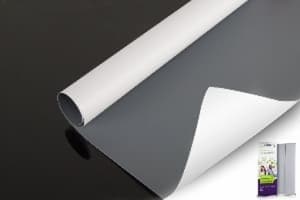
UNISIGN DSP-BLK-D is a 250gsm double-sided printable blockout fabric for commercial display graphics. Its black internal blocking structure helps separate the artwork printed on each white face, making it suitable for backdrops, pop-up displays, frame systems and exhibition graphics.
The current DSP-BLK-D specification supports direct and paper-transfer dye sublimation, widths up to 3.2m / 126 inches, a standard roll length of 100m / 110 yards, and listed shrinkage of ≤2%. Before a production order, test the exact roll with your printer, ink, heat cycle and finishing process.
Compare this two-face construction with black-, grey-, white- and silver-back options in the single-sided and double-sided blockout fabric range.
250gsm Double-Sided Blockout Fabric at a Glance

DSP-BLK-D / Ares
- Weight: 250gsm / 7.4oz
- Printing: Direct or paper-transfer dye sublimation
- Maximum width: 3.2m / 126 inches
- Standard roll: 100m / 110 yards
- Listed shrinkage: ≤2%
- Structure: White printable face / black internal blocking structure / white printable reverse face
- Typical uses: Backdrops, pop-ups, frames, exhibitions and display systems
Best starting point: Projects that need different graphics on the two faces and better image separation than a standard non-blockout display textile.
DSP-BLK-D Technical Specifications
The following values summarize UNISIGN’s current DSP-BLK-D product information. Confirm the current specification, tolerance and documents for the exact order.
| Specification | DSP-BLK-D / Ares | What to Confirm Before Ordering |
|---|---|---|
| Product Type | Double-sided printable blockout fabric | Use double-sided blockout, not ordinary display fabric |
| Weight | 250gsm / 7.4oz | Production tolerance for your order |
| Printing | Direct / paper-transfer dye sublimation | Your printer, ink, paper and heat workflow |
| Maximum Width | 3.2m / 126 inches | Available width for the ordered roll |
| Standard Roll Length | 100m / 110 yards | Usable roll length and packaging |
| Listed Shrinkage | ≤2% | Test result under your temperature and dwell time |
| Blockout Description | Black inside; good opacity | Required opacity and visible show-through under project lighting |
| Printable Faces | Both sides | Registration, color, finishing and handling on both faces |
| Applications | Backdrops, pop-ups, frames, exhibitions, display systems | Final system fit and viewing distance |
| Listed FR Options | B1 / NFPA 701 / AS 1530 / JIS L 1091 | Exact product, report, destination and validity |
Important: “Good opacity” is the wording on the current product information. It should not be interpreted as a universal 100% light-blocking guarantee. Approve opacity under the lighting, artwork and viewing conditions of the finished display.
What Is 250gsm Double-Sided Dye Sublimation Blockout Fabric?
It is a polyester display textile designed to receive separate dye-sublimation graphics on two faces while an internal dark blocking structure reduces interaction between the images. In practical terms, one side can carry artwork A and the reverse can carry artwork B without using two independent fabric panels.
The term “250gsm” means that the fabric has a nominal mass of 250 grams per square meter. GSM is useful for comparison, but it does not by itself describe opacity, printable surface, dimensional stability, stretch, fire performance or finished display quality.
Conceptual fabric structure
Graphic A
Helps separate the two printed messages
Graphic B
Diagram is illustrative. Request the current technical specification and inspect a physical sample for the exact construction.
How Does Double-Sided Blockout Fabric Work?
Ordinary white display fabric may allow light or a strong image to influence the reverse side. A blockout fabric uses a dark internal structure to reduce that interaction. The two outside surfaces remain printable, so each viewing direction can carry its own design.
This can simplify a double-sided display, but production still requires careful control. Dense black artwork on one side, high-intensity lighting, close viewing distance or an incorrect heat cycle can reveal limitations that are not obvious from an unprinted hand sample.
What the Blocking Structure Helps With
- Separating different artwork printed on opposite faces
- Reducing visible image interference and show-through
- Creating one fabric graphic for a two-direction display system
- Keeping both exterior faces white before printing
What It Does Not Automatically Guarantee
- Absolute opacity under every light level
- Perfect front-to-back registration
- Identical color on direct and transfer equipment
- Correct dimensions after every heat cycle
- Compliance without product-specific test documentation
Where Is 250gsm Double-Sided Blockout Fabric Used?
| Application | Why Double-Sided Blockout Helps | What to Test |
|---|---|---|
| Exhibition Backdrops | Different messages can face two traffic directions | Opacity, seams, lighting and wrinkle appearance |
| Pop-Up Displays | One textile can serve two visible sides | System tension, folding and edge finishing |
| Frame Systems | Supports reversible or two-direction frame graphics | Finished dimensions, stretch and frame fit |
| Trade-Show Graphics | Helps separate booth artwork from neighboring graphics | FR documentation and venue lighting |
| Retail Display Panels | Different campaigns or messages can appear on each side | Color consistency and close-view surface quality |
| Display Walls | Provides a textile alternative for two-sided visual communication | Panel alignment, flatness and installation |


Why Choose 250gsm?
A 250gsm construction can provide a practical balance between blockout function, handling and wide-format production. It is heavier than many standard single-layer display textiles because it must provide two printable faces and an internal blocking structure. At the same time, it remains a fabric solution that can be rolled, sewn and installed in compatible display systems.
However, the right weight depends on the project. Do not select 250gsm only because it is lighter or cheaper than a 270gsm or 310gsm option. First decide whether you need two printable faces, then compare opacity, white point, surface, width, heat behavior and the display system.
250gsm Blockout vs Standard Display Fabric
| Factor | 250gsm Double-Sided Blockout | Standard Non-Blockout Display Fabric |
|---|---|---|
| Printable Sides | Designed for separate printing on both faces | Often optimized for one primary printable face |
| Image Separation | Internal dark structure helps reduce show-through | Reverse image influence may be more visible |
| Weight | 250gsm nominal | Varies; many options are lighter |
| Best Use | Two-direction graphics, backdrops and display panels | Front-facing displays and applications without blockout need |
| Production | Requires control of both printed faces | Usually simpler one-face production |
| Selection Priority | Opacity, two-side print quality and registration | Surface, stretch, light behavior and application fit |
If a project does not need blockout or two printable faces, compare this construction with 230gsm dye sublimation display fabric for front-facing commercial displays.
How Does 250gsm Compare With Other Blockout Fabrics?
UNISIGN lists several backdrop blockout options. The names below describe different constructions and should not be treated as interchangeable solely because their weights are close.
| Product | Listed Weight | Construction Positioning | Consider It When |
|---|---|---|---|
| DSP-BLK-D / Ares | 250gsm | Double-sided printable blockout; black inside | You need two printable faces with a relatively light blockout construction |
| DSP-BLK-01 | 260gsm | Black-back blockout | A black reverse and one main printable face suit the application |
| DSP-BLK-DTR | 270gsm | Super-white double-sided blockout | White appearance and double-sided positioning are priorities |
| DSP-BLK-02 | 280gsm | Grey-back blockout | A grey reverse is acceptable or preferred |
| DSP-BLK-W | 310gsm | White-back blockout | A heavier white-back option better matches the display requirement |
Data note: The current DSP-BLK-D individual product page and product card list 250gsm. If you see a different weight in a summary table, confirm the exact product code and current technical data before purchasing.
A black reverse is not the same as a dark inner layer between printable faces. See the blockout and blackback fabric comparison to choose the right structure for one-side or two-side graphics.
Quick Product Selection Flow
- Do both faces need different printed artwork? If yes, start with a double-sided printable blockout model such as DSP-BLK-D.
- Does one face only need to be black, grey or white? Compare black-back, grey-back and white-back constructions instead.
- What opacity does the finished display require? Test the artwork under real ambient and directional lighting.
- Which sublimation workflow will you use? Confirm direct or paper-transfer printing with the exact machine and ink.
- What finished width and size are required? Check the available roll width, heat shrinkage, seams and finishing allowance.
- Is fire documentation required? Match the product, standard, venue and destination market.
- Can you approve a representative sample? Print both faces, finish it and install it before ordering production volume.
Direct vs Paper-Transfer Dye Sublimation
DSP-BLK-D is currently listed for both direct and paper-transfer dye sublimation. That compatibility gives commercial printers flexibility, but the same color profile and heat settings should not be assumed for both methods.
| Check | Direct Sublimation | Paper-Transfer Sublimation |
|---|---|---|
| Ink Placement | Ink is printed onto the fabric before fixation | Ink is printed on transfer paper, then transferred by heat |
| Key Controls | Feeding, strike-through, fixation and surface uniformity | Paper stability, transfer pressure, temperature and ghosting |
| Two-Side Work | Protect the reverse face and control contamination | Control paper alignment and heat exposure for both faces |
| Approval | Measure color, opacity, shrinkage and finished dimensions after the complete process | |
Your final result depends on the combined system: printer + ink + profile + paper where used + fabric + temperature + time + pressure + finishing.
How Should You Test Blockout Performance?
Do not evaluate opacity only by holding an unprinted swatch against a window. Use a realistic two-side print test.
- Print a high-density image with deep black and large solid areas on face A.
- Print a different high-contrast design on face B.
- View both sides under the project’s normal front lighting.
- Add a strong light source behind or beside the sample to reveal edge cases.
- Evaluate at the intended viewing distance, including close inspection if relevant.
- Check seams, cut edges and stretched areas where the internal structure may be more visible.
- Photograph the result and record the printer, ink, profile and heat settings.
A pass/fail requirement should be agreed before production. “Good opacity” is useful positioning, but a buyer-specific acceptance standard is more reliable.
How Should You Check Shrinkage and Dimensional Stability?
The DSP-BLK-D page lists shrinkage of ≤2%, but the result in your facility depends on temperature, time, pressure, fabric direction and handling. A two-sided production cycle may expose the textile to heat more than once, so the full workflow matters.
- Mark a measured square in both machine and cross directions.
- Record the original width, length and diagonal measurements.
- Run the planned first-side printing and heat cycle.
- Measure again before processing the reverse face.
- Complete the second-side process and measure a third time.
- Finish the sample by cutting, sewing or adding the required edge system.
- Install it in the intended frame or display and record final fit.
For frames and pop-ups, finished dimensions can be more important than nominal GSM. Add a controlled cutting allowance only after the test establishes repeatable behavior.
What Does a 3.2m Maximum Width Mean for Buyers?
A maximum width of 3.2m / 126 inches can reduce seams on large-format backdrops and display walls. However, maximum width does not mean every roll width is continuously stocked or suitable for every machine.
Before ordering, provide the required finished width, printer model, usable media width, edge allowance and quantity. Ask which roll widths are available for DSP-BLK-D and whether the quoted width is the total roll width or the guaranteed usable printable width.
What Should You Check When Printing Both Sides?
- Artwork orientation: Confirm which edges align when the panel is viewed from each direction.
- Registration: Define acceptable front-to-back position tolerance.
- Color: Use separate profiling or calibration if the two passes behave differently.
- Contamination: Protect the completed first face during reverse-side production.
- Heat history: Account for any second heat exposure and additional dimensional change.
- Edge visibility: Inspect cut and sewn edges where the internal black structure may be seen.
- Finishing marks: Check sewing, silicone edging, hook-and-loop tape or frame hardware on both faces.
What About Flame-Retardant Requirements?
The current DSP-BLK-D product information lists FR options including B1, NFPA 701, AS 1530 and JIS L 1091. A listed option is not automatically proof that every roll is certified for every venue.
Before ordering for an exhibition or public space, confirm:
- The exact product code and construction covered by the report
- The test standard requested by the venue or destination market
- The report number, laboratory and current validity where applicable
- Whether finishing, printing or post-treatment affects acceptance
- Whether the shipment needs supporting batch or transaction documents
Recommended Sample Test Plan
| Stage | Test | Record |
|---|---|---|
| Incoming Fabric | Width, weight, surface, white point, visible defects | Roll and batch identification |
| Face A Printing | Feeding, color blocks, gradients, deep black, fine text | Profile and machine settings |
| Face B Printing | Registration, contamination, color and image separation | Artwork orientation and alignment |
| Heat Processing | Temperature, time, pressure and dimensional change | Measurements after each exposure |
| Opacity Review | Normal and challenging light conditions | Photos and acceptance result |
| Finishing | Cutting, sewing, edging and hardware | Edge quality and finished size |
| Installation | Flatness, tension, wrinkles, display fit | Final approval in the real system |
When Should You Choose DSP-BLK-D?
Consider the 250gsm DSP-BLK-D when:
- You need different artwork on two printable faces
- The display is viewed from two directions
- A black internal blocking structure is acceptable
- Your workflow uses direct or paper-transfer dye sublimation
- You need widths up to 3.2m
- You can test opacity, shrinkage and finishing before production
Consider Another Fabric When
- Only one face needs printing and a black-, grey- or white-back construction is more efficient
- The graphic will be illuminated as a lightbox; choose a purpose-built backlit textile
- The project needs stretch and recovery characteristics not confirmed for this model
- Your print method is UV, latex or another process not listed for DSP-BLK-D
- The project requires product-specific test evidence that is not available for the proposed order
Why Source Double-Sided Blockout Fabric From UNISIGN?
UNISIGN has produced digital-printing materials since 2007 and supplies multiple textile families for lightboxes, displays, backdrops, flags and related applications. For blockout sourcing, the practical advantage is the ability to compare double-sided, black-back, grey-back and white-back options by product code rather than treating all “blockout fabric” as one material.
Use the UNISIGN backdrop fabric range to compare constructions, or review the DSP-BLK-D product page for the current model details. If you are evaluating suppliers, see our guides on choosing a dye sublimation fabric manufacturer and finding a reliable dye sublimation fabric supplier.
Buyer Information Checklist
Send these details to receive a relevant sample and quotation:
- Application and display system
- Finished graphic dimensions
- Printer model and ink
- Direct or paper-transfer dye sublimation
- Required roll width
- Artwork on one or both faces
- Opacity acceptance requirement
- FR standard and destination country
- Finishing method
- Estimated order quantity and schedule
For chain-store rollouts, use the retail hanging banner guide to turn two-face opacity into a written batch approval plan.
Frequently Asked Questions
What is 250gsm double-sided dye sublimation blockout fabric?
It is a polyester display textile with two printable white faces and a dark internal blocking structure that helps separate different graphics printed on opposite sides. The 250gsm value describes its nominal weight per square meter.
Can DSP-BLK-D be printed on both sides?
Yes. The current UNISIGN product information describes DSP-BLK-D as double-sided printable. Test orientation, registration, color, opacity and dimensional change using your full production process.
Does 250gsm blockout fabric provide 100% opacity?
Do not assume a universal 100% result. UNISIGN currently describes DSP-BLK-D as having “good opacity.” Approve it with high-density artwork under the actual lighting and viewing conditions.
Is it suitable for direct dye sublimation?
Yes. DSP-BLK-D is currently listed for direct and paper-transfer dye sublimation. The printer, ink, profile and heat settings still require validation.
What is the maximum width?
The listed maximum is 3.2m / 126 inches. Confirm the available and guaranteed usable width for the exact roll you plan to order.
What is the listed shrinkage?
The current product page lists shrinkage of ≤2%. Measure dimensional change after each planned heat exposure and after finishing because actual results depend on the production conditions.
Can this fabric be used for lightboxes?
It is positioned as a blockout backdrop and display fabric, not a translucent backlit material. For illuminated lightboxes, select and test a dedicated backlit textile.
Is FR documentation available?
The product information lists B1, NFPA 701, AS 1530 and JIS L 1091 options. Confirm the exact report and product coverage for the order, venue and destination market.
How should I choose between 250gsm and 270gsm double-sided blockout?
Compare the exact product construction, white point, opacity, surface, width, heat behavior and finished system—not weight alone. DSP-BLK-D is listed at 250gsm, while DSP-BLK-DTR is positioned as a 270gsm super-white double-sided option.
Should I request a sample before a bulk order?
Yes. Print different high-contrast artwork on both faces, complete the heat and finishing processes, and install the sample in the intended display system before approving production.
Request a 250gsm Double-Sided Blockout Fabric Sample
Tell UNISIGN your application + printer + sublimation method + required width + finished size + FR requirement + quantity. We can help you confirm whether DSP-BLK-D or another backdrop blockout construction is the better starting point for testing.

![Top 10 Vinyl Tarp Manufacturers in the World [2026 Guide]](https://unisignflex.com/wp-content/uploads/2026/04/pvc-tarpaulin-product-line.jpg)