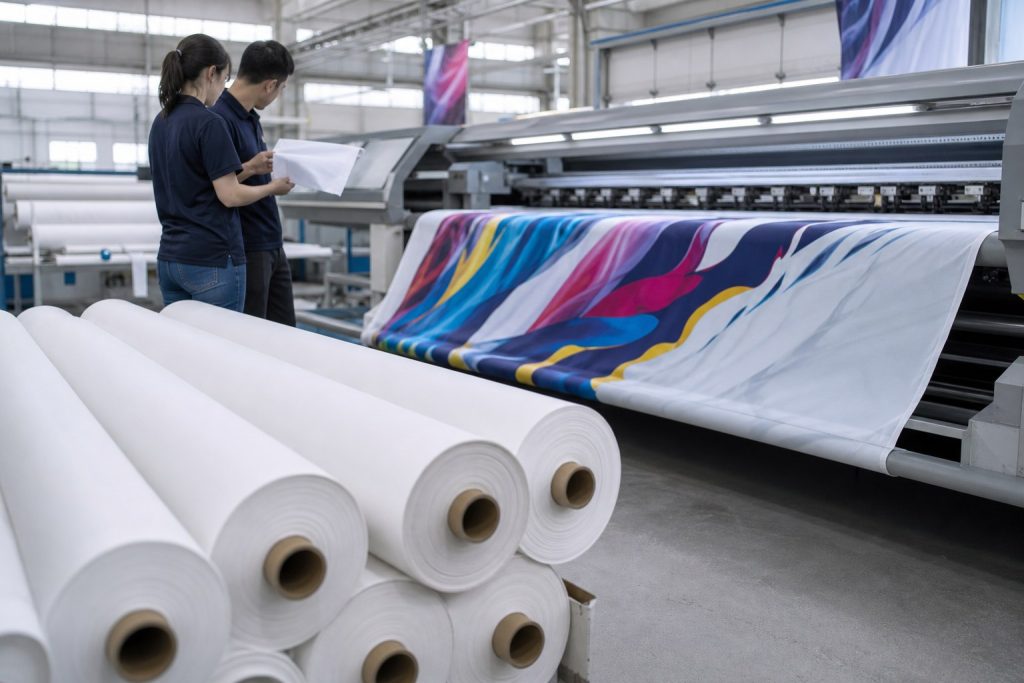
A reliable dye sublimation fabric supplier for commercial printing should provide more than a low price.
Look for these 8 things:
- The right fabric for your application
- Clear technical specifications
- Compatibility with your printing process
- Consistent roll-to-roll quality
- Samples for production testing
- Reliable bulk supply
- Relevant test documents and certifications
- Technical support when printing problems occur
Before approving a supplier, test the actual fabric using your own:
Printer + Ink + Transfer Paper + Heat Setting + Finishing Process
For a broader factory-evaluation framework, see our related guide on how to choose a dye sublimation fabric manufacturer.
1. Can the Supplier Recommend Fabric by Application?
Start with your application. Do not start with:
What is your cheapest fabric?
And do not start with:
Do you have 230 GSM polyester?
Instead, tell the supplier what you are producing.
Common Commercial Printing Applications
| Application | Important Fabric Properties |
|---|---|
| SEG Display | Low shrinkage, controlled stretch, smooth surface |
| Backlit Lightbox | Light diffusion, color density, uniformity |
| Frontlit Display | Whiteness, print sharpness, wrinkle resistance |
| Flag | Low weight, penetration, tear resistance |
| Blockout Display | Opacity, dimensional stability |
| Backdrop | Flatness, opacity, wrinkle resistance |
| Pop-up Display | Stretch control, recovery |
| Trade Show Graphic | FR options, portability, print quality |
A supplier offering only one or two general-purpose polyester fabrics may not be suitable for a commercial printer producing many types of graphics. A stronger supplier should be able to answer:
What are you printing, how are you printing it, and how will the finished graphic be installed?
UNISIGN currently supplies dye sublimation textile categories for lightboxes, displays, backdrops, flags, PVC-free coated applications and tents.
2. Does the Supplier Provide Clear Technical Specifications?
Commercial printers need measurable information. Statements such as “premium quality,” “excellent fabric,” “best polyester” and “high quality” are not enough. Ask for a technical specification.
What Should Be Included?
| Specification | Why It Matters |
|---|---|
| Material | Confirms fiber composition |
| Construction | Affects stability and surface |
| GSM | Indicates fabric weight |
| Width | Must fit your printer and job |
| Roll Length | Important for production planning |
| Shrinkage | Affects finished dimensions |
| Stretch | Important for SEG and frame systems |
| Printing Process | Confirms media compatibility |
| FR Option | Important for some projects |
| Application | Helps prevent incorrect material selection |
Good Supplier Answer
Instead of “This is 230 GSM display fabric,” a better answer is:
This is a 230 GSM warp-knitted display fabric for direct and transfer dye sublimation, available up to 3.2 m wide, with specified shrinkage and recommended for display, pop-up and backdrop applications.
The more measurable the information, the easier it is to compare suppliers.
3. Is the Fabric Compatible With Your Printing Process?
Commercial dye sublimation production is not the same for every printer. Common workflows include:
- Direct dye sublimation
- Transfer dye sublimation
- Direct disperse printing
Some commercial printers also operate latex and UV equipment. Do not assume every polyester fabric performs equally well with every process.
Ask These 6 Questions
- Is this fabric designed for direct sublimation?
- Is it suitable for transfer sublimation?
- What ink systems have been tested?
- What heat-setting conditions are normally used?
- Is profiling recommended?
- Can I test a production sample?
Your final print result depends on more than the fabric.
Printer → Ink → Transfer Paper → Fabric → Heat → Finishing
4. Can the Supplier Maintain Roll-to-Roll Consistency?
For commercial printers, one good sample is not enough. You may need 10 rolls today, 50 rolls next month and the same fabric six months later. The material should perform consistently.
Check These Items
| Item | What Should Stay Consistent? |
|---|---|
| GSM | Within agreed tolerance |
| Width | Stable across rolls |
| Surface | Similar appearance |
| Whiteness | Similar base color |
| Stretch | Similar behavior |
| Shrinkage | Similar after heat setting |
| Roll Length | Matches specification |
| Print Performance | Similar color and handling |
Poor batch consistency can cause color differences, incorrect finished dimensions, SEG fitting problems, reprints, material waste and production delays. For repeat business, consistency can be more important than getting the lowest price.
5. Ask for Shrinkage Data
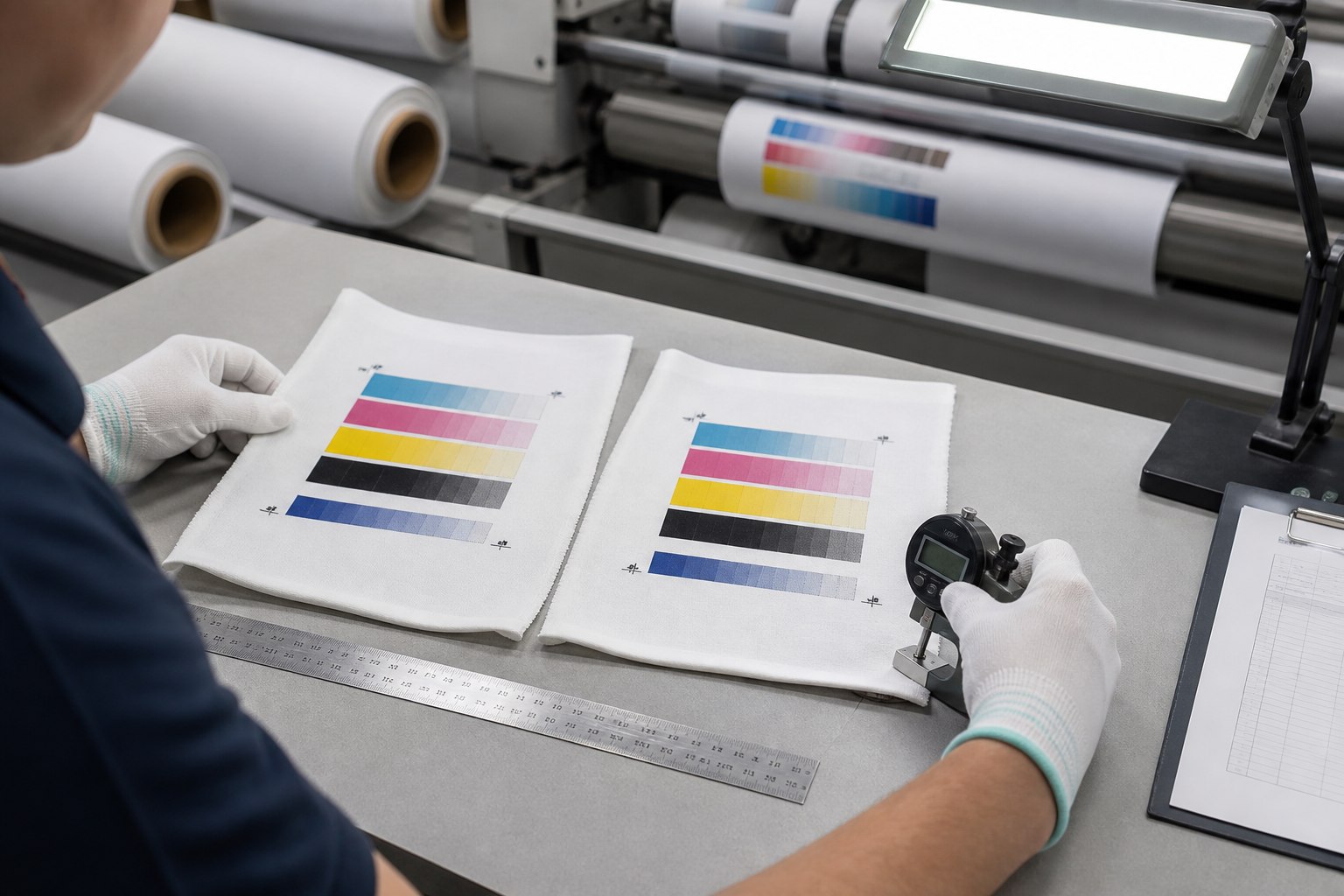
Shrinkage is especially important for SEG, tension frames, backlit frames, large-format displays, sewn graphics and repeat production. Dye sublimation exposes polyester fabric to heat, and the fabric can change dimensions during the process.
Do not accept only “low shrinkage.” Ask:
What is the shrinkage under the recommended heat-setting conditions?
Simple Test
- Measure the sample before heat setting.
- Measure it after heat setting.
- Measure it after sewing or finishing.
- Check it after installation.
Use a repeatable fabric shrinkage batch-test record before bulk cutting.
For an SEG project, the final question is simple: Does it fit the frame correctly?
6. Can You Test a Representative Sample Before Buying?
A reliable supplier should make evaluation easier. For a new fabric, test the material before committing to a large order.
Before Printing
- GSM
- Width
- Surface
- Whiteness
- Stretch
- Visible defects
During Printing
- Feeding
- Flatness
- Ink behavior
- Transfer performance
After Heat Setting
- Shrinkage
- Color density
- Sharpness
- Curling
- Creasing
- Surface appearance
After Finishing
- Cutting
- Sewing
- Edge condition
- Stretch recovery
- SEG fit
Final Application
Do not stop at the printer. Test the finished graphic in the real application.
| Fabric | Final Test |
|---|---|
| SEG Fabric | Install in SEG frame |
| Backlit Fabric | Install in lightbox |
| Flag Fabric | Check print-through and movement |
| Blockout Fabric | Check opacity |
| Stretch Fabric | Check tension and recovery |
7. Does the Supplier Understand Commercial Printing?
A fabric supplier should understand more than fabric weight. When you report that a graphic is too small after sublimation, a useful technical team should help check fabric shrinkage, temperature, dwell time, machine tension, transfer process and finishing allowance.
If a backlit graphic looks uneven, the supplier should understand that possible factors include fabric construction, ink density, lightbox setup, print profile and surface uniformity. A commercial printing supplier should help identify the problem instead of immediately saying, “The fabric is fine.”
8. Check Width and Roll Format
Fabric width affects production efficiency. A wider roll may help reduce seams, sewing, labor, material waste and installation complexity.
Ask for the available width of the exact product. Do not ask only, “What is your maximum factory width?” Different products can have different available widths.
Check:
- Standard widths
- Maximum width
- Standard roll length
- Custom roll length
- Core size
- Packaging
- Roll weight
- Minimum order quantity
These details matter when planning commercial production.
9. Can the Supplier Support Repeat Bulk Orders?
A supplier may perform well on a small order but struggle with repeat volume. For commercial printing, ask:
- What is the normal lead time?
- What is the MOQ?
- Is this a standard or custom product?
- How is repeat-order consistency controlled?
- Can production lots be traced?
- What happens if volume increases?
- Can the same specification be supplied long term?
- How are quality claims handled?
Do not evaluate only the first order. Evaluate whether the supplier can support:
Sample → Trial Order → Bulk Order → Repeat Order
10. Ask for Test Reports and Certificates Where Required
Different projects require different documents. Useful evidence may include:
- Technical Data Sheet
- Fabric test report
- Flame-retardant documentation
- REACH documentation
- Recycled-content documentation
- Production inspection data
Certification requirements depend on the product, destination and application. For example, exhibition or public-space projects may require specific flame-performance standards.
Do not ask only, “Do you have certificates?” Ask:
Do you have the relevant document for the exact fabric I am buying?
11. Check Sustainability Claims Carefully
If recycled polyester is required, ask for evidence. Do not rely only on words such as “eco-friendly,” “sustainable,” “green” or “recycled.” Ask for:
- Certification standard
- Certificate holder
- Certification body
- Product scope
- Current validity
- Applicable transaction documentation
UNISIGN has provided a GRS Scope Certificate for its textile operations.

A GRS Scope Certificate does not mean that every fabric sold by a company is automatically GRS-certified. Confirm the required product and transaction documentation before ordering.
For a focused checklist, read our recycled polyester sublimation fabric guide to compare recycled content, print methods and the documents for the selected fabric.
12. Look for Third-Party Testing
Third-party testing can support technical claims. UNISIGN has also provided an SGS textile test report covering a tested fabric sample. The report includes tests related to fabric weight, tear strength and water resistance.

Important: A test report applies to the sample or product covered by that report. It should not be used to claim that every fabric from the supplier has identical performance. For a large order, ask for documentation relevant to the exact material being purchased.
Commercial Printing Supplier Scorecard
The following is a practical 100-point supplier evaluation framework for commercial printers. It is not an industry standard; it is designed to help buyers compare suppliers using the same criteria.
| Evaluation | Points |
|---|---|
| Application Fit | 15 |
| Technical Specifications | 15 |
| Batch Consistency | 15 |
| Sample & Print Testing | 15 |
| Printing Compatibility | 10 |
| Supply Capacity | 10 |
| Certification & Documentation | 10 |
| Technical Support | 10 |
| Total | 100 |
85–100 Points
Strong candidate for production testing and long-term sourcing.
70–84 Points
Potential supplier, but important gaps should be checked.
Below 70 Points
More verification is recommended before a large order.
Dye Sublimation Fabric Supplier Comparison Table
Use the same questions for every supplier.
| Requirement | Supplier A | Supplier B | Supplier C |
|---|---|---|---|
| Recommended Application | |||
| Material | |||
| Construction | |||
| GSM | |||
| Width | |||
| Roll Length | |||
| Direct Sublimation | |||
| Transfer Sublimation | |||
| Shrinkage | |||
| FR Option | |||
| Technical Data Sheet | |||
| Test Report | |||
| Sample Available | |||
| MOQ | |||
| Lead Time | |||
| Batch Traceability | |||
| Technical Support | |||
| Price |
Do not choose the winner from the last row alone.
Lowest Price vs. Lowest Production Cost
Commercial printers should compare total production cost, not only fabric price. A cheaper fabric may cost more if it creates more waste, more reprints, color variation, excessive shrinkage, sewing problems, installation problems or production downtime.
Supplier A
Fabric price: Lower
- More shrinkage
- Higher reject rate
- Poorer consistency
Supplier B
Fabric price: Slightly higher
- Stable production
- Fewer reprints
- Better repeatability
Supplier B may have the lower real production cost.
Red Flags When Choosing a Dye Sublimation Fabric Supplier
Be careful if the supplier:
- Recommends fabric only by GSM.
- Always recommends the cheapest product.
- Cannot explain the fabric construction.
- Cannot explain direct vs. transfer sublimation.
- Has no technical specifications.
- Cannot provide a representative sample.
- Cannot provide shrinkage information.
- Cannot explain batch control.
- Uses one certificate to represent every product.
- Cannot identify the relevant test report.
- Cannot explain how quality complaints are handled.
- Has no technical support for printing problems.
Example UNISIGN Fabrics for Different Commercial Printing Applications
UNISIGN currently offers different fabrics for different printing applications rather than one general-purpose product. Its textile portfolio includes display, flag, lightbox, backdrop and other fabric categories.
| Product | Typical Application | Weight | Max Width | Listed Shrinkage |
|---|---|---|---|---|
| DSP09 | Display / Pop-up / Backdrop | 230 gsm | 3.2 m | ≤2% |
| DSP02 | Flags | 110 gsm | 3.2 m | ≤2% |
| DSP-BLK-D | Double-sided Blockout / Exhibition | 250 gsm | 3.2 m | ≤2% |
The current product pages list these materials for direct and/or paper-transfer dye sublimation and provide additional specification information. The correct product should still be selected according to the specific printing system and final application.
Why Commercial Printers Consider UNISIGN
UNISIGN produces a range of dye sublimation textiles for commercial advertising applications, including:
- Display Fabric
- Light Box Fabric
- Backdrop Fabric
- Flag Fabric
- PVC-Free Coated Fabric
- Tent Fabric
UNISIGN states that annual production of its polyester fabric for dye sublimation is approximately 25 million square meters.
Its website also states that its quality process covers raw-material selection, production inspection and printing tests before shipment, with printing tests carried out 2–3 times.
Available supporting documentation includes, where applicable:
- Product specifications
- Fabric testing documentation
- SGS test reports
- Flame-retardant documentation
- GRS documentation
Buyers should always confirm the documentation for the exact product and current order.
What Should I Send a Supplier Before Asking for a Quote?
A better RFQ produces a better recommendation. Send these 10 details:
- Final application
- Printer model
- Printing process
- Ink system
- Required width
- Target GSM, if known
- Required roll length
- FR or recycled-content requirements
- Destination country
- Expected purchase volume
Example RFQ
| Requirement | Example |
|---|---|
| Application | SEG Exhibition Display |
| Printing | Transfer Dye Sublimation |
| Printer | Commercial 3.2 m Printer |
| Width | 3.2 m |
| Weight | Around 230 gsm |
| FR | NFPA 701 Required |
| Market | United States |
| Initial Quantity | 10,000 m² |
| Annual Usage | 150,000 m² |
This allows the supplier to recommend a specific product instead of giving you a general price list.
Questions to Ask Before Approving a New Supplier
Use these 12 questions:
- Which fabric do you recommend for my application?
- Why do you recommend that product?
- Is it compatible with my printing process?
- What are the GSM, construction and width?
- What shrinkage should I expect?
- What are the production tolerances?
- Can I test a representative sample?
- What documents are available?
- How do you control batch consistency?
- What is the normal lead time?
- Can you support repeat orders?
- What happens if we have a printing or quality problem?
A supplier that can answer all 12 clearly is easier to evaluate than one that only sends a quotation.
Frequently Asked Questions
What is the most important factor when choosing a dye sublimation fabric supplier?
For a commercial printer, the most important factors are application fit, print compatibility and repeatable quality. Price should be compared only after these requirements are satisfied.
Should I choose a supplier based on GSM?
No. GSM measures fabric weight, but it does not tell you enough about construction, shrinkage, stretch, surface, print compatibility or final application.
Should a dye sublimation fabric supplier provide samples?
Yes. A representative sample allows you to evaluate the fabric with your actual production setup before committing to a bulk order.
How do I test a new dye sublimation fabric supplier?
Use this sequence: Technical Data → Sample → Print Test → Heat Test → Finishing Test → Application Test → Trial Order → Bulk Order.
Why is batch consistency important?
Commercial printers often repeat the same jobs. Large differences between production batches can create problems with color, dimensions, sewing, installation and customer expectations.
Do I need flame-retardant fabric?
It depends on the destination, venue and application. Check your project requirements and request documentation for the exact fabric when flame performance is required.
Is recycled polyester suitable for commercial dye sublimation printing?
It can be, provided the fabric meets the required printing and application performance. Evaluate recycled fabrics using the same criteria as standard polyester: print quality, shrinkage, stability, consistency and application suitability. Also verify recycled-content claims when they are part of your purchasing requirement.
Is buying directly from a manufacturer always better?
Not necessarily. A commercial printer needs a supplier that can provide the right combination of product + consistency + availability + documentation + technical support + commercial terms. The best supplier model depends on your volume and service requirements.
How should I compare dye sublimation fabric prices?
Compare equivalent specifications first. Then consider fabric cost + waste + reprints + labor + downtime + logistics. The lowest price per square meter is not always the lowest production cost.
Test UNISIGN Dye Sublimation Fabric
If you are evaluating a new fabric supplier, send us:
Application + Printer + Printing Process + Width + GSM + Certification Requirement + Order Volume
UNISIGN can recommend suitable fabric options for testing.
![Top 10 Vinyl Tarp Manufacturers in the World [2026 Guide]](https://unisignflex.com/wp-content/uploads/2026/04/pvc-tarpaulin-product-line.jpg)