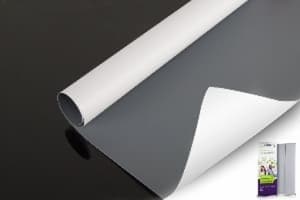
UNISIGN SDB180 is a 180gsm polyester backlit fabric designed for dye sublimation printing and SEG lightbox applications. It supports direct and paper-transfer dye sublimation, comes in widths up to 3.2m / 126 inches, and is supplied in standard 100m / 110-yard rolls. The fabric is intended for illuminated graphics where print density, dimensional stability and a uniform backlit appearance are important.
180gsm Backlit Fabric at a Glance

SDB180 / Selene
- Weight: 180gsm / 5.3oz
- Construction: Woven polyester backlit fabric
- Printing: Direct or paper-transfer dye sublimation
- Maximum width: 3.2m / 126 inches
- Standard roll: 100m / 110 yards
- Applications: SEG lightboxes and SEG frame systems
- Listed FR options: B1 / NFPA 701 / AS 1530 / JIS L 1091
Selection priority: Approve the illuminated print, light diffusion, color density, shrinkage and final SEG fit—not the GSM alone.
180gsm Dye Sublimation Backlit Fabric Specifications
The values below summarize UNISIGN’s current SDB180 product information. Confirm the current specification, available width and applicable documentation for the exact order.
| Specification | UNISIGN SDB180 | What the Buyer Should Confirm |
|---|---|---|
| Product Code | SDB180 | The same code appears on the quotation, sample and production order |
| Product Name | Selene Backlit Fabric | Current technical data sheet for SDB180 |
| Product Type | Backlit / lightbox fabric | Light-transmitting textile, not blockout fabric |
| Weight | 180gsm / 5.3oz | Production tolerance for the ordered roll |
| Construction | Woven | Surface and stretch behavior in the intended frame |
| Printing | Direct / paper-transfer dye sublimation | Your printer, ink, paper, profile and heat workflow |
| Maximum Width | 3.2m / 126 inches | Available stock width and usable printable width |
| Standard Roll Length | 100m / 110 yards | Usable roll length, packaging and tolerance |
| Shrinkage | Confirm for the exact product and test conditions | Temperature, time, machine direction and cross direction |
| FR Options | B1 / NFPA 701 / AS 1530 / JIS L 1091 | Exact product, report, destination, venue and current validity |
| Applications | SEG lightbox / SEG frame systems | Lightbox depth, LED layout, finished dimensions and frame fit |
What Is 180gsm Dye Sublimation Backlit Fabric?
It is a polyester textile with a nominal mass of 180 grams per square meter, designed to receive dye-sublimation graphics and transmit light in an illuminated display. The fabric is commonly finished with silicone edging and installed under controlled tension in an SEG lightbox or frame.
“180gsm” describes fabric weight. “Dye sublimation” describes the print process. “Backlit” describes the optical application: a light source sits behind the printed graphic. These three terms should be evaluated together, but weight alone does not determine backlit quality.
Two fabrics with the same nominal GSM may look very different when illuminated. Compare light diffusion, light transmission, surface uniformity, print density, white point, shrinkage, construction and width before approving a commercial order.
What Makes a Good Backlit Fabric?
| Property | What the Buyer Should Check | Why It Matters |
|---|---|---|
| Light Diffusion | Does the light spread evenly across the graphic? | Helps reduce visible bright spots and dark bands |
| Light Transmission | How much light passes through the printed material? | Affects the brightness of the finished lightbox |
| Surface Uniformity | Are there uneven areas, pinholes or visible defects? | Defects can become more obvious after illumination |
| Print Density | Do colors and blacks remain strong with the light on? | Backlighting can make under-inked graphics look washed out |
| White Point | Is the unprinted base consistently white? | Influences color appearance and panel-to-panel consistency |
| Shrinkage | What dimensional change occurs after the planned heat cycle? | Critical for cutting allowance and SEG frame fit |
| Wrinkle Recovery | How does the textile recover after transport and installation? | Wrinkles may be emphasized by backlighting |
| Width | Does the roll width fit the printer and finished lightbox? | Wider rolls can reduce seams and finishing time |
| Flame Performance | Which product-specific report does the venue require? | Often important for exhibitions and public spaces |
Why Is Light Diffusion Important?
An LED lightbox may use strips or modules positioned at regular intervals behind the textile. If the fabric does not diffuse light effectively, the viewer may see alternating bright and dark zones. A suitable backlit textile helps spread the incoming light more evenly across the printed graphic.
Poor Light Diffusion
● ● ● ●
Bright and dark bands remain visible in the illuminated graphic.
Better Light Diffusion
● ● ● ●
The light is distributed more evenly across the viewing area.
This diagram explains the concept; it is not a measured transmission result for SDB180. Approve a printed sample in your actual lightbox.
Backlit Fabric When the Light Is OFF vs ON
A backlit print should not be evaluated only with the lightbox turned off. Ambient light shows surface quality and normal reflected color, while illumination reveals diffusion, transmission, color density, deep-black performance and hidden defects.


| Light OFF | Light ON |
|---|---|
| Surface defects and print sharpness | Hotspots, dark bands and light uniformity |
| Reflected color and white point | Transmitted color density and brightness |
| Wrinkles, seams and edge finishing | Deep-black performance and pinholes |
| Graphic dimensions before installation | Final illuminated appearance in the frame |
What Is 180gsm Backlit Fabric Used For?
| Application | Suitable? | What to Check |
|---|---|---|
| SEG Lightbox | Yes | Shrinkage, silicone edging and final frame fit |
| LED Lightbox | Yes | Light diffusion, box depth and LED spacing |
| Backlit Frame | Yes | Uniformity, dimensions and tension |
| Exhibition Lightbox | Yes | Applicable FR documentation and transport handling |
| Retail Lightbox | Yes | Color density, gradients and panel consistency |
| Airport / Mall Display | Project dependent | Venue fire requirements, installation and maintenance |
| Frontlit Display | Possible, but not its main purpose | A dedicated display fabric may be more suitable |
| Flag | No | Use a lightweight flag fabric with suitable print-through |
| Blockout Display | No | Blockout and backlit have opposite optical objectives |
| Double-Sided Blockout | No | Use a dedicated two-sided blockout textile |
Backlit fabric and blockout fabric solve opposite problems: backlit material must transmit and distribute light, while double-sided blockout fabric is designed to reduce light and image interaction.
Why Choose 180gsm for Backlit Printing?
Medium-Light Commercial Textile
A 180gsm construction can be practical for commercial SEG graphics that need fabric handling and a backlit optical function without automatically moving to a heavier construction.
Designed for SEG Lightbox Systems
UNISIGN positions SDB180 for SEG lightboxes and SEG frame systems. The final suitability still depends on the frame, finishing method, lighting layout and approved sample.
Wide-Format Availability
Widths up to 3.2m / 126 inches can support larger seamless graphics and reduce sewing on compatible printers and lightbox systems.
Long Roll Format
A standard 100m / 110-yard roll is suitable for commercial production and repeat graphics. Confirm usable roll length, defect allowance and packaging before ordering.
150gsm vs 180gsm vs 190gsm vs 250gsm vs 280gsm Backlit Fabric
Higher GSM does not automatically mean better backlit performance. Compare light diffusion, construction, printing behavior, shrinkage, application fit and then weight.
| GSM | UNISIGN Example | Construction Positioning | Main Question to Compare |
|---|---|---|---|
| 150gsm | SDB150 | Lighter backlit textile | Do you need a lighter construction for the intended system? |
| 180gsm | SDB180 | Woven SEG backlit option | Does it deliver the required illuminated appearance and frame fit? |
| 190gsm | SDB190 | Alternative backlit construction | Does its surface and heat behavior better suit the workflow? |
| 250gsm | SDB250 | Heavier backlit option | Do you need its specific structure and handling characteristics? |
| 270gsm | SDB270KN | Knitted backlit construction | Does a knitted construction better fit the frame and finishing process? |
| 280gsm | SDB280 | Heavier woven option | Does the heavier woven structure match the display system? |
Use the UNISIGN light box fabric range to shortlist constructions, then print and illuminate representative samples under the same controlled conditions.
Can 180gsm Backlit Fabric Be Used for Direct and Transfer Sublimation?
Yes. UNISIGN SDB180 is currently listed for both direct dye sublimation and paper-transfer dye sublimation. The product information also lists latex compatibility, but a dye-sublimation project should be approved using the intended sublimation workflow.
| Printing Method | SDB180 | What to Test |
|---|---|---|
| Direct Dye Sublimation | Listed | Feeding, ink behavior, fixation, density and show-through |
| Paper-Transfer Dye Sublimation | Listed | Paper stability, transfer pressure, heat, ghosting and shrinkage |
| Latex | Listed by UNISIGN | Confirm the current recommendation and profile for the exact workflow |
Your result depends on the complete system: printer + ink + profile + transfer paper where used + fabric + temperature + time + pressure + finishing + lightbox.
Why Do Backlit Prints Need Strong Color Density?
When the lightbox turns on, light passes through the printed graphic. If ink density is too low, black may appear grey and saturated colors may look weak. A print that looks acceptable under room lighting can appear washed out after illumination.
Include the following in a representative print test:
- CMYK solid blocks
- Deep black and dark neutral areas
- Saturated red, blue and green
- Skin tones and neutral grey
- Smooth gradients
- Fine text and thin lines
- Large solid-color areas
Always evaluate the final test with the lightbox illuminated. Record the printer, ink, profile, heat settings, lightbox depth and LED configuration so the result can be repeated.
How Much Does 180gsm Backlit Fabric Shrink?
Shrinkage must be tied to a defined test method. The result can differ by temperature, dwell time, pressure, fabric direction and whether the textile is printed directly or transferred from paper. For this reason, request the current SDB180 technical value and test conditions for the exact order rather than relying on an isolated percentage.
| Test Condition | Value to Record |
|---|---|
| Temperature | _____ °C |
| Time | _____ seconds |
| Machine-Direction Shrinkage | _____ % |
| Cross-Direction Shrinkage | _____ % |
| Printer / Calender | _____ |
| Finished SEG Size and Fit | Pass / Adjust allowance |
Measure the sample before heat, after sublimation, after sewing and after installation. For SEG graphics, the final fit can matter more than the nominal GSM.
Is 3.2m / 126-Inch Wide 180gsm Backlit Fabric Available?
Yes. UNISIGN currently lists SDB180 in widths up to 3.2m / 126 inches, with a standard roll length of 100m / 110 yards. Wide rolls can support larger seamless graphics, fewer seams, less sewing and faster finishing for compatible wide-format SEG systems.
Ask which roll widths are available for the exact production order. Also confirm whether the quoted width means total roll width or guaranteed usable printable width.
Is Flame-Retardant 180gsm Backlit Fabric Available?
FR options are currently listed for SDB180, including B1, NFPA 701, AS 1530 and JIS L 1091. Buyers should confirm the current test document for the exact fabric, order, destination market and venue before purchasing.
Do not interpret a list of FR options as proof that every SDB180 roll automatically complies with every standard. Ask for the report number, test organization, product description and current applicability.
How We Recommend Testing 180gsm Backlit Fabric
| Test | What to Measure | Production Decision |
|---|---|---|
| GSM Test | Actual fabric weight and tolerance | Confirm the ordered construction |
| Shrinkage Test | Dimensions before and after the complete heat cycle | Set cutting and finishing allowance |
| Light Transmission | Amount of light passing through under a defined method | Match the required lightbox brightness |
| Light Uniformity | Hotspots, dark bands and panel-to-panel variation | Approve the textile with the intended LED layout |
| Print Density | Color and black with the light on | Approve the ink limit and profile |
| SEG Installation | Finished dimensions, edge fit and surface tension | Approve sewing and silicone edging |
For a meaningful comparison, keep the LED distance, LED brightness, lightbox depth, printed image, printer settings and viewing distance the same. This separates material performance from changes elsewhere in the system.
Should I Choose 180gsm Dye Sublimation Backlit Fabric?
Choose 180gsm When
- You are producing SEG lightbox graphics.
- You need a medium-light polyester backlit textile.
- You use direct or paper-transfer dye sublimation.
- You require wide rolls up to 3.2m.
- You need fabric for illuminated frame systems.
- Dimensional stability and finished frame fit are important.
Consider Another Fabric When
- You need blockout rather than light transmission.
- You need flag material or a frontlit-only display textile.
- Your system requires a heavier or knitted construction.
- You need different stretch or finishing behavior.
- Your printer requires another media technology.
- Your specification requires a measured optical value that has not yet been verified for SDB180.
180gsm Backlit Fabric from UNISIGN
SDB180 Selene Backlit Fabric is a 180gsm woven textile listed for direct and paper-transfer dye sublimation, widths up to 3.2m / 126 inches and standard 100m / 110-yard rolls. It is positioned for SEG lightboxes and SEG frame systems, with product-specific FR options available for confirmation.
For broader supplier evaluation, use the dye sublimation fabric manufacturer checklist to compare technical data, samples, batch control, certifications and production support.
How Should I Test a Backlit Fabric Sample?
Before Printing
- Check GSM and measure roll width.
- Inspect the surface, white point and visible defects.
- Record the sample roll and batch information.
After Sublimation
- Measure machine- and cross-direction shrinkage.
- Check black density, saturated colors and gradients.
- Inspect wrinkles, curling and surface uniformity.
Inside the Lightbox
- Check light uniformity and visible hotspots.
- Evaluate color density, black and graphic sharpness.
- Install the finished sample and approve SEG fit.
Before Ordering 180gsm Backlit Fabric
| Requirement | Buyer Should Confirm |
|---|---|
| Application | SEG / LED lightbox / illuminated frame |
| Product | SDB180 Selene Backlit Fabric |
| Weight | 180gsm and applicable tolerance |
| Printing | Direct or paper-transfer dye sublimation |
| Required Width | _____ m |
| Roll Length | _____ m |
| Shrinkage Requirement | _____ % under defined conditions |
| Light Transmission | Required value or approved visual sample |
| Light Uniformity | Approved in the intended lightbox |
| FR Standard | _____ |
| Destination Market | _____ |
| Quantity | _____ m² / rolls |
Frequently Asked Questions
What is 180gsm dye sublimation backlit fabric?
It is a 180-gram-per-square-meter polyester textile designed for dye-sublimation printing and illuminated display systems. It should be selected by its light diffusion, print density, dimensional stability and final lightbox performance—not by weight alone.
Is 180gsm fabric suitable for SEG lightboxes?
Yes. UNISIGN positions SDB180 for SEG lightboxes and SEG frame systems. Print, finish and install a representative sample to approve shrinkage, tension and illuminated appearance.
Can 180gsm backlit fabric be used for direct dye sublimation?
Yes. SDB180 is currently listed for direct dye sublimation and paper-transfer dye sublimation. Use the intended printer, ink, profile and heat process during approval testing.
What makes a good fabric for LED lightboxes?
Important factors include even light diffusion, suitable transmission, strong illuminated color density, a consistent white point, surface uniformity, low and repeatable shrinkage, correct width and project-appropriate FR documentation.
How much does 180gsm backlit fabric shrink?
Ask for the current product-specific value and test conditions, then verify it using your own temperature, time and finishing process. Record both machine-direction and cross-direction change.
Is 180gsm backlit fabric available in 3.2m width?
Yes. UNISIGN currently lists SDB180 in widths up to 3.2m / 126 inches. Confirm the available stock width and guaranteed usable printable width when ordering.
Does 180gsm backlit fabric need to be flame retardant?
It depends on the destination, venue and application. SDB180 lists several FR options, but buyers should request current documentation for the exact product and project.
What is the difference between 150gsm, 180gsm and 280gsm backlit fabric?
They represent different construction and handling options, not a simple good-better-best scale. Compare light diffusion, transmission, printing, shrinkage, surface, frame fit and then GSM using representative illuminated samples.
Request an 180gsm Backlit Fabric Sample
Send UNISIGN your lightbox type + printer + direct or transfer sublimation + required width + FR standard + quantity. A representative SDB180 sample can then be tested with your artwork, heat process and illuminated frame.
![Top 10 Vinyl Tarp Manufacturers in the World [2026 Guide]](https://unisignflex.com/wp-content/uploads/2026/04/pvc-tarpaulin-product-line.jpg)