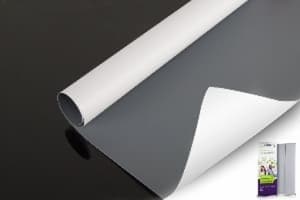
UNISIGN SDB280 is a 280gsm woven polyester backlit fabric for premium illuminated display applications where fabric body, handling and finished appearance are important. It supports direct and paper-transfer dye sublimation, comes in widths up to 3.2m / 126 inches, and is supplied in standard 50m / 55-yard rolls. Typical uses include lightboxes, backlit displays, backdrops and pop-up systems.
Compared with lighter backlit textiles, a 280gsm construction has more material weight and may be preferred for large-format SEG lightboxes, premium retail graphics and exhibition systems. However, higher GSM does not automatically mean better backlit performance. Approve light diffusion, print density, shrinkage, surface, frame compatibility and the illuminated result.
280gsm Backlit Fabric at a Glance

SDB280 / Starlight
- Weight: 280gsm / 8.2oz
- Construction: Woven polyester backlit fabric
- Finish: Matte
- Printing: Direct or paper-transfer dye sublimation; latex also listed
- Maximum width: 3.2m / 126 inches
- Standard roll: 50m / 55 yards
- Listed shrinkage: ≤2%
- Applications: Backlit displays, lightboxes, backdrops and pop-ups
Best starting point: Professional illuminated-display projects that value a more substantial woven construction and premium installed appearance.
SDB280 Technical Specifications
The following values summarize UNISIGN’s current SDB280 product information. Confirm the current specification, tolerance and documents for the exact order.
| Specification | UNISIGN SDB280 | What to Confirm Before Ordering |
|---|---|---|
| Product Code | SDB280 | Quotation, sample and production order use the same code |
| Product Name | Starlight Backlit Fabric | Current technical data sheet for SDB280 |
| Product Type | Backlit / lightbox textile | Required light-transmission and diffusion performance |
| Weight | 280gsm / 8.2oz | Production tolerance for the ordered roll |
| Construction | Woven | Surface, body, stretch and frame behavior |
| Surface | Matte | Appearance with ambient light and illumination |
| Printing | Direct / paper-transfer dye sublimation / latex | Your printer, ink, paper, profile and heat workflow |
| Maximum Width | 3.2m / 126 inches | Available stock width and usable printable width |
| Standard Roll Length | 50m / 55 yards | Usable length, packaging and roll tolerance |
| Listed Shrinkage | ≤2% | Temperature, time, machine direction and cross direction |
| Listed FR Options | B1 / NFPA 701 / AS 1530 / JIS L 1091 | Exact product, report, project, destination and current validity |
| Applications | Backlit displays, lightboxes, backdrops, pop-ups | Final system, lighting, dimensions and installation |
What Is 280gsm Dye Sublimation Backlit Fabric?
It is a heavier polyester textile designed to receive dye-sublimation graphics and transmit light in an illuminated display system. The nominal weight is 280 grams per square meter. Compared with a lightweight backlit textile, the construction generally has more body and a more substantial hand.
That does not mean every 280gsm fabric produces a better lightbox. GSM does not directly tell a buyer how evenly the fabric diffuses light, how much light passes through, how dense the print looks when illuminated or how accurately the finished graphic fits a frame.
Evaluate these factors together:
- Light diffusion and transmission
- Surface uniformity and matte appearance
- Color and black density with the light on
- Fabric construction and wrinkle behavior
- Shrinkage after the complete heat process
- Width, finishing and frame compatibility
Why Choose 280gsm Backlit Fabric?
The buying logic should not be “choose the heaviest fabric.” A 280gsm backlit textile is worth testing when the project needs a more substantial construction, controlled handling and a premium finished appearance.
| Project Requirement | Why a 280gsm Construction May Be Considered | What Still Requires Testing |
|---|---|---|
| More Fabric Body | A heavier woven textile can feel more substantial during handling | Feeding, tension, sewing and frame compatibility |
| Premium Installed Appearance | Suitable positioning for high-specification display systems | Flatness, wrinkles, texture and illuminated appearance |
| Large-Format Graphics | 3.2m maximum width can support larger seamless panels | Usable width, heat behavior and final dimensions |
| Repeat Commercial Production | Defined woven construction and roll format support planned workflows | Batch consistency, print profile and quality tolerance |
| Professional Display Systems | Can suit backlit displays, backdrops and pop-ups | The exact frame, lighting, finishing and venue requirements |
Installed appearance matters more than hand feel. A fabric can feel substantial on the roll but still fail if it shows hotspots, wrinkles, weak color density or incorrect finished dimensions in the lightbox.
280gsm vs 180gsm Backlit Fabric
Both weights can be used for dye-sublimation lightbox graphics, but they serve different selection priorities. Use the comparison below as a starting point, then approve representative samples.
| Factor | 180gsm Backlit Fabric | 280gsm Backlit Fabric |
|---|---|---|
| UNISIGN Example | SDB180 Selene | SDB280 Starlight |
| Selection Position | Medium-light commercial SEG lightbox option | More substantial high-specification woven option |
| Weight | 180gsm / 5.3oz | 280gsm / 8.2oz |
| Construction | Woven | Woven, matte finish |
| Maximum Width | 3.2m / 126 inches | 3.2m / 126 inches |
| Standard Roll | 100m / 110 yards | 50m / 55 yards |
| Typical Decision | Cost balance, broad commercial use and lighter handling | More body, premium positioning and professional installation |
| Not Guaranteed by GSM | Light uniformity, transmission, color density, shrinkage, wrinkle control or frame fit | |
Choose 180gsm when a medium-light commercial backlit textile matches the printer, frame and project economics. Choose 280gsm when the project values a heavier woven construction and the installed sample proves that it performs better for the specific lightbox.
150gsm vs 180gsm vs 190gsm vs 250gsm vs 280gsm Backlit Fabric
UNISIGN provides several backlit constructions. They should not be ranked only by weight or described as a simple good-better-best series.
| GSM | UNISIGN Example | General Positioning | Main Question to Compare |
|---|---|---|---|
| 150gsm | SDB150 | Lighter backlit textile | Does a lighter construction fit the frame and production workflow? |
| 180gsm | SDB180 | Medium-light woven SEG option | Does it provide the required commercial balance? |
| 190gsm | SDB190 | Alternative backlit construction | Does its surface and heat behavior better suit the process? |
| 250gsm | SDB250 | Heavier backlit option | Does its specific structure fit the display requirement? |
| 270gsm | SDB270KN | Knitted backlit construction | Would knitted stretch and handling better suit the system? |
| 280gsm | SDB280 | Heavier woven, matte backlit option | Does it deliver the desired premium installed appearance? |
The correct order of comparison is usually application → construction → illuminated performance → printing → shrinkage → frame fit → GSM → price.
What Applications Use 280gsm Backlit Fabric?
| Application | Why SDB280 May Be Considered | What to Approve |
|---|---|---|
| Premium Retail Lightboxes | More substantial woven construction and matte surface | Brand colors, black density and close-view surface |
| Large SEG Lightboxes | Width up to 3.2m may reduce seams | Heat shrinkage, finishing allowance and frame fit |
| Exhibition Systems | Professional appearance and listed FR options | Venue documentation, wrinkles and transport recovery |
| Shopping Mall Displays | Suitable for high-visibility illuminated graphics | Lightbox depth, hotspots, installation and maintenance |
| Airport Displays | Can be evaluated for long-format professional systems | Project specification, fire documents and viewing conditions |
| Backdrops and Pop-Ups | Listed SDB280 applications | Whether the project needs backlit behavior or a dedicated display textile |
| Permanent Installations | More body may suit premium long-term display positioning | Long-term tension, color, cleaning and replacement plan |


How Does Backlit Fabric Perform When Illuminated?
A high-specification backlit fabric must be evaluated with the light on. Illumination can reveal problems that are difficult to see on an unprinted roll or under room lighting.
Light OFF
- Check surface, texture and matte appearance.
- Inspect wrinkles, creases and finishing marks.
- Evaluate normal reflected color and fine detail.
- Measure the finished graphic before installation.
Light ON
- Check hotspots, dark areas and light uniformity.
- Confirm black remains dense rather than grey.
- Evaluate saturated colors and smooth gradients.
- Inspect pinholes, texture visibility and final tension.
Keep the LED spacing, brightness, lightbox depth, printed test image and viewing distance constant when comparing fabrics. Otherwise, a lighting change may be mistaken for a textile difference.
How Should You Test 280gsm Backlit Fabric?
Before Printing
- Verify product code, GSM, width and roll identification.
- Inspect white point, matte surface and visible defects.
- Check feeding, tension and compatibility with the printer.
During and After Sublimation
- Print CMYK solids, deep black, gradients, fine text and saturated colors.
- Record temperature, dwell time, pressure, profile and ink settings.
- Measure machine- and cross-direction shrinkage after the complete heat cycle.
- Inspect wrinkles, curling, surface variation and color density.
Inside the Intended Lightbox
- Check light uniformity, hotspots and dark bands.
- Evaluate black density, gradients and graphic sharpness.
- Finish the sample with the intended edge system and install it.
- Approve flatness, tension, seams and final dimensions.
| Test | Value to Record |
|---|---|
| Actual GSM | _____ gsm |
| Temperature / Time | _____ °C / _____ seconds |
| MD / CD Shrinkage | _____ % / _____ % |
| Printer / Ink / Profile | _____ |
| Lightbox Depth / LED Spacing | _____ |
| Light Uniformity | Pass / Adjust |
| Color Density | Pass / Adjust profile |
| Final Frame Fit | Pass / Adjust cutting allowance |
Can SDB280 Be Used for Direct and Transfer Sublimation?
Yes. UNISIGN currently lists SDB280 for direct dye sublimation and paper-transfer dye sublimation. Latex is also listed on the product information. Each method requires its own approval because ink placement, heat history, feeding and profiling differ.
| Printing Method | Current SDB280 Listing | Primary Controls |
|---|---|---|
| Direct Dye Sublimation | Supported | Feeding, ink behavior, fixation, density and surface uniformity |
| Paper-Transfer Dye Sublimation | Supported | Paper stability, transfer pressure, heat, ghosting and shrinkage |
| Latex | Listed | Confirm current profile, curing and finished backlit appearance |
The final result depends on printer + ink + profile + paper where used + fabric + temperature + time + pressure + finishing + lightbox.
Is 3.2m / 126-Inch Wide 280gsm Backlit Fabric Available?
Yes. UNISIGN currently lists SDB280 in widths up to 3.2m / 126 inches. The standard roll length is 50m / 55 yards.
A wider roll can support larger seamless graphics, reduce sewing and improve production efficiency. Before ordering, confirm the available stock width, guaranteed usable printable width, printer capacity, edge allowance and packed-roll handling.
What FR Options Are Listed for SDB280?
The current SDB280 information lists FR options including B1, NFPA 701, AS 1530 and JIS L 1091. This does not mean every roll is automatically certified to every listed standard.
For a retail, exhibition, airport or public-space project, confirm the exact product covered, report number, testing organization, current applicability, destination market and venue requirement before placing the order.
How Should Buyers Compare High-Specification Backlit Fabrics?
| Priority | Question to Ask | Evidence to Request |
|---|---|---|
| Application Fit | Which fabric suits the exact lightbox and installation? | Application recommendation and installed sample |
| Construction | Woven or knitted? What surface and stretch behavior? | Technical specification and physical sample |
| Illuminated Performance | Are diffusion, brightness and density acceptable? | Controlled lightbox test |
| Dimensional Stability | What happens after the planned heat cycle? | MD/CD shrinkage under defined conditions |
| Printing | Direct, transfer or another workflow? | Representative print test and settings |
| Width | Can the graphic be produced without unnecessary seams? | Available and usable roll width |
| Consistency | Will repeat rolls behave similarly? | Batch identification and QC records |
| FR | Which standard does the exact project require? | Product-specific current report |
| Supply | Can the supplier support repeat commercial orders? | MOQ, lead time, capacity and sample support |
Use the same test image, lightbox, equipment and acceptance criteria for every sample. A heavier fabric should earn its place by improving the project result, not by GSM alone.
280gsm Backlit Fabric from UNISIGN
SDB280 Starlight Backlit Fabric is a 280gsm woven, matte textile listed for direct and paper-transfer dye sublimation, latex printing, widths up to 3.2m / 126 inches and 50m / 55-yard rolls. Its listed applications include backlit displays, lightboxes, backdrops and pop-ups.
Compare it with the broader UNISIGN light box fabric range. For supplier-level evaluation, review the dye sublimation fabric manufacturer checklist.
Before Ordering 280gsm Backlit Fabric
| Requirement | Buyer Should Confirm |
|---|---|
| Application | SEG / LED lightbox / illuminated display / backdrop / pop-up |
| Product | SDB280 Starlight Backlit Fabric |
| Weight and Construction | 280gsm woven, matte finish |
| Printing | Direct / paper-transfer dye sublimation / latex |
| Required Width | _____ m |
| Roll Length | 50m standard or requested length |
| Shrinkage Requirement | _____ % under defined conditions |
| Light Uniformity | Approved in the intended lightbox |
| Print Density | Approved with the light on |
| FR Standard | _____ |
| Destination Market | _____ |
| Quantity | _____ m² / rolls |
Frequently Asked Questions
What is 280gsm dye sublimation backlit fabric?
It is a heavier polyester textile designed for dye-sublimation printing and illuminated display systems. UNISIGN SDB280 is a 280gsm woven, matte backlit fabric available in widths up to 3.2m.
Is higher GSM better for backlit fabric?
Not automatically. Higher GSM gives the textile more weight and may add body, but light diffusion, transmission, print density, shrinkage, construction and frame fit determine the final result.
What is the difference between 180gsm and 280gsm backlit fabric?
A 180gsm option is lighter and can suit broad commercial SEG applications. A 280gsm construction is more substantial and may suit premium display systems. Test both in the intended lightbox before deciding.
What applications use 280gsm backlit fabric?
Typical projects include premium retail lightboxes, large SEG displays, exhibition systems, shopping-mall graphics, backdrops and pop-ups. Final suitability depends on the display and approval test.
Can 280gsm fabric be used for SEG lightboxes?
It can be evaluated for SEG systems. Finish a representative sample with the intended silicone edge, then approve shrinkage, tension, light uniformity and frame fit.
How does GSM affect lightbox fabric performance?
GSM affects fabric weight and can influence handling and body. It does not directly specify light diffusion, transmission, color density or dimensional stability.
How should I test backlit fabric before bulk ordering?
Print representative colors and gradients, measure shrinkage, finish the sample and install it in the intended illuminated frame. Evaluate hotspots, black density, wrinkles, uniformity and dimensions.
What should I check when buying high-specification backlit fabric?
Check application fit, construction, illuminated performance, shrinkage, printing compatibility, width, consistency, FR documentation, sample support and repeat-order capacity.
Request a 280gsm Backlit Fabric Sample
Send UNISIGN your lightbox type + printer + printing method + required width + FR standard + quantity. Test SDB280 with your artwork, heat process, finishing and illuminated display before a bulk order.
![Top 10 Vinyl Tarp Manufacturers in the World [2026 Guide]](https://unisignflex.com/wp-content/uploads/2026/04/pvc-tarpaulin-product-line.jpg)