Fabric terms · Display material selection
Three Terms. Three Different Buying Questions.
Blockout describes a light-blocking need. Blackback describes a black reverse side. Blackout is an overlapping trade term, often used for curtains and room darkening.
This guide covers printed signs, SEG displays and backdrops. They are not three fixed quality grades. A black-back fabric can be a blockout product, but not every blockout fabric has a black back. Ask what the fabric must do and which faces need printing.
Blockout vs Blackout vs Blackback: Quick Comparison
| Term | Main meaning | Ask the supplier |
|---|---|---|
| Blockout fabric | A fabric selected to limit light or background show-through. | What light-blocking result does this exact model provide, and how is it tested? |
| Blackout fabric | Overlapping market wording; often found in curtains, blinds and room-darkening products. | Is this for printed signs or window coverings? What performance is specified? |
| Blackback / black-back fabric | A fabric with a black reverse side. | Which face is printable? Does its light blocking meet the job? |
The name is not a test result. These words alone do not establish an opacity percentage, fire rating, service life or print method. For purchasing, compare the model code and technical data sheet (TDS), not just the listing title.
In sign-making, suppliers may use “blockout” and “blackout” for similar jobs. In a curtain brief, “blackout” may carry different expectations about room darkness. State the actual application so both sides are discussing the same product.
A Black Back Is Not the Same as a Black Inner Layer
A black interlayer means dark material inside the structure. A black back is exposed on the reverse. That affects the visible back and the printing choice. TVF explains the difference between backing and blockout performance.
Concept diagrams only. Not to scale and not cross-sections of a specific UNISIGN model. Actual construction can differ.
1. Black Reverse
Useful when one main graphic faces the viewer and the reverse can be black. Do not assume the black side accepts a second bright graphic.
2. Dark Material Inside
One route used for blockout products. Two light-looking faces are not proof of two-side printing: that must be stated in the model specification.
For example, UNISIGN lists DSP-BLK-W as white-back blockout fabric. Its white reverse does not, by itself, confirm that both sides are approved for printing. Fisher also lists a white-backed blockout product, showing why backing colour alone is not the buying rule.
Two Real UNISIGN Product Examples
These models show two buying paths—not three separate grades called blockout, blackout and blackback. Both list direct and paper-transfer dye sublimation.

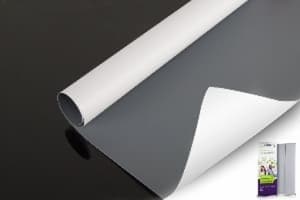
DSP-BLK-01 / Nox
- Weight: 260gsm
- Construction: warp knitted; white/black
- Print path: one main white graphic face
- Listed maximum width: 5.0m
- Standard roll: 100m
- Typical use: backdrops and display systems

DSP-BLK-D / Ares
- Weight: 250gsm
- Listed feature: black inside
- Print path: double-side printing specified
- Listed maximum width: 3.2m
- Standard roll: 100m
- Typical use: two-sided display graphics
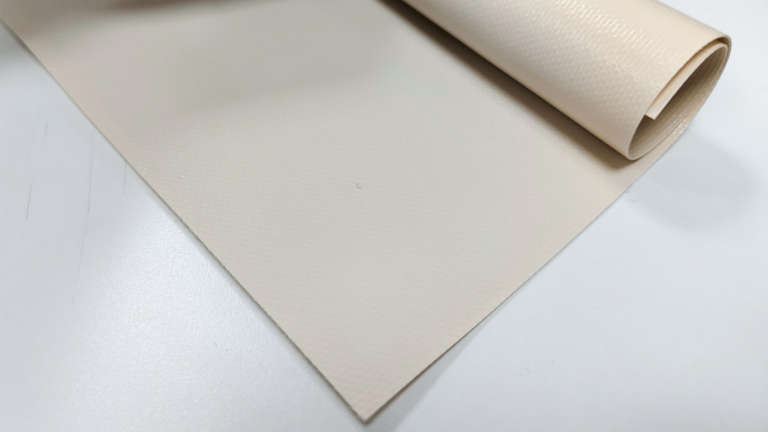
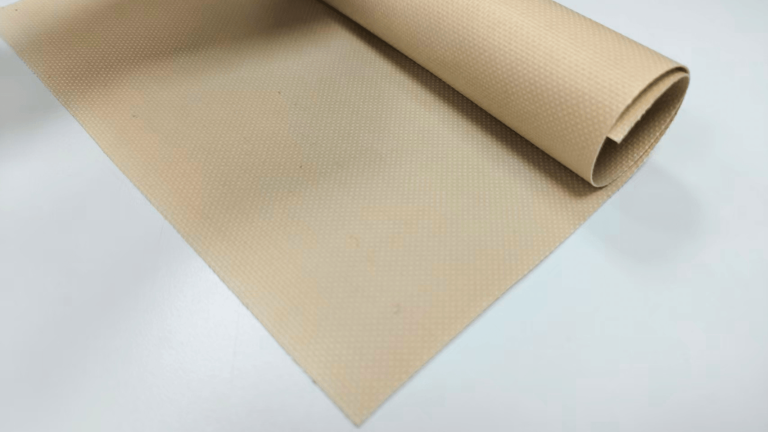
Specifications above follow the individual model pages. Confirm current width availability and the TDS for your order. Photographs identify the products; they do not measure opacity or reveal the complete internal construction.
For detailed buying guidance, read 260gsm black-back fabric and 250gsm double-sided blockout fabric. For other back colours and weights, compare the full blockout fabric roll range.
Printed Signs and Blackout Curtains Need Different Checks
| Buying point | Printed display or backdrop | Curtain or window covering |
|---|---|---|
| Main purpose | Show a clear graphic and reduce show-through. | Control light entering a room. |
| Surface | Print quality, glare, colour and finished flatness. | Drape, handle, lining and appearance. |
| Finished system | Frame, seams, tension and printed faces. | Seams, window edges, tracks and light gaps. |
| Documents | Print compatibility and project-specific test reports. | Window-covering performance, care and required safety documents. |
A fabric that blocks light in a sample is not automatically a complete blackout curtain system. Light can enter around edges or through an unsuitable installation. Likewise, a curtain fabric is not automatically approved for dye sublimation printing.
Choose the Fabric by the Job
| Your application | Start with | Confirm before ordering |
|---|---|---|
| One-sided exhibition backdrop | Black-back or another suitable blockout fabric. | Front print quality, coverage and acceptable rear appearance. |
| Two-sided hanging sign | A model explicitly approved for two-side printing. | Both print faces, show-through and the approved two-side printing process. |
| Frontlit SEG graphic | Blockout fabric with suitable stretch and recovery. | Shrinkage, sewing allowance and installed frame fit. |
| Visible rear of a display | The required backing colour or approved second print face. | How the back looks under the actual lighting. |
| Illuminated lightbox | Backlit fabric, not blockout. | Light diffusion, colour density and lightbox uniformity. |
| Room-darkening curtain | A fabric and system specified for that use. | Light control, drape, care and installation details. |

Start With One Simple Question
Should light pass through the graphic?
- No: compare the required blockout performance.
- Yes: choose a light-diffusing backlit material.
- Two graphics: add a separate check for two printable faces.
This is more useful than choosing a material only because its name contains “black.”
Why Blockout Fabric Is Not Backlit Fabric
The arrows show intended functions, not measured transmission values.
A lightbox needs the light source to work through the print. A blockout fabric is not the illuminated graphic face. A separate blockout backing or liner may serve another role in the assembly. For this application, see UNISIGN lightbox fabrics or the 280gsm backlit fabric guide.
7 Checks Before You Buy
- Use: signage, backdrop, lightbox or curtain?
- Light: what must be hidden behind the fabric?
- Faces: one graphic, two graphics or a visible plain back?
- Print: exact printer, ink and transfer or direct process?
- Size: roll width, heat shrinkage and finishing allowance?
- Documents: current TDS and applicable model-specific reports?
- Order: quantity, packing, lead time and destination?
Test the Finished Graphic, Not Only the White Swatch
Print the sample with your normal ink and settings. Check pale areas and solid dark areas with the intended light behind it. If there is a frame or structure behind the fabric, include it in the test.
- For two-side printing, print both faces and follow the approved process.
- After heat, measure length and width, then check the finished fit.
- For repeated orders, keep the model, batch, sample and settings together.
If your project requires a numerical opacity or light-transmission result, agree on the method, conditions and acceptance limit. A phone photo or the word “blackout” is not a substitute for that report.
Common Questions
Are blockout and blackout fabric the same?
They overlap in trade use, but the name alone is not enough. Ask whether the product is for printable signage or window coverings, and confirm the stated light-blocking performance.
Does blackback mean 100% light blocking?
No. It describes the black reverse. Check the exact model and the light-blocking result under the conditions needed for your project.
Does all blockout fabric have a black inner layer?
No. That is one construction route. Blockout describes the function; the materials, layers and backing colour can differ.
Can I print both sides of black-back fabric?
Do not assume so. A black reverse is not a second white print face. Choose a model that explicitly lists two-side printing when you need two independent graphics.
Can white-back fabric be printed on both sides?
Only when its specification approves both faces. White appearance alone does not establish the surface treatment, colour result or printing compatibility.
Which fabric should I use for a lightbox?
Choose a backlit fabric designed to transmit and spread light. Test the print with the actual lightbox switched on; blockout and backlit serve opposite light-handling needs.
What should I send to get a sample recommendation?
Send the application, number of printed faces, printer and ink, required width, quantity and destination. Include a photo or drawing of the display if possible.
Choose the Right Blockout Fabric for Your Display
Tell us what must stay hidden and what viewers should see:
- Application and display photo
- One or two printed faces
- Printer, ink and print process
- Required width and quantity
- Light-blocking and FR needs
- Destination and target delivery
Sources and Product References
- TVF: What Is Black Back Fabric? — backing construction and blockout function.
- Fisher Textiles: GF 8819 DS Nirvana — a named example with inward-facing black backs and two approved print faces.
- Fisher Textiles: DD 7118 White-Out — a white-backed blockout example.
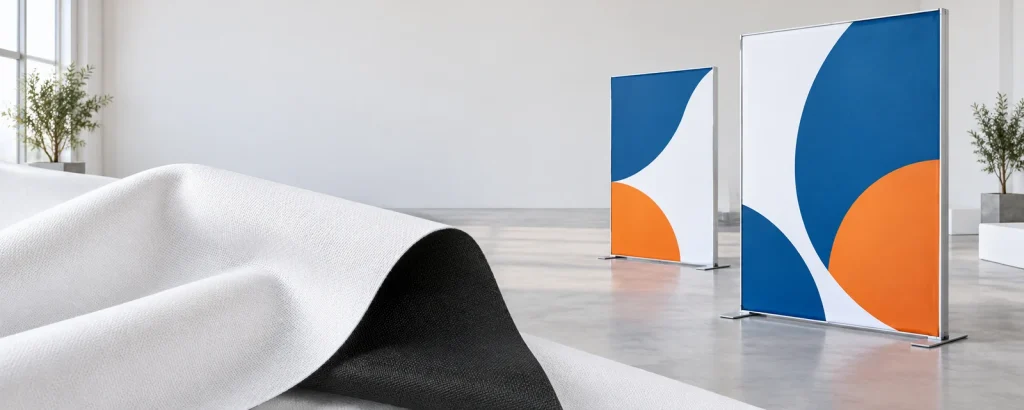
Header: illustrative display application, AI-generated. Product cards show UNISIGN samples. Diagrams are conceptual, not measured model cross-sections.
![Top 10 Vinyl Tarp Manufacturers in the World [2026 Guide]](https://unisignflex.com/wp-content/uploads/2026/04/pvc-tarpaulin-product-line.jpg)