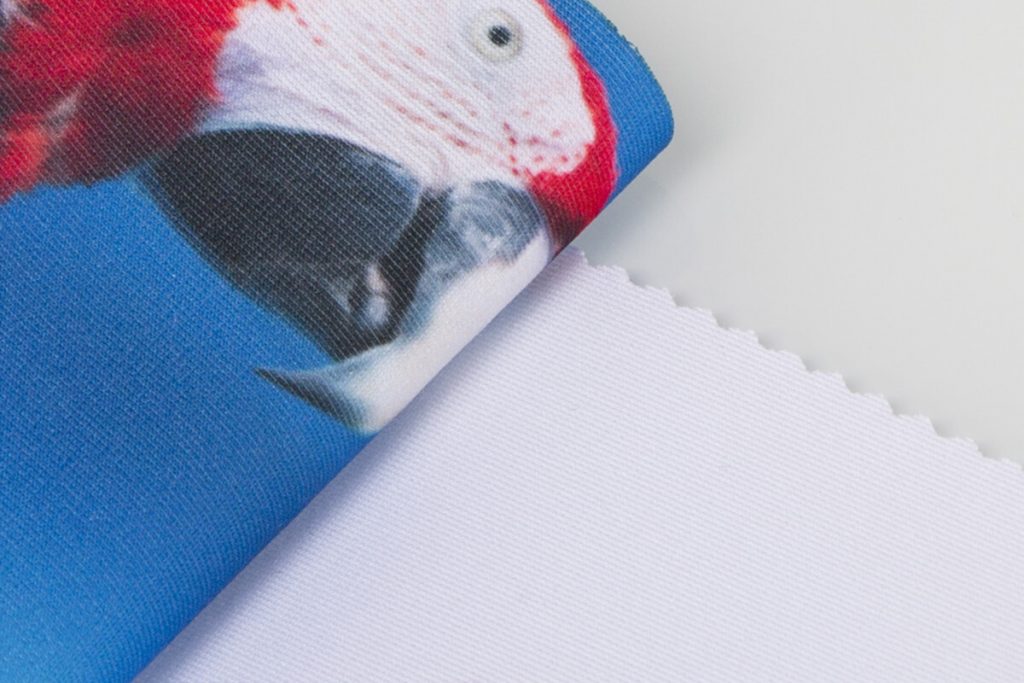
UNISIGN DSP08-T is a 250gsm power-stretch polyester fabric for dye-sublimation tension displays, geometric structures and compatible frame systems. Its spandex-containing construction provides two-direction stretch, helping the printed textile conform to irregular or tensioned display shapes. It supports direct and paper-transfer dye sublimation, comes in widths up to 3.2m / 126 inches, and is supplied in standard 100m / 110-yard rolls.
For tension and SEG projects, do not select fabric by GSM alone. Approve the combination of stretch direction, recovery, heat shrinkage, print distortion, edge finishing and final frame fit before bulk production.
250gsm Stretch Display Fabric at a Glance

DSP08-T / Venus
- Weight: 250gsm / 7.4oz
- Feature: Power stretch
- Stretch: Two-direction stretch with spandex
- Printing: Direct or paper-transfer dye sublimation
- Maximum width: 3.2m / 126 inches
- Standard roll: 100m / 110 yards
- Listed shrinkage: ≤3%
- Listed FR: No
- Applications: Geometric displays, trade shows and grand-format graphics
Selection priority: Use it where controlled two-direction stretch helps the graphic fit a tensioned or irregular frame—not simply because the fabric is 250gsm.
DSP08-T Technical Specifications
The following values summarize UNISIGN’s current DSP08-T product information. Confirm the current specification, tolerance and exact production sample before ordering.
| Specification | UNISIGN DSP08-T | What the Buyer Should Confirm |
|---|---|---|
| Product Code | DSP08-T | The quotation, sample and production order use the same code |
| Product Name | Venus Power Stretch Fabric | Current technical data sheet and sample label |
| Product Type | Stretch display / tension fabric | The exact frame and finishing system |
| Weight | 250gsm / 7.4oz | Production tolerance for the ordered roll |
| Construction Feature | Power stretch with spandex | Fabric structure and spandex content where required |
| Stretch Direction | Two-direction | Machine- and cross-direction elongation and recovery |
| Printing | Direct / paper-transfer dye sublimation | Printer, ink, paper, profile and heat workflow |
| Maximum Width | 3.2m / 126 inches | Available stock width and usable printable width |
| Standard Roll Length | 100m / 110 yards | Usable length, packaging and roll tolerance |
| Listed Shrinkage | ≤3% | Temperature, time, machine direction and cross direction |
| Listed FR | No | Select another verified product if the venue requires FR |
| Applications | Geometric, trade-show and grand-format displays | Final tension, print distortion, seams and installed shape |
What Is 250gsm Stretch Display Fabric?
It is a polyester display textile with a nominal mass of 250 grams per square meter and an elastic construction designed to stretch in two directions. DSP08-T includes spandex, allowing the material to conform to tensioned frames and irregular display shapes more readily than a conventional low-stretch display fabric.
“250gsm” describes fabric weight. It does not tell the buyer how far the fabric stretches, how well it recovers, how much the printed artwork distorts or whether the finished panel fits a specific SEG channel or tension frame.
For a meaningful specification, evaluate:
- Machine-direction and cross-direction stretch
- Elastic recovery after the load is removed
- Permanent deformation after repeated installation
- Heat shrinkage during sublimation
- Print distortion under final tension
- Edge finishing and frame compatibility
Why Does Two-Direction Stretch Matter?
A display graphic may need to stretch both horizontally and vertically to fit a frame, wrap a curved structure or maintain a smooth surface. A one-direction stretch fabric can accommodate movement primarily along one axis, while a two-direction stretch construction provides more flexibility across both axes.
Conceptual stretch behavior
← controlled stretch →
↑ controlled stretch ↓
The diagram explains two-direction movement; it is not a measured elongation value. Request machine- and cross-direction test data for DSP08-T.
More stretch is not always better. Excessive or uneven stretch can distort logos, circles, text and alignment. The objective is controlled stretch plus reliable recovery.
Stretch, Recovery and Shrinkage Are Different
| Property | What It Means | Why It Matters |
|---|---|---|
| Stretch / Elongation | How far the fabric extends under a defined load | Determines whether the graphic can reach and tension in the frame |
| Recovery | How closely the fabric returns to its original dimensions | Affects reuse, wrinkles and permanent deformation |
| Heat Shrinkage | Dimensional change caused by the sublimation process | Changes the cutting size before the graphic reaches the frame |
| Installed Tension | Force applied by the final frame or geometry | Controls flatness, artwork distortion and edge stress |
A fabric can have strong stretch but weak recovery. It can also stretch well after printing yet shrink during heat fixation. Record each property separately instead of using “elastic” as the only specification.
Is 250gsm Stretch Fabric Suitable for Tension and SEG Displays?
DSP08-T is designed for power-stretch display applications and is a strong candidate for tension structures, geometric systems and compatible frame graphics. For an SEG project, suitability depends on the silicone edge, channel dimensions, cutting allowance, stretch behavior and required finished tension.
| Display System | Suitability | What to Test |
|---|---|---|
| Geometric Tension Display | Core DSP08-T application | Multi-axis stretch, seams and image distortion |
| Pillowcase Frame | Suitable for evaluation | Compression fit, zipper/seam strength and corners |
| SEG Frame | Compatible systems should be sample tested | Silicone size, cut dimensions, channel fit and surface tension |
| Trade-Show Structure | Listed application direction | Transport, repeated installation and venue requirements |
| Grand-Format Display | Listed application direction | 3.2m width, seams, sagging and handling |
| Flat Non-Tension Backdrop | Possible, but stretch may not be required | A lower-stretch display fabric may be simpler |
| Backlit Lightbox | Not the main DSP08-T positioning | Use a dedicated backlit fabric when light transmission is required |
| Blockout Display | No | Use a dedicated blockout construction when opacity is required |


250gsm Stretch Fabric vs 230gsm Display Fabric
The correct comparison is not simply 250gsm versus 230gsm. The main difference is the construction and required stretch behavior.
| Factor | DSP08-T 250gsm Power Stretch | 230gsm Display Fabric |
|---|---|---|
| Main Priority | Two-direction stretch and irregular/tensioned shapes | Flat or controlled-stretch commercial display graphics |
| Fabric Position | Spandex power-stretch construction | Standard or moderate-stretch construction, depending on model |
| UNISIGN Examples | DSP08-T / Venus | DSP09 / DSP06N |
| Weight | 250gsm | 230gsm |
| Best Starting Point | Geometric, tension, trade-show and grand-format structures | Pop-ups, backdrops, flat frames and standard displays |
| Critical Test | MD/CD stretch, recovery and artwork distortion | Surface, controlled stretch, shrinkage and frame fit |
| Selection Rule | Choose by the finished display system, not by a 20gsm difference | |
How Does It Differ from Backlit and Blockout Fabric?
| Fabric Type | Main Performance Goal | Typical Use |
|---|---|---|
| 250gsm Power-Stretch Display Fabric | Controlled two-direction stretch and shape conformity | Tension, geometric and compatible frame displays |
| Backlit Fabric | Transmit and diffuse light evenly | LED and SEG lightboxes |
| Blockout Fabric | Reduce light and image show-through | Double-sided graphics and opaque displays |
| Standard Display Fabric | Stable printable surface for non-illuminated graphics | Backdrops, pop-ups and flat frames |
Stretch, backlit and blockout are different performance requirements. One fabric should not be treated as the default solution for all three.
How Much Does DSP08-T Stretch?
The current DSP08-T page describes two-direction power stretch but does not publish a numeric elongation and recovery value. Before sizing an SEG or tension graphic, request measurable data for both fabric directions and verify it with the intended load.
| Stretch Test | Value to Record |
|---|---|
| Original marked length | 100 mm or another defined gauge length |
| Machine-direction elongation under defined load | _____ % |
| Cross-direction elongation under defined load | _____ % |
| Recovery after 1 minute | _____ % / permanent set _____ % |
| Recovery after 30 minutes | _____ % / permanent set _____ % |
| Repeated installation cycles | _____ cycles before visible deformation |
Use the measured result to define artwork compensation, sewing allowance and cut size. Do not assume the same percentage in both directions.
How Should You Test 250gsm Stretch Display Fabric?
- Inspect the unprinted roll: Confirm GSM, width, surface, white point and visible defects.
- Measure directional stretch: Record elongation and recovery in both axes under a defined load.
- Print a distortion target: Include circles, squares, a grid, fine text, logos and color blocks.
- Run the full heat cycle: Record printer, ink, paper where used, temperature, time and pressure.
- Measure shrinkage: Check machine and cross directions after sublimation.
- Finish the real edge: Sew the actual silicone, zipper, seam or sleeve system.
- Install the sample: Use the intended frame and required tension.
- Check artwork distortion: Confirm circles stay round, text remains aligned and logos are not stretched unevenly.
- Remove and reinstall: Evaluate recovery and repeat-use behavior.
A hand-stretch test is useful for screening, but it cannot replace a printed, finished and installed sample.
How Should Artwork Be Prepared for Stretch Displays?
- Keep logos and critical text away from highly stretched corners and seams.
- Use a test grid to identify unequal horizontal and vertical distortion.
- Confirm whether the cutting template already includes negative ease or compression.
- Add bleed for sewn edges, silicone channels, zippers and wraparound areas.
- Do not apply a generic distortion percentage without testing the exact fabric and frame.
- Approve the final artwork on the installed structure, not only on the printer table.
Can DSP08-T Be Used for Direct and Transfer Sublimation?
Yes. UNISIGN currently lists DSP08-T for direct dye sublimation and paper-transfer dye sublimation. Each workflow requires its own profile and heat test because ink placement, feeding, fixation and shrinkage can differ.
| Printing Method | DSP08-T | Primary Controls |
|---|---|---|
| Direct Dye Sublimation | Supported | Feeding, web tension, ink behavior, fixation and dimensional change |
| Paper-Transfer Dye Sublimation | Supported | Paper stability, transfer pressure, heat, ghosting and stretch after transfer |
Your final result depends on printer + ink + profile + paper where used + fabric + heat settings + finishing + frame tension.
How Should Shrinkage Be Evaluated?
The current DSP08-T information lists shrinkage of ≤3%. That number should be verified under the buyer’s temperature, dwell time and pressure. Stretch does not cancel shrinkage; both affect the final dimensions.
- Mark a measured square before printing.
- Record the machine direction, cross direction and diagonals.
- Run the planned direct or transfer sublimation cycle.
- Measure again after cooling and conditioning.
- Finish and install the sample.
- Record the final tension and visual fit.
For SEG and geometric displays, the usable cutting allowance should be based on the combined heat-shrinkage and installed-stretch test.
What Does a 3.2m Maximum Width Mean?
DSP08-T is currently listed in widths up to 3.2m / 126 inches, with a standard roll length of 100m / 110 yards. Wide rolls can reduce seams in grand-format graphics and improve production efficiency.
Confirm the stocked width, guaranteed usable printable width, printer capacity, edge allowance and packed-roll handling. Maximum width does not mean every width is always in stock.
Does DSP08-T Have a Flame-Retardant Option?
The current DSP08-T product information lists Available FR: No. Do not specify this model for an exhibition or public-space project that requires flame-retardant documentation unless UNISIGN provides updated, product-specific evidence for the exact order.
If FR is mandatory, state the required standard and destination market first, then ask for another display fabric whose current test documentation covers the intended application.
How Does DSP08-T Compare with Other Display Fabrics?
| Model | Listed Weight | Positioning | Consider It When |
|---|---|---|---|
| DSP08-T | 250gsm | Power stretch / spandex / two-direction stretch | Irregular, geometric or strongly tensioned display shapes are required |
| DSP09 | 230gsm | Stretch display fabric | A popular moderate-stretch display option fits the frame |
| DSP06N | 230gsm | Traditional / economic display fabric | The project needs a standard display surface rather than power stretch |
| DSP05A | 175gsm | Table-cloth fabric | A lighter table or drape application is required |
Use the UNISIGN display fabric range to shortlist models, then test the exact construction in the intended frame.
Should I Choose 250gsm Power-Stretch Fabric?
Choose DSP08-T When
- The structure requires two-direction stretch.
- You are producing geometric or irregular display shapes.
- The project uses direct or transfer dye sublimation.
- You need widths up to 3.2m for grand-format graphics.
- You can approve the printed sample in the final frame.
Consider Another Fabric When
- The display needs only a flat, low-stretch printable surface.
- The project requires blockout or backlit optical performance.
- Current FR documentation is mandatory.
- The frame requires a measured stretch/recovery value not yet verified.
- A lighter construction better matches handling and cost targets.
250gsm Stretch Display Fabric from UNISIGN
DSP08-T Venus Power Stretch Fabric is a 250gsm spandex-containing display textile with two-direction stretch. It is listed for direct and paper-transfer dye sublimation, widths up to 3.2m / 126 inches and standard 100m / 110-yard rolls.
For more background, review the tension display fabric guide and tension fabric display overview. For supplier evaluation, use the dye sublimation fabric manufacturer checklist.
Before Ordering 250gsm Stretch Display Fabric
| Requirement | Buyer Should Confirm |
|---|---|
| Display System | SEG / pillowcase / geometric / trade-show / grand-format frame |
| Product | DSP08-T Venus Power Stretch Fabric |
| Weight | 250gsm and applicable tolerance |
| Stretch Direction | Two-direction |
| MD / CD Elongation | _____ % / _____ % under defined load |
| Recovery / Permanent Set | _____ % / _____ % |
| Printing | Direct or paper-transfer dye sublimation |
| Required Width | _____ m |
| Shrinkage Requirement | _____ % under defined conditions |
| Edge Finishing | Silicone / seam / zipper / sleeve / other |
| FR Requirement | DSP08-T is currently listed as No FR |
| Quantity | _____ m² / rolls |
Frequently Asked Questions
What is 250gsm stretch display fabric?
It is a 250-gram-per-square-meter elastic display textile. UNISIGN DSP08-T contains spandex and provides two-direction power stretch for geometric, trade-show and grand-format display structures.
Is 250gsm stretch fabric suitable for SEG frames?
It can be evaluated for compatible SEG systems, but the silicone edge, channel, cut size, heat shrinkage, stretch and recovery must be tested in the intended frame.
What is two-direction stretch?
It means the fabric can extend along both primary axes. The amount of stretch and recovery may differ between directions, so request measurable MD and CD data.
Is higher stretch always better for tension displays?
No. Excessive or uneven stretch can distort artwork and weaken dimensional control. The goal is sufficient, controlled stretch with reliable recovery.
What is the difference between stretch and shrinkage?
Stretch occurs when a load extends the fabric. Shrinkage is dimensional change caused by heat or processing. Both must be included in the cutting allowance.
Can DSP08-T be used for direct dye sublimation?
Yes. It is currently listed for direct and paper-transfer dye sublimation. Test feeding, profiling, heat behavior and final stretch with the intended workflow.
Does DSP08-T have a flame-retardant option?
The current product information states Available FR: No. Choose another documented product if the project requires a specific flame-retardant standard.
How should I test stretch fabric before a bulk order?
Measure directional stretch and recovery, print a distortion grid, record heat shrinkage, finish the actual edges and install the sample in the intended frame before approval.
Request a 250gsm Stretch Display Fabric Sample
Send UNISIGN your display system + frame dimensions + printer + printing method + required width + finishing method + quantity. Test DSP08-T with the actual artwork and frame before bulk production.
![Top 10 Vinyl Tarp Manufacturers in the World [2026 Guide]](https://unisignflex.com/wp-content/uploads/2026/04/pvc-tarpaulin-product-line.jpg)