Choose 230gsm or 250gsm dye sublimation display fabric by the finished display system—not by weight alone. Start with UNISIGN DSP09 230gsm for standard displays, pop-ups, backdrops and flat or controlled-stretch graphics. Choose DSP08-T 250gsm when the frame needs two-direction power stretch for a tensioned or irregular shape. Choose DSP-BLK-D 250gsm when the job needs opacity and two printable faces.
The 20gsm difference is only 8.7% of 230gsm. Construction, stretch, recovery, shrinkage, opacity and flame-retardant requirements can create a much bigger performance difference.
Quick answer
- Flat display, pop-up or backdrop: start with DSP09 230gsm.
- Geometric or strongly tensioned frame: start with DSP08-T 250gsm power stretch.
- Two visible printed sides or light blocking: start with DSP-BLK-D 250gsm blockout.
- FR document required: do not assume every 250gsm fabric is suitable. Check the exact model and current report.
230gsm vs 250gsm: Comparison at a Glance
This table compares three verified UNISIGN models. It shows why two fabrics with the same 250gsm weight can solve different problems.
| Factor | DSP09 230gsm | DSP08-T 250gsm | DSP-BLK-D 250gsm |
|---|---|---|---|
| Main Position | Stretch display fabric | Power-stretch display fabric | Double-sided blockout fabric |
| Weight | 230gsm / 6.8oz | 250gsm / 7.4oz | 250gsm / 7.4oz |
| Construction / Feature | Warp knitted; slight stretch | Spandex; two-direction power stretch | Black inside; two printable sides |
| Printing | Direct / paper-transfer dye sublimation | Direct / paper-transfer dye sublimation | Direct / paper-transfer dye sublimation |
| Max Width | 3.2m / 126in | 3.2m / 126in | 3.2m / 126in |
| Standard Length | 100m / 110yd | 100m / 110yd | 100m / 110yd |
| Listed Shrinkage | ≤2% | ≤3% | ≤2% |
| Listed FR | B1 / NFPA 701 / AS 1530 / JIS L 1091 options | No | B1 / NFPA 701 / AS 1530 / JIS L 1091 options |
| Best Starting Point | Display, pop-up, backdrop | Geometric, tension, trade-show and grand-format structures | Opaque, two-sided backdrops and display systems |
Data scope: the values above come from the current product information for DSP09, DSP08-T and DSP-BLK-D. Confirm the latest technical data, tolerance and applicable documents for the exact order.
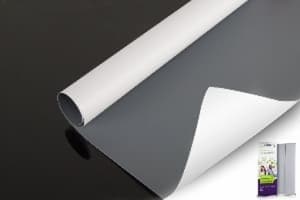
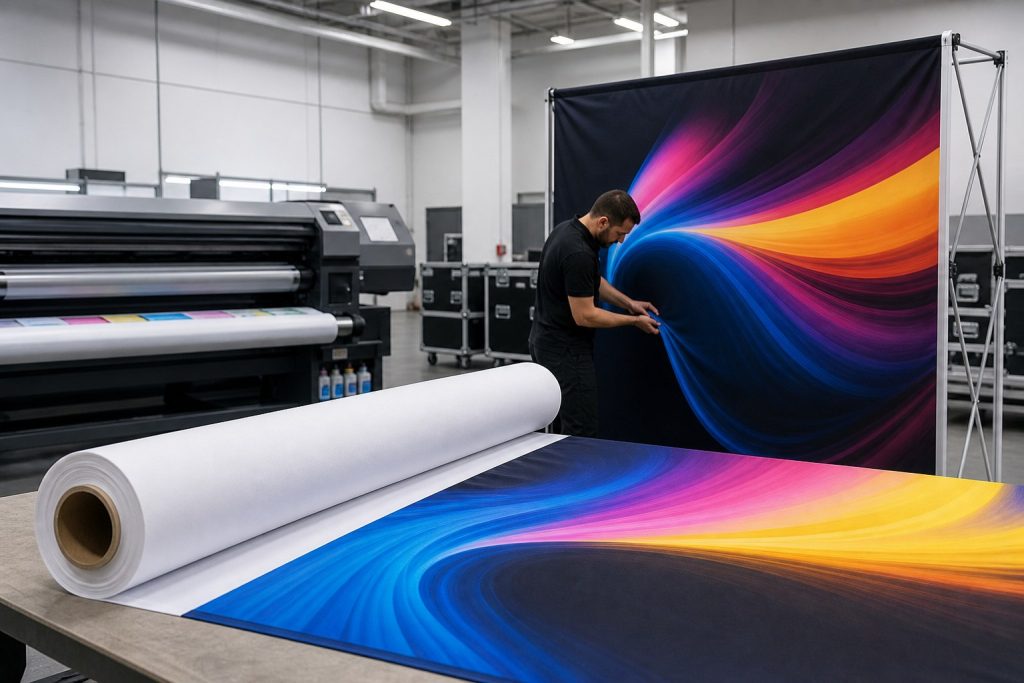
See the Three Products Before You Compare
A short product list with real images helps buyers confirm that they are comparing the right textile type. It is more useful here than a long general catalog.

DSP09 — 230gsm
- Slight stretch
- Warp knitted
- ≤2% listed shrinkage
- FR options listed
Choose for: standard displays, pop-ups and backdrops.

DSP08-T — 250gsm
- Two-direction stretch
- Spandex construction
- ≤3% listed shrinkage
- FR currently listed as No
Choose for: tensioned, geometric or irregular display shapes.

DSP-BLK-D — 250gsm
- Black internal structure
- Two printable sides
- ≤2% listed shrinkage
- FR options listed
Choose for: opaque two-sided backdrops and display graphics.
Does 250gsm Mean Better Than 230gsm?
No. GSM means grams per square meter. It measures fabric mass per area. It does not directly tell you:
- Thickness
- Stretch direction
- Stretch recovery
- Opacity
- Light diffusion
- Heat shrinkage
- Surface smoothness
- Flame-retardant status
- Final frame fit
The nominal weight change is easy to calculate:
(250 − 230) ÷ 230 × 100 = 8.7%
For 100m² of fabric, the theoretical fabric-only mass is 23kg at 230gsm and 25kg at 250gsm—a 2kg difference. Packaging, core and tolerance are not included.
The 8.7% weight difference can matter for handling and transport. However, a change from slight stretch to two-direction power stretch can matter much more for installation.
The Main Difference Is Construction and Stretch
DSP09 and DSP08-T are not the same construction in two weights.
| Question | DSP09 230gsm | DSP08-T 250gsm |
|---|---|---|
| How does it move? | Slight, controlled stretch | Power stretch in two directions |
| What is the main goal? | Stable commercial display surface | Conform to a tensioned or irregular shape |
| What can go wrong? | Loose fit, wrinkles or incorrect finished size | Uneven distortion, weak recovery or excessive tension |
| What should be measured? | Shrinkage, surface, controlled stretch and frame fit | MD/CD elongation, recovery, shrinkage and artwork distortion |
Simple selection diagram
Flat or controlled stretch
← slight movement →
Tensioned shape
↔ two-direction stretch ↕
Opaque two-sided graphic
print | black core | print
This diagram explains product positioning. It is not a measured stretch or opacity test.
Which Fabric Fits Each Display Application?
| Application | Best Starting Point | Why | Critical Test |
|---|---|---|---|
| Flat backdrop | DSP09 230gsm | Standard display surface with slight stretch | Flatness, opacity and finished size |
| Pop-up display | DSP09 230gsm | Listed use for pop-ups and displays | Wrinkles, seams and repeat installation |
| Standard frame graphic | DSP09 230gsm | Controlled stretch may be easier to size | Cut allowance and frame fit |
| Geometric tension structure | DSP08-T 250gsm | Two-direction power stretch | MD/CD stretch, recovery and logo distortion |
| Pillowcase tension frame | DSP08-T 250gsm for evaluation | Power stretch can conform to the frame | Zipper, seam, corner tension and recovery |
| SEG frame | Test DSP09 or DSP08-T against the exact system | Channel and cut size decide the required stretch | Silicone size, shrinkage and installed tension |
| Two-sided freestanding graphic | DSP-BLK-D 250gsm | Black internal structure reduces show-through | Opacity and both printed faces |
| Backlit lightbox | Use a dedicated backlit fabric | Light transmission and diffusion are different requirements | Test inside the real lightbox |
| Outdoor flag | Use a dedicated flag fabric | Low weight, print-through and movement matter | Tear, wind and ink penetration |


How Do Shrinkage and Finished Size Compare?
The current product information lists ≤2% shrinkage for DSP09 and ≤3% for DSP08-T. DSP-BLK-D lists ≤2%. These values are model-specific. They do not mean every 230gsm or 250gsm fabric will behave the same way.
For a 3,000mm marked length, a 2% change equals 60mm and a 3% change equals 90mm. That 30mm difference can affect an SEG edge, zipper, seam or frame fit.
- Mark the original machine and cross directions.
- Record width and length before printing.
- Run the planned direct or transfer heat cycle.
- Cool and condition the sample.
- Measure both directions again.
- Finish the real edge.
- Install the sample in the intended frame.
Do not size a graphic from the listed shrinkage number alone. Use the combined result of heat shrinkage, finishing allowance and installed stretch.
How Do Opacity and Blockout Change the Choice?
A 250gsm fabric is not automatically blockout. DSP08-T and DSP-BLK-D have the same listed weight, but their main functions are different.
- DSP08-T: prioritize stretch and shape conformity.
- DSP-BLK-D: prioritize opacity and two printed faces.
- DSP09: a standard display option with good opacity, but it is not positioned as a double-sided blockout construction.
If the reverse image must not show through, test bright colors, deep black and high-contrast artwork on both sides under the intended lighting. See the detailed 250gsm double-sided blockout fabric guide.
Can Both Weights Use Direct and Transfer Sublimation?
Yes, for the three models compared on this page. DSP09, DSP08-T and DSP-BLK-D are currently listed for direct and paper-transfer dye sublimation.
| Workflow | What to Control |
|---|---|
| Direct Dye Sublimation | Feeding, web tension, ink behavior, fixation, surface and dimensional change |
| Paper-Transfer Dye Sublimation | Paper stability, temperature, dwell time, pressure, ghosting and shrinkage |
The final result depends on printer + ink + profile + paper where used + fabric + heat + finishing + display system. Print the same test image on each candidate fabric before comparing color and detail.
What About Flame-Retardant Requirements?
FR requirements can decide the product before GSM does.
- DSP09 currently lists B1, NFPA 701, AS 1530 and JIS L 1091 options.
- DSP08-T currently lists Available FR: No.
- DSP-BLK-D currently lists B1, NFPA 701, AS 1530 and JIS L 1091 options.
Before ordering for an exhibition or public venue, confirm:
- Exact product model
- Required test standard
- Destination market and venue rule
- Report or certificate number
- Current applicability to the order
Do not use one certificate to claim that every 230gsm or 250gsm fabric is flame retardant.
A 4-Step Decision Rule
- Define the final system. Is it flat, tensioned, backlit or two-sided?
- Define the key property. Do you need controlled stretch, power stretch, opacity, light diffusion or FR?
- Shortlist the exact model. Compare construction, shrinkage, width, printing and documents—not only GSM.
- Print, finish and install the sample. Approve it in the real frame before bulk production.
Fast buying path
Need a standard display? → Test DSP09 230gsm.
Need a strongly tensioned shape? → Test DSP08-T 250gsm.
Need opaque two-sided graphics? → Test DSP-BLK-D 250gsm.
Need even illumination? → Leave this comparison and test a dedicated backlit fabric.
How to Test 230gsm and 250gsm Samples Side by Side
- Label each model: record product code, batch and roll number.
- Check unprinted fabric: measure GSM, width, surface, stretch direction and visible defects.
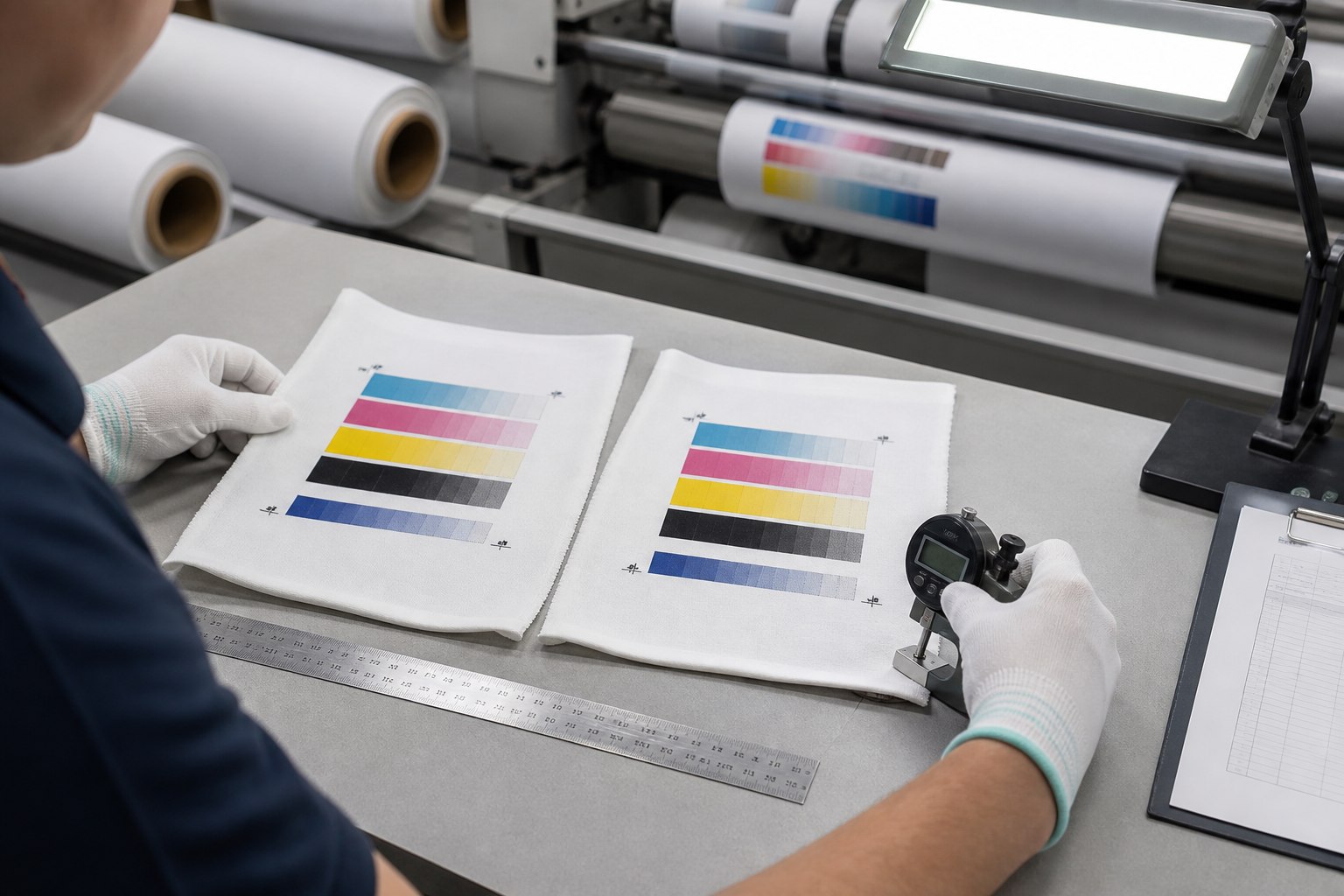
- Use one test file: include CMYK blocks, deep black, gradients, fine text, circles, grids and large solid areas.
- Use the real workflow: print with the intended printer, ink, paper where used and heat settings.
- Measure heat change: record machine- and cross-direction shrinkage.
- Test stretch and recovery: use a defined load and record both directions.
- Finish the real edge: add the silicone, seam, zipper or sleeve used in production.
- Install the sample: check fit, wrinkles, tension, opacity and artwork distortion.
- Repeat installation: check recovery and reuse performance.
- Approve a representative production sample: do not rely on a small hand sample alone.
Buyer Checklist: 230gsm or 250gsm?
| Requirement | Your Project | Why It Matters |
|---|---|---|
| Final application | Flat / tension / SEG / two-sided / other | Sets the main performance target |
| Product model | DSP09 / DSP08-T / DSP-BLK-D | GSM alone is not enough |
| Printing | Direct / paper transfer | Changes feeding and heat controls |
| Required width | _____ m | Must match printer and finished size |
| Stretch direction | Slight / two-direction / measured value | Controls fit and distortion |
| Recovery | _____ % under defined method | Affects reuse and wrinkles |
| Heat shrinkage | MD _____ % / CD _____ % | Changes final cut size |
| Opacity | Standard / blockout / measured target | Controls show-through |
| FR standard | _____ | May rule out a model |
| Finishing | SEG / zipper / seam / sleeve | Must be included in sample approval |
| Quantity | _____ rolls / m² | Supports batch planning |
230gsm and 250gsm Display Fabric from UNISIGN
UNISIGN supplies polyester textiles for commercial soft signage, displays, backdrops and tension systems. The current comparison models are available in widths up to 3.2m / 126 inches and standard 100m / 110-yard rolls.
Use these detailed guides and product pages to continue the selection:
- 230gsm dye sublimation display fabric guide
- 250gsm stretch display fabric guide
- 250gsm double-sided blockout fabric guide
- UNISIGN display fabric range
- Dye sublimation fabric manufacturer checklist

Frequently Asked Questions
What is the main difference between 230gsm and 250gsm display fabric?
The weight difference is 20g/m², but the main practical difference may be construction. UNISIGN DSP09 230gsm has slight stretch, while DSP08-T 250gsm has two-direction power stretch. DSP-BLK-D is also 250gsm but focuses on blockout and two printed sides.
Is 250gsm dye sublimation fabric better than 230gsm?
No. A heavier fabric is not automatically better. Choose by the display system, stretch, recovery, shrinkage, opacity, FR need, printing process and finished fit.
Should I choose 230gsm or 250gsm for a backdrop?
Start with DSP09 230gsm for a standard backdrop. Consider DSP08-T 250gsm if the backdrop is strongly tensioned or has an irregular shape. Choose DSP-BLK-D 250gsm if two-sided opacity is the main requirement.
Which weight is better for a tension display?
Weight alone cannot answer the question. DSP08-T 250gsm is the stronger starting point when two-direction power stretch is required. A flat or controlled-stretch display may be easier with DSP09 230gsm.
Can 230gsm fabric be used for SEG?
It can be tested for a compatible SEG system. Check heat shrinkage, controlled stretch, silicone size, cut allowance and final frame fit.
Can 250gsm power-stretch fabric be used for SEG?
It can be evaluated where the frame needs more stretch, but measure both stretch directions and recovery. Too much or uneven stretch can distort artwork.
Which one has lower shrinkage?
The current product information lists ≤2% for DSP09, ≤3% for DSP08-T and ≤2% for DSP-BLK-D. Test the exact model under your real heat settings before sizing the finished graphic.
Does 250gsm mean blockout?
No. DSP08-T is 250gsm power-stretch fabric and is not positioned as blockout. DSP-BLK-D is a separate 250gsm construction with a black internal layer and two printable sides.
Which model has flame-retardant options?
DSP09 and DSP-BLK-D currently list B1, NFPA 701, AS 1530 and JIS L 1091 options. DSP08-T currently lists Available FR: No. Confirm current model- and order-specific documents.
Can both weights use direct dye sublimation?
Yes, for the models compared here. DSP09, DSP08-T and DSP-BLK-D are listed for direct and paper-transfer dye sublimation. Test each workflow separately.
How much heavier is 250gsm than 230gsm?
250gsm is 8.7% heavier than 230gsm. For 100m², the theoretical fabric-only difference is 2kg.
What sample should I request?
Request representative samples of the exact shortlisted models and batches. Print the same test file, use the real heat cycle, finish the actual edge and install each sample in the intended display system.
Request 230gsm and 250gsm Comparison Samples
Send UNISIGN your application + frame type + printer + direct or transfer workflow + required width + stretch need + opacity need + FR standard + quantity. The team can recommend the right models for side-by-side testing.
![Top 10 Vinyl Tarp Manufacturers in the World [2026 Guide]](https://unisignflex.com/wp-content/uploads/2026/04/pvc-tarpaulin-product-line.jpg)