When choosing a dye sublimation fabric manufacturer, do not compare price and GSM alone.
For commercial printing, soft signage and display production, check these 12 factors:
- Application fit
- Fabric construction and GSM
- Printing compatibility
- Shrinkage and dimensional stability
- Print performance
- Batch consistency
- Testing and certifications
- Project-specific certifications
- Recycled-content credentials
- Production capacity and widths
- Pre-shipment quality control
- Samples and technical support
Before placing a bulk order, ask for technical specifications, test documents and representative samples, then test the fabric with your own printer, ink and heat-setting process.
1. Start With the Application
The first question should not be:
What is your cheapest polyester fabric?
It should be:
What fabric is suitable for my application?
Different applications need different fabric properties.
| Application | What to Check |
|---|---|
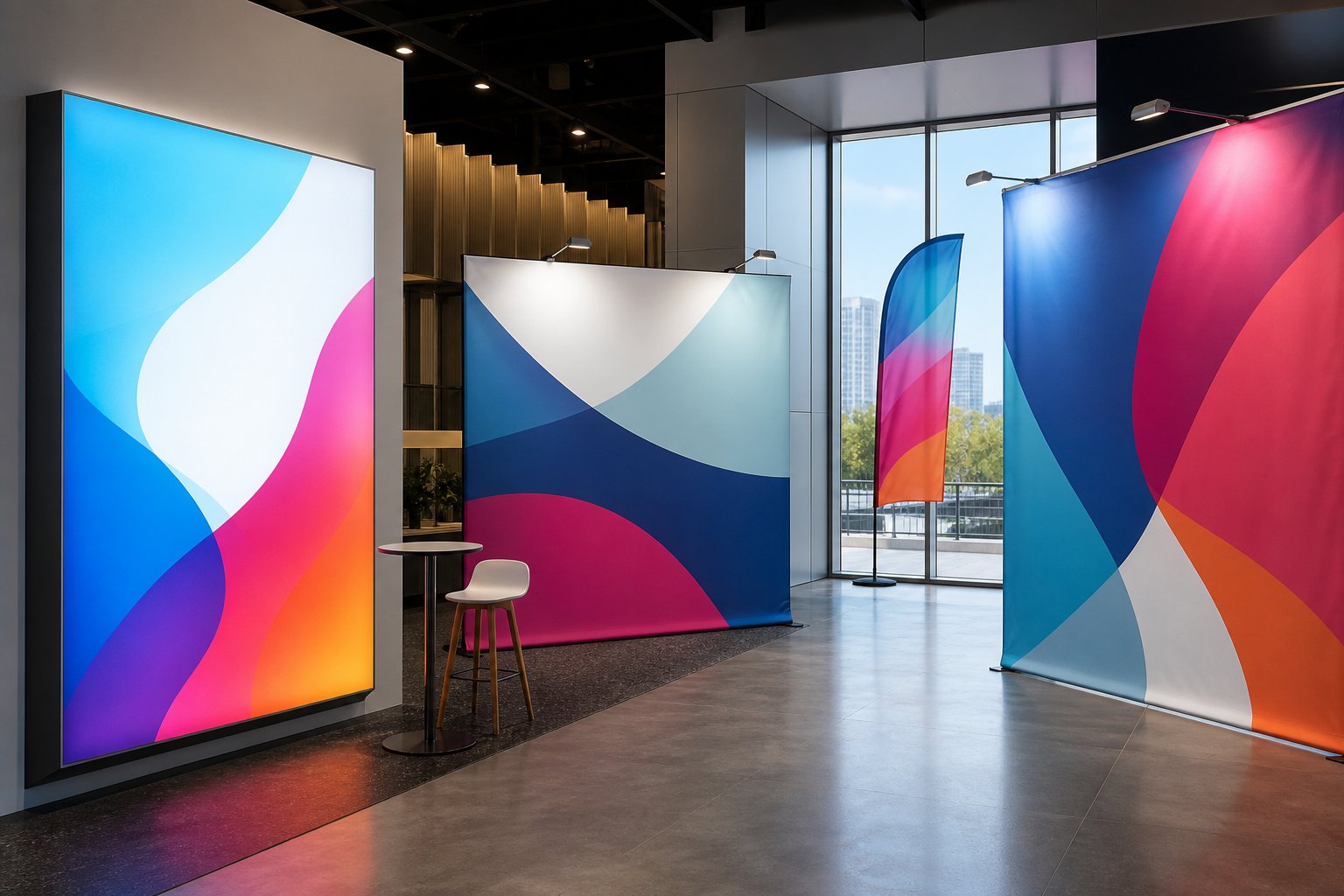
| SEG Displays | Low shrinkage, controlled stretch, smooth surface |
| Backlit Lightboxes | Light diffusion, color density, uniformity |
| Frontlit Displays | Smooth surface, print definition, wrinkle resistance |
| Flags | Lightweight structure, ink penetration, tear resistance |
| Backdrops | Opacity, flatness, wrinkle resistance |
| Blockout Displays | High opacity, dimensional stability |
| Stretch Displays | Elasticity and recovery |
| Trade Show Graphics | FR requirements, easy transport, crease resistance |
A good manufacturer should recommend different fabrics for different applications. One fabric should not be recommended for every project.
UNISIGN currently supplies dye sublimation textile categories including light box fabric, display fabric, backdrop fabric, flag fabric, PVC-free coated fabric and tent fabric.
2. Check More Than GSM
GSM means grams per square meter. It tells you the weight of the fabric. But higher GSM does not automatically mean better dye sublimation fabric. Two 230 GSM fabrics can perform very differently.
| Specification | Why It Matters |
|---|---|
| Material | Determines sublimation compatibility |
| Construction | Affects stability and surface |
| GSM | Indicates fabric weight |
| Width | Must match printer and application |
| Stretch | Important for SEG and tension displays |
| Thickness | Affects handling and installation |
| Shrinkage | Important after heat setting |
| Surface | Affects image quality |
| Opacity | Important for blockout displays |
| FR Option | May be required for exhibitions |
Ask the Supplier
Instead of asking only, “What GSM is this fabric?”, ask:
What are the material, construction, GSM, width, shrinkage and recommended application of this fabric?
That gives you much more useful information.
3. Confirm Printing Compatibility
Not every polyester fabric performs the same way with every printing process. Common processes include:
- Direct dye sublimation
- Transfer dye sublimation
- UV printing
- Latex printing
- Screen printing
For dye sublimation, ask the manufacturer:
| Question | Why Ask? |
|---|---|
| Is it for direct sublimation? | Confirms printing workflow |
| Is it for transfer sublimation? | Confirms heat-transfer suitability |
| Can it support both? | Useful for different production lines |
| What heat setting is recommended? | Helps control shrinkage |
| Has the fabric been print tested? | Reduces production risk |
UNISIGN lists dye-direct, dye-paper and other printing compatibility for parts of its current textile range.
Important
Even when a fabric is listed as compatible with your printing process, test it before a large order. Your final result also depends on:
Printer + Ink + Paper + Fabric + Temperature + Time + Finishing
4. Check Shrinkage and Dimensional Stability
This is especially important for SEG graphics, tension frames, large wall displays, double-sided graphics and repeat production.
For a product-specific example, see our guide to evaluating 250gsm double-sided blockout fabric, including opacity, dimensional stability and two-side print testing.
Polyester fabric is exposed to heat during dye sublimation. If the fabric changes size too much, you may get:
- Incorrect finished dimensions
- Poor SEG fitting
- Loose graphics
- Misaligned panels
- Sewing problems
- Repeat-order inconsistency
Ask for Measurable Data
Do not accept only “low shrinkage.” Ask:
What is the shrinkage under the recommended heat-setting conditions?
For important projects, measure:
| Stage | What to Check |
|---|---|
| Before heat setting | Original width and length |
| After heat setting | Dimensional change |
| After sewing | Finished dimensions |
| After installation | Final fit |
For SEG fabric, this can be more important than GSM.
5. Test Actual Print Performance
A fabric may look good before printing but perform poorly in production. Check at least these 7 items:
- Color density
- Image sharpness
- Solid black performance
- Gradient smoothness
- Surface uniformity
- Dimensional stability
- Finished appearance
Use a Proper Test Image
Your sample print should include CMYK color blocks, fine text, gradients, deep black, bright colors, neutral gray and large solid-color areas. Do not evaluate a fabric only by printing one small logo.
For backlit fabric, also test the printed sample inside a real lightbox. For SEG fabric, install the finished sample inside the intended frame.
6. Check Batch-to-Batch Consistency
A good sample does not prove that every future roll will be the same. This matters especially for commercial printers, distributors, large exhibition projects, retail campaigns and repeat orders.
Ask how the manufacturer controls:
| Item | What Should Stay Consistent? |
|---|---|
| GSM | Within agreed tolerance |
| Width | Stable roll width |
| Surface | No major visible variation |
| Whiteness | Consistent appearance |
| Stretch | Similar performance |
| Shrinkage | Similar heat-setting behavior |
| Printing | Stable color performance |
| Roll Quality | Controlled defects |
Also ask, “Can production batches be identified and traced?” For repeat purchasing, consistency is often more important than getting one perfect sample.
7. Ask for Test Results — Not Just “High Quality”
Words such as “premium quality,” “high quality,” “strict QC” and “best fabric” do not give buyers enough information. A professional manufacturer should be able to explain:
What is tested → How it is tested → What result is recorded
Useful Fabric Tests
| Test | What It Helps Evaluate |
|---|---|
| Fabric Weight | GSM |
| Tear Strength | Resistance to tearing |
| Tensile Strength | Mechanical strength |
| Shrinkage Test | Dimensional stability |
| Width Inspection | Roll consistency |
| Print Test | Printing performance |
| Flame Test | FR compliance |
| Water Resistance | Performance where relevant |
UNISIGN Third-Party Testing Example
UNISIGN has an SGS Test Report for a tested textile sample. The report includes testing related to fabric weight, Elmendorf tear strength and water resistance.

Important: Do not assume one SGS report represents every fabric model. For a bulk order, ask for test information relevant to the exact fabric you plan to purchase.
8. Check Certifications for Your Project
Certificates should match the product + application + destination market.
For exhibition and public-space applications, flame-retardant requirements may be important. UNISIGN’s current display-fabric information lists FR options including:
- B1
- NFPA 701
- JIS L 1091
- M1
It also lists REACH information for relevant textile products.
Before Ordering, Check:
- Exact product covered
- Test standard
- Report or certificate number
- Testing or certification organization
- Current validity where applicable
Do not assume that a certificate for one fabric automatically applies to every polyester fabric from the same manufacturer.
9. Check Recycled-Content Credentials
If you are sourcing recycled polyester fabric, ask for more than an environmental claim. UNISIGN has documentation relating to the Global Recycled Standard (GRS) for its textile operations.

When Checking GRS Documentation, Ask for:
| Item | Why Check It? |
|---|---|
| Company Name | Confirms certificate holder |
| Certification Body | Confirms who issued it |
| Scope | Shows covered products and processes |
| Certificate Status | Confirms current applicability |
| Product Coverage | Confirms your fabric is included |
| Transaction Documentation | May be needed for specific orders |
Important: A GRS Scope Certificate should not be interpreted as meaning every fabric sold by the company is automatically GRS-certified. If recycled content is required, confirm the current certificate and exact product coverage before ordering.
Use our recycled polyester sublimation fabric selection checklist to compare recycled percentage, printing method and supplier documents for each proposed fabric.
10. Check Production Capacity and Available Widths
If you buy fabric in bulk, the manufacturer must be able to support repeat orders. Ask about:
- Available widths
- Standard roll length
- Maximum roll width
- MOQ
- Monthly capacity
- Lead time
- Repeat-order capacity
- Custom specifications
UNISIGN states that its annual production of polyester fabric for dye sublimation is approximately 25 million square meters. UNISIGN also offers multiple textile product families with different weights, constructions and applications.
Do not ask only, “What is your maximum width?” Ask, “What widths are available for the exact fabric model I want?” Different fabrics may have different maximum widths.

11. Ask How Quality Is Controlled Before Shipment
Quality control should happen at several stages:
Raw Material → Production → Finished Roll → Printing Test → Shipment
UNISIGN states that its quality-control process includes raw-material inspection, production inspection and 2–3 printing tests before shipment.
Buyers Should Ask:
- Is each production batch inspected?
- Is roll width checked?
- Is GSM checked?
- Are visible defects recorded?
- Is printing tested?
- Can test results be traced to the production batch?
The answer should be more specific than “We have strict QC.”
12. Test a Sample Before Placing a Bulk Order
For a new supplier or new fabric, always test a representative sample first.
Before Printing
- GSM
- Width
- Surface
- Whiteness
- Stretch
- Visible defects
During Printing
- Feeding
- Flatness
- Ink behavior
- Transfer performance
After Heat Setting
- Shrinkage
- Color
- Sharpness
- Curling
- Creasing
- Surface appearance
After Finishing
- Cutting
- Sewing
- Edge condition
- SEG fitting
- Stretch recovery
Final Step
Test the fabric in the actual application:
- Backlit fabric: test in a lightbox.
- SEG fabric: test in the frame.
- Flag fabric: check print-through and movement.
This is much more useful than selecting fabric by hand feel alone.
Dye Sublimation Fabric Manufacturer Comparison Checklist
Use the same checklist when comparing different suppliers.
| Item | Supplier A | Supplier B | Supplier C |
|---|---|---|---|
| Product Code | |||
| Application | |||
| Material | |||
| Construction | |||
| GSM | |||
| Width | |||
| Direct Sublimation | |||
| Transfer Sublimation | |||
| Shrinkage Data | |||
| Stretch Data | |||
| FR Option | |||
| SGS/Test Report | |||
| GRS Option | |||
| Sample Available | |||
| MOQ | |||
| Lead Time | |||
| Batch Control | |||
| Technical Support | |||
| Price |
Which Factors Matter Most?
| Factor | Priority |
|---|---|
| Application Fit | ★★★★★ |
| Print Compatibility | ★★★★★ |
| Batch Consistency | ★★★★★ |
| Shrinkage | ★★★★★ |
| Technical Data | ★★★★★ |
| Certifications | ★★★★☆ |
| Production Capacity | ★★★★☆ |
| Technical Support | ★★★★☆ |
| Price | ★★★★☆ |
Price matters, but it should not be the first filter. A cheaper fabric can cost more if it causes printing waste, color variation, excessive shrinkage, reprints, installation problems or customer complaints.
Red Flags When Choosing a Dye Sublimation Fabric Supplier
Be careful if a supplier:
- Talks only about GSM and price.
- Cannot explain the fabric construction.
- Cannot tell you the recommended application.
- Cannot explain direct vs. transfer sublimation compatibility.
- Has no technical data.
- Cannot provide relevant test documents.
- Cannot explain shrinkage.
- Uses one certificate to claim every product is certified.
- Cannot identify production batches.
- Sends a sample that does not represent normal production.
- Recommends the same fabric for flags, SEG and backlit lightboxes.
- Cannot help troubleshoot printing problems.
Why Consider UNISIGN for Dye Sublimation Fabric?
UNISIGN has produced digital printing materials since 2007. Its current dye sublimation textile portfolio includes:
- Light Box Fabric
- Display Fabric
- Backdrop Fabric
- Flag Fabric
- PVC-Free Coated Fabric
- Tent Fabric
UNISIGN states that its polyester dye sublimation fabric production capacity is approximately 25 million m² per year.
Quality and compliance evidence available for applicable textile products includes:
| Evidence | What It Helps Verify |
|---|---|
| SGS Test Report | Tested fabric properties |
| GRS Documentation | Recycled-material sourcing where applicable |
| FR Documentation | Fire-performance requirements where applicable |
| REACH Information | Chemical compliance information where applicable |
| Printing Tests | Production printing performance |
UNISIGN also states that printing tests are carried out 2–3 times before shipment as part of its quality process. But we still recommend:
Test the exact fabric you intend to purchase before placing a large order.
What Information Should You Send Us?
To recommend the right fabric, provide these 8 details:
- Application
- Printer model
- Direct or transfer sublimation
- Required width
- Target GSM, if known
- FR requirement
- Destination country
- Expected order quantity
Example:
| Requirement | Example |
|---|---|
| Application | SEG Display |
| Printing | Transfer Sublimation |
| Width | 3.2 m |
| Target Weight | About 230 GSM |
| Market | USA |
| FR | NFPA 701 Required |
| Quantity | 50,000 m² |
Our team can then recommend suitable fabric options for testing.
Frequently Asked Questions
What is the most important factor when choosing a dye sublimation fabric manufacturer?
Start with application fit, printing compatibility and quality consistency. The cheapest fabric is not necessarily the lowest-cost option if it causes shrinkage, printing waste or repeat-order inconsistency.
Is higher GSM better for dye sublimation fabric?
No. GSM only measures fabric weight. Construction, stretch, shrinkage, surface, printing performance and final application are also important.
Should I test fabric before a bulk order?
Yes. Test the fabric using your own printer, ink, transfer paper, heat-setting conditions and finishing process. Whenever possible, also test it in the final display system.
What documents should I ask a fabric manufacturer for?
Depending on the product and project, ask for technical specifications, relevant test reports, FR documentation, recycled-content documentation, compliance documents and a production sample.
Does one SGS report prove the quality of every fabric from a manufacturer?
No. A test report normally applies to the sample or product covered by that report. Ask for information relevant to the exact fabric you want to purchase.
Does a GRS Scope Certificate mean every fabric is GRS-certified?
No. Confirm the current certificate scope and whether the specific product and order meet the applicable GRS requirements.
What should I check for SEG fabric?
Focus on shrinkage, dimensional stability, controlled stretch, surface smoothness, print quality and final frame fit.
What should I check for backlit fabric?
Focus on light diffusion, color density, surface uniformity, deep black performance, wrinkle resistance and appearance when illuminated.
How should I compare two dye sublimation fabric manufacturers?
Compare them using the same requirements. Focus on Application → Specification → Testing → Consistency → Certification → Capacity → Sample → Price. Do not compare price alone.
Request a Dye Sublimation Fabric Sample
Choosing the right fabric is easier when you test it in your own production environment. Send UNISIGN:
Application + Printing Method + Width + GSM + Certification Requirement + Quantity
We can help you identify suitable dye sublimation fabric options for evaluation.
![Top 10 Vinyl Tarp Manufacturers in the World [2026 Guide]](https://unisignflex.com/wp-content/uploads/2026/04/pvc-tarpaulin-product-line.jpg)