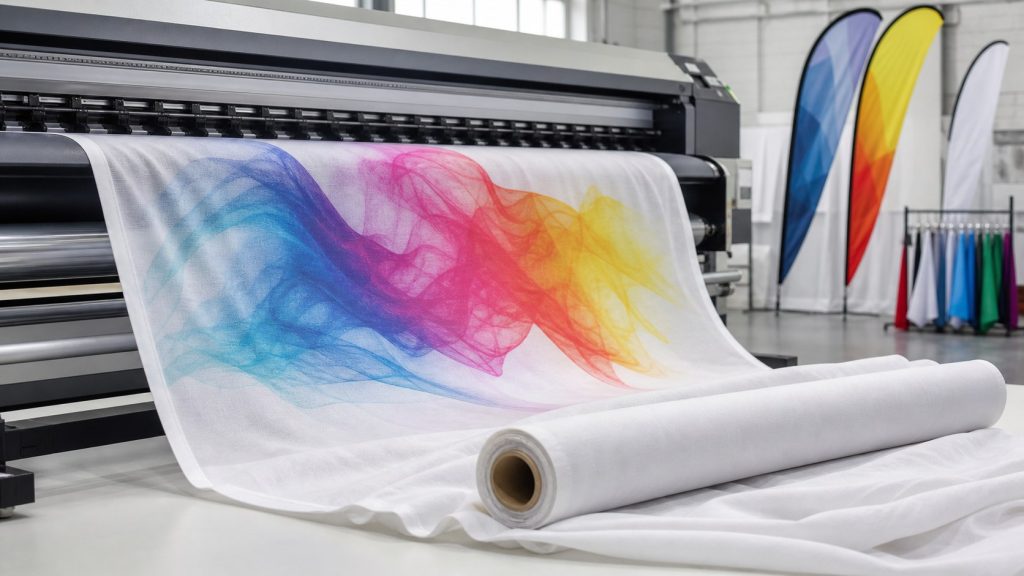
UNISIGN 110gsm dye sublimation flag fabric is a lightweight polyester textile for commercial flag printing. Current 110gsm options include DSP02 Popular Flag Fabric and DSP02TB Strong Flag Fabric. Both are listed for direct and paper-transfer dye sublimation, with maximum widths of 3.2m / 126 inches and listed shrinkage of ≤2%.
Choose by application, fabric construction, print-through, heat-setting behavior and finishing requirements—not by GSM alone.
Choose Your 110gsm Flag Fabric
UNISIGN currently offers two 110gsm flag-fabric models. Use these product cards to confirm that you are comparing lightweight printable flag textiles, then review the construction differences below.

DSP02 Flag Fabric
Popular Flag Fabric
- 110gsm / 3.2 oz
- Warp knitted
- Direct / paper-transfer dye sublimation
- Up to 3.2m / 126 inches
- Double-penetration positioning

DSP02TB Flag Fabric
Strong Flag
- 110gsm / 3.2 oz
- Warp knitted 3-bar
- Direct / paper-transfer dye sublimation
- Up to 3.2m / 126 inches
- D-Gen machine note
Quick choice: Start with DSP02 for general commercial flag printing and when reverse-side visibility is a priority. Compare DSP02TB when the 3-bar knitted construction or D-Gen compatibility is relevant. Approve either model with your own print and finishing test.
110gsm Dye Sublimation Flag Fabric Specifications
The following specifications summarize UNISIGN’s current DSP02 and DSP02TB product pages. Confirm the exact model and current technical documents before ordering.
| Specification | UNISIGN 110gsm Options |
|---|---|
| Weight | 110gsm / 3.2 oz |
| Material Type | Polyester flag fabric |
| Construction | Warp knitted / warp knitted 3-bar |
| Printing | Direct / paper-transfer dye sublimation |
| Maximum Width | 3.2m / 126 inches |
| Standard Roll Length | 100m / 110 yards |
| Listed Shrinkage | ≤2% |
| Products | DSP02 / DSP02TB |
| Application | Flags |
| Listed FR Options | B1 / NFPA 701 / AS 1530 / JIS L 1091 |
Important: An FR option or test standard listed on a product page is not a blanket certificate for every roll or order. Confirm the applicable report for the exact product, destination market and project.
What Is 110gsm Dye Sublimation Flag Fabric?
110gsm dye sublimation flag fabric is a lightweight polyester textile used for digitally printed flags and related graphics. “110gsm” means the material weighs approximately 110 grams per square meter. It describes fabric weight, not a complete quality or durability grade.
| 110gsm Tells You | 110gsm Does Not Tell You |
|---|---|
| Approximate fabric weight per square meter | Knitted or woven construction |
| How light the roll may be compared with heavier options | Tear or tensile strength |
| A starting point for product comparison | Print-through and reverse-side visibility |
| — | Shrinkage under your heat cycle |
| — | Outdoor service life or FR compliance |
For a purchasing decision, compare GSM together with construction, printing method, ink penetration, width, shrinkage, finishing and the intended flag system.
Why Is 110gsm Commonly Used for Printed Flags?
1. Lightweight Handling
A 110gsm polyester flag material is relatively light, which can help with movement, folding, roll handling, shipping and installation. Finished behavior still depends on flag size, construction, sewing and wind exposure.
2. Dye Sublimation Compatibility
Suitable polyester flag fabrics can be engineered for direct or paper-transfer dye sublimation. UNISIGN DSP02 and DSP02TB are currently listed for both methods, but compatibility should be confirmed by product model rather than assumed from GSM.
3. Wide-Format Production
Both current UNISIGN 110gsm options are listed up to 3.2m / 126 inches wide. This supports commercial wide-format flag production and can reduce seams on large graphics.
4. Print-Through Potential
Many single-sided printed flags are judged from both sides. A suitable fabric and print process can allow color to show through to the reverse, but the result must be evaluated using the actual printer, ink, color profile and heat-setting conditions.

What Is 110gsm Flag Fabric Used For?
| Application | Is 110gsm Suitable? | What to Check |
|---|---|---|
| Promotional Flags | Yes | Print-through, movement and finishing |
| Event Flags | Yes | Print quality, handling and venue requirements |
| Beach Flags | Often suitable | Wind exposure, pole system and edge finishing |
| Teardrop Flags | Often suitable | Fabric structure, tension and edge finishing |
| Feather Flags | Often suitable | Movement, tear resistance and pole fit |
| Indoor Flags | Yes | Color, detail and FR requirements |
| Hanging Flag Graphics | Yes, depending on design | Flatness, print-through and suspension method |
| High-Wind Locations | Depends | Consider construction, mesh and site conditions |
| Heavy Banner | Usually consider another material | Body, opacity and finishing |
| Backlit Graphics | No—use dedicated backlit fabric | Light diffusion and illuminated density |
Application suitability is conditional. Wind, dimensions, pole or frame design, sewing, environment and replacement cycle can change the correct choice.
How Important Is Ink Penetration for 110gsm Flag Fabric?
Ink penetration is a key purchasing factor for many single-sided printed flags. The buyer should compare the printed face with the reverse side instead of judging only the front.
| Check | Why It Matters |
|---|---|
| Front color density | Determines the primary viewing-side impact |
| Reverse-side visibility | Shows how much color appears on the back |
| Front-to-back color difference | Helps set customer expectations |
| Fine-detail reproduction | Reveals loss of small lines or text |
| Deep black and saturated colors | Exposes weak penetration or muddiness |
| Fabric uniformity | Highlights streaks, mottling or uneven penetration |
The current DSP02 product page describes an “excellent double penetration effect.” Treat this as a model feature to verify with a representative sample. A useful production test records the same red, blue, black and neutral-gray patches from both sides under consistent lighting.
Which UNISIGN 110gsm Flag Fabric Should I Choose?
DSP02 and DSP02TB have the same listed weight, width, roll length, printing methods and shrinkage, but they are not the same fabric.
| Specification | DSP02 | DSP02TB |
|---|---|---|
| Weight | 110gsm | 110gsm |
| Site Positioning | Popular Flag Fabric | Strong Flag |
| Construction | Warp knitted | Warp knitted 3-bar |
| Printing | Direct / paper transfer | Direct / paper transfer |
| Maximum Width | 3.2m / 126 inches | 3.2m / 126 inches |
| Standard Roll Length | 100m / 110 yards | 100m / 110 yards |
| Listed Shrinkage | ≤2% | ≤2% |
| Current Product Note | Double penetration | Specially for D-Gen machine |
Choose DSP02 When:
- You need a general-purpose starting point for commercial flag printing.
- Reverse-side color visibility is an important evaluation item.
- The standard warp-knitted construction fits your printing and finishing process.
Consider DSP02TB When:
- You want to evaluate the 3-bar warp-knitted construction.
- Your printing setup or application is better matched to this model.
- D-Gen machine compatibility is a project consideration.
Data limit: The current product pages do not publish comparable tear or tensile values for DSP02 and DSP02TB. Do not translate “Strong Flag” into a percentage strength claim or service-life promise without model-specific test data.
110gsm vs 120gsm Flag Fabric: Which Should I Choose?
The most useful comparison is not simply 110gsm versus 120gsm. UNISIGN’s current 120gsm DSP04 is a warp-knitted mesh flag, so construction and airflow are part of the decision.
| Specification | DSP02 | DSP02TB | DSP04 |
|---|---|---|---|
| Type | Popular Flag | Strong Flag | Mesh Flag |
| Weight | 110gsm | 110gsm | 120gsm |
| Construction | Warp knitted | 3-bar warp knitted | Warp-knitted mesh |
| Maximum Width | 3.2m | 3.2m | 3.2m |
| Main Difference | Standard flag structure | Different knitted structure | Open mesh construction |
| Consider For | General printed flags | Alternative 3-bar construction | Applications where more airflow is needed |
120gsm is not automatically better than 110gsm. In this comparison, the mesh construction and final application matter more than the extra 10gsm alone.
Is a Heavier Flag Fabric Always Better?
No. A heavier fabric may provide more body, but it can also move, print, fold and finish differently. Product construction and application should be evaluated before weight.
| Example | Weight | Structure |
|---|---|---|
| DSP02 | 110gsm | Warp knitted |
| DSP02TB | 110gsm | 3-bar warp knitted |
| DSP04 | 120gsm | Warp-knitted mesh |
| DSP10 | 80 / 130 / 150gsm | Woven satin |
These fabrics cannot be ranked reliably by GSM alone. Compare construction, ink behavior, reverse-side appearance, strength, wind exposure and the required visual finish.
Can 110gsm Flag Fabric Be Used for Direct and Transfer Dye Sublimation?
Yes, depending on the exact product. UNISIGN DSP02 and DSP02TB are currently specified for both direct and paper-transfer dye sublimation.
| Method | Basic Process | Production Check |
|---|---|---|
| Direct Dye Sublimation | Print directly to the fabric, then heat-fix the image | Feeding, strike-through, ink control and heat fixation |
| Transfer Dye Sublimation | Print transfer paper first, then transfer the image with heat | Paper, transfer pressure, temperature, dwell time and shrinkage |
Approve the exact fabric with your printer, ink, transfer paper, color profile and heat-setting conditions before bulk production.
Is 110gsm Flag Fabric Available in 3.2m / 126-Inch Width?
Yes. UNISIGN DSP02 and DSP02TB currently list maximum widths of 3.2m / 126 inches and standard roll lengths of 100m / 110 yards.
Wide-format rolls can support large flags, fewer seams, improved material nesting and more efficient cutting. Ask for the available width of the exact model and production batch, because not every width is necessarily stocked at all times.
How Much Does 110gsm Dye Sublimation Flag Fabric Shrink?
Shrinkage depends on fabric construction and heat-setting conditions. UNISIGN DSP02 and DSP02TB currently list shrinkage of ≤2%.
| Factor | Can Affect Shrinkage? |
|---|---|
| Temperature | Yes |
| Dwell Time | Yes |
| Fabric Construction | Yes |
| Machine Tension | Yes |
| Finishing and Sewing | Yes |
For production approval, mark a known distance on the sample, measure it before and after the actual heat cycle, and record dimensional change in both directions. Do not rely only on the nominal specification.
What Strength Tests Matter for Flag Fabric?
GSM is not a strength test. Depending on the application, useful evaluations can include:
- Tear strength: resistance to an existing cut or tear extending.
- Tensile strength: resistance to being pulled apart.
- Bursting strength: resistance to pressure applied across the fabric surface, where relevant.
- Seam and edge performance: behavior around stitching, hems and reinforced areas.
- Application test: performance in the intended pole, frame and wind conditions.
Request a report for the exact model when strength is critical. A category-level claim or report for another sample should not be treated as DSP02 or DSP02TB test data.
Is Flame-Retardant 110gsm Flag Fabric Available?
FR options are listed for both current 110gsm models. The DSP02 and DSP02TB product pages list B1, NFPA 701, AS 1530 and JIS L 1091.
Requirements depend on the venue, application and destination market. Before ordering, confirm:
- Exact product model
- Applicable test standard
- Report or certificate number
- Testing organization
- Current applicability
- Whether the document covers the required order
How Should 110gsm Flag Fabric Be Tested?
A representative sample should be tested with the real production workflow. A practical approval sequence is:
- Weight test: verify GSM using a controlled sample area.
- Width inspection: check usable width, edges and roll condition.
- Direct sublimation test: if used, record feeding, color and fixation.
- Transfer sublimation test: if used, record paper, transfer settings and finished appearance.
- Penetration test: photograph and compare the printed and reverse sides under the same light.
- Heat-shrinkage test: measure before and after the production heat cycle.
- Strength and finishing test: check the applicable tear, seam, hem and pole-system requirements.
Do not publish a measured result as a product specification until the sample identity, method, conditions and result have been recorded.

Which Flag Fabric Should I Use?
| Requirement | UNISIGN Product to Consider |
|---|---|
| General lightweight printed flags | DSP02 — 110gsm Popular Flag Fabric |
| Alternative 3-bar knitted construction | DSP02TB — 110gsm Strong Flag |
| Mesh construction / more airflow | DSP04 — 120gsm Mesh Flag |
| Woven satin appearance | DSP10 — 80 / 130 / 150gsm Satin Banner |
| Unsure which construction fits | Request a side-by-side sample comparison |
This matrix is a starting point. Final approval should follow printing, heat setting, finishing and application testing.
Should I Choose 110gsm Flag Fabric?
Choose 110gsm When:
- You need lightweight polyester flag material.
- You are producing digitally printed flags.
- Direct or transfer dye sublimation is required.
- Print-through is an important evaluation item.
- Widths up to 3.2m are useful.
- You want a material designed specifically for flags.
Consider Another Fabric When:
- You need a mesh structure for increased airflow.
- You want a woven satin appearance.
- You need a heavier banner material.
- Your graphic requires backlit or blockout performance.
- Your actual print, shrinkage or finishing test favors another construction.
110gsm Dye Sublimation Flag Fabric from UNISIGN
UNISIGN currently offers two 110gsm flag-fabric options: DSP02 and DSP02TB. Both are listed up to 3.2m / 126 inches wide for direct and paper-transfer dye sublimation. Buyers can request specifications, representative samples and bulk-order information for comparison.
For the wider product family, see UNISIGN flag fabrics. For supplier evaluation, read what to look for when choosing a dye sublimation fabric manufacturer and how commercial printers can evaluate a dye sublimation fabric supplier.
Before Ordering: 110gsm Flag Fabric Buyer Checklist
| Requirement | Buyer Input |
|---|---|
| Application | Beach / Teardrop / Feather / Other |
| Product | DSP02 / DSP02TB |
| Weight | 110gsm |
| Printing | Direct / Transfer |
| Printer | ___ |
| Required Width | ___ m / inches |
| Roll Length | ___ m |
| Penetration Requirement | ___ |
| Shrinkage Requirement | ___ |
| FR Requirement | ___ |
| Destination Country | ___ |
| Quantity | ___ rolls / m² |
Frequently Asked Questions
What is 110gsm dye sublimation flag fabric?
It is a lightweight polyester textile weighing approximately 110 grams per square meter and designed for digitally printed flags. Construction, printing compatibility, penetration and shrinkage must also be checked.
Is 110gsm a good weight for printed flags?
It can be a practical lightweight choice for promotional, event, beach, teardrop, feather and indoor flags. The correct choice depends on construction, flag system, wind exposure and test results.
What is the difference between 110gsm and 120gsm flag fabric?
Weight is only one difference. UNISIGN’s 110gsm DSP02 and DSP02TB are warp-knitted flag fabrics, while the 120gsm DSP04 uses a warp-knitted mesh construction. Application and airflow requirements matter more than the 10gsm difference alone.
Can 110gsm flag fabric be used for direct dye sublimation?
Yes, for compatible models. UNISIGN DSP02 and DSP02TB are currently listed for direct and paper-transfer dye sublimation.
Does dye sublimation ink show through 110gsm flag fabric?
It can, but the amount depends on fabric construction, printer, ink, profile and heat setting. DSP02 is currently positioned for double penetration; verify front and reverse appearance with a production sample.
How much does 110gsm polyester flag fabric shrink?
UNISIGN DSP02 and DSP02TB currently list shrinkage of ≤2%. Actual dimensional change depends on temperature, dwell time, tension and finishing, so measure the sample under your real process.
Is 110gsm flag fabric available in 3.2m / 126-inch width?
Yes. Current DSP02 and DSP02TB product pages list maximum widths of 3.2m / 126 inches and standard roll lengths of 100m / 110 yards.
What is the difference between DSP02 and DSP02TB?
Both are 110gsm warp-knitted flag fabrics, but DSP02 uses a standard warp-knit construction and emphasizes double penetration, while DSP02TB uses a 3-bar warp-knit construction and is noted for D-Gen machines. Compare samples because the current pages do not publish comparable strength values.
Request a 110gsm Flag Fabric Sample
Send UNISIGN your application + product model + printing method + printer + width + penetration requirement + FR requirement + quantity. The team can recommend DSP02, DSP02TB or another flag-fabric construction for testing.
![Top 10 Vinyl Tarp Manufacturers in the World [2026 Guide]](https://unisignflex.com/wp-content/uploads/2026/04/pvc-tarpaulin-product-line.jpg)