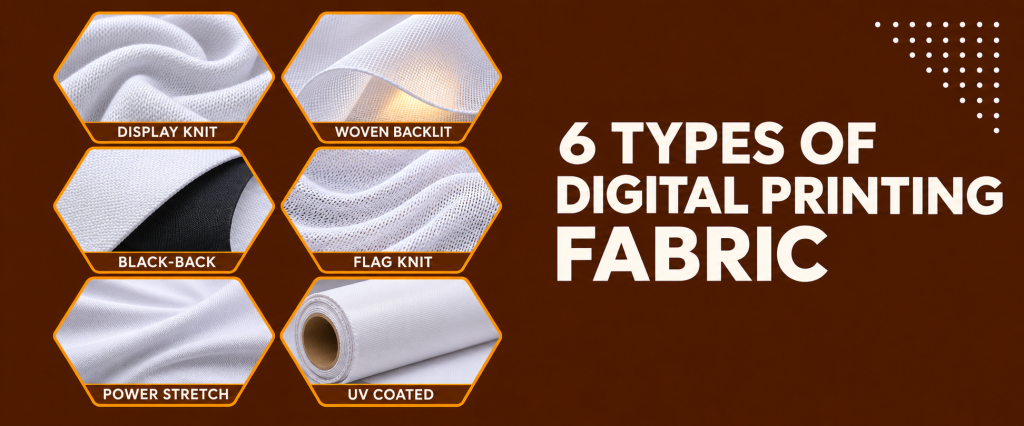
Digital printing fabric must match more than the artwork. The fabric surface, ink, heat or curing process, and finishing method all influence the finished result. In wide-format signage, a material that works well for a flag may be unsuitable for a light box or a shaped display.
This guide compares six types of digital printing fabric for signage and displays. The categories describe fabric constructions and applications, rather than every textile used in apparel or home furnishing. Use the individual model’s print specification to choose the production route.
1. Knitted Display Fabric for Digital Printing
For an indoor graphic viewed under room lighting, the starting point is often a display knit. DSP06N Saturn has a warp-knitted structure with slight stretch. It is designed for applications such as frame displays and exhibitions, where the printed textile must look even after finishing.

Here’s Why It’s Popular:
- Model and weight: DSP06N, 230 g/m².
- Listed printing methods: Direct or paper-transfer dye sublimation.
- Roll size: Maximum width 3.2 m; standard length 100 m.
- Production focus: Compare image sharpness, fabric tension, and cut-size consistency.
- Advantages:
- A familiar textile format for non-lit displays.
- Slight stretch for developing fitted panels.
- A soft surface for large indoor brand images.
The printed color is only one approval point. Check the panel after cooling, cutting, and sewing so changes during finishing are included in the sample review.
Explore material specifications
Request a Free Sample2. Woven Backlit Fabric for Digital Printing
Digital printing for light boxes requires an image that works with illumination behind it. SDB280 Starlight is a woven backlit fabric with a matte finish. It gives print teams a specific material on which to evaluate density, color, and the uniformity of transmitted light.

Here’s Why It’s Popular:
- Model and weight: SDB280, 280 g/m².
- Listed printing methods: Direct dye sublimation, paper-transfer dye sublimation, and latex.
- Roll size: Maximum width 3.2 m; standard length 50 m.
- Production focus: Approve the finished graphic under the actual light source.
- Advantages:
- A textile construction intended for illuminated graphics.
- A matte woven surface for comparing fine detail.
- Multiple listed print routes for a suitable equipment setup.
A profile approved for an unlit display should not automatically be reused for backlit work. Evaluate gradients, dark areas, and white balance with the LEDs on.
Explore material specifications
Request a Free Sample3. Black-Back Fabric for Digital Printing
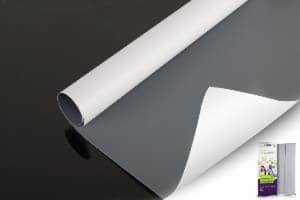
A dark reverse helps separate the printed message from what is behind the panel. DSP-BLK-01 Nox uses a white/black textile structure for backdrops and display systems. The white face carries the image while the reverse reduces unwanted show-through.

Here’s Why It’s Popular:
- Model and weight: DSP-BLK-01, 260 g/m².
- Listed printing methods: Direct or paper-transfer dye sublimation.
- Construction: Warp-knitted with slight stretch.
- Roll size: The model page lists up to 5 m wide and 100 m long; confirm the available width.
- Advantages:
- Helps conceal a backdrop’s support structure.
- Combines a printable face with a dark reverse.
- A listed extra-wide option for large display walls.
The category table gives a 3.2 m maximum, so obtain a confirmed width for the order. Use the specified white print face and test opacity after the graphic is tensioned.
Explore material specifications
Request a Free Sample4. Lightweight Flag Fabric for Digital Printing
A digitally printed flag needs to carry its design on a light, moving surface. DSP02 is a warp-knitted flag textile made for this application. Print-through, finishing, and the position of text matter because the flag may be viewed from both directions.

Here’s Why It’s Popular:
- Model and weight: DSP02, 110 g/m².
- Listed printing methods: Direct or paper-transfer dye sublimation.
- Roll size: Maximum width 3.2 m; standard length 100 m.
- Production focus: Compare front color, reverse penetration, hems, and pole pockets.
- Advantages:
- Low fabric weight for flag production.
- A structure intended to support reverse-side color visibility.
- Wide roll supply for several flag formats.
Reverse penetration does not produce a second independently readable image: text is normally mirrored. Specify a separate two-sided construction when both views require different or correctly oriented artwork.
Explore material specifications
Request a Free Sample5. Power-Stretch Fabric for Digital Printing
When a graphic wraps around a shaped display, the printed image has to tolerate the intended extension. DSP08-T Venus contains spandex and is described as a two-direction power-stretch fabric. It is a candidate for geometric trade-show graphics whose pattern is developed around the display shape.

Here’s Why It’s Popular:
- Model and weight: DSP08-T; the individual product page lists 250 g/m².
- Listed printing methods: Direct or paper-transfer dye sublimation in the specification table.
- Roll size: Maximum width 3.2 m; standard length 100 m.
- Production focus: Check image distortion, seam positions, and fit under working tension.
- Advantages:
- More extension for evaluating irregular shapes.
- A textile surface for shaped promotional graphics.
- A distinct option when slight-stretch display fabric is insufficient.
Confirm the supplied weight because the category table differs. The model page lists no available FR option; a project requiring fire-performance documentation needs a separately suitable, documented material.
Explore material specifications
Request a Free Sample6. UV-Coated Fabric for Digital Printing
Not every digitally printed textile uses sublimation. PCG135B Pearl has a coated surface specified for UV printing and is intended for backlit light boxes. It illustrates why the coating, printable side, and ink system must be considered together.

Here’s Why It’s Popular:
- Model and weight: PCG135B, 135 g/m².
- Listed printing method: UV on the coating side.
- Roll size: Maximum width 3.2 m; standard length 100 m.
- Production focus: Test ink adhesion, curing, flexibility, and appearance when illuminated.
- Advantages:
- A coated textile option for compatible UV equipment.
- A smooth print surface for image evaluation.
- PVC-free construction for briefs that specify this composition.
Do not infer sublimation, solvent, or latex compatibility from the word textile. Ask for the current technical sheet and approved settings for the chosen printing side.
Explore material specifications
Request a Free SampleWhy Choose UNISIGN?
- Application-specific fabrics: Compare display, backlit, blockout, flag, stretch, and coated options.
- Model-level specifications: Discuss printing methods and roll formats using a defined product code.
- Samples for process approval: Check the actual fabric with your equipment before scaling up.
UNISIGN supplies textile roll media for digital print production. Share the printer model, ink, fixation or curing process, and finished display requirements to help identify a suitable sampling shortlist.
Request Factory Prices and Free Samples
Request factory prices and free samples with the print process, required width, application, panel dimensions, quantity, destination, and any required venue documentation.