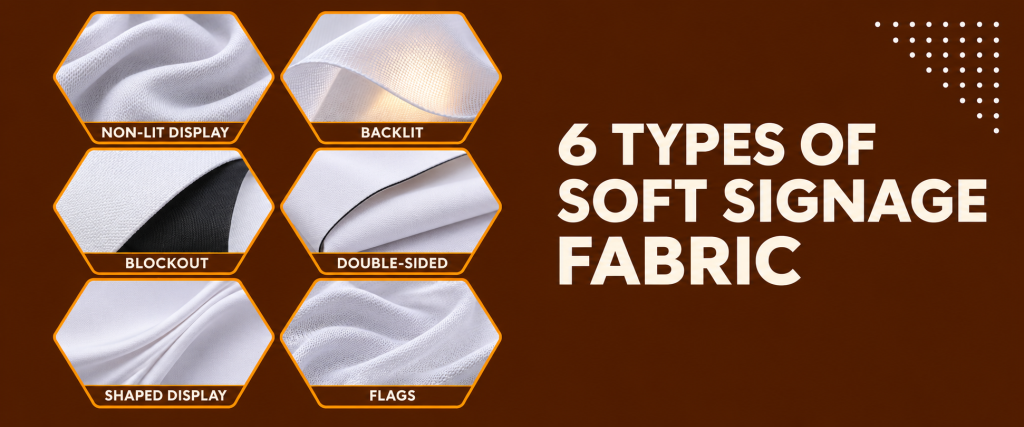
Soft signage fabric turns a printed message into a flexible textile display. It is used across retail campaigns, exhibitions, backdrops, light boxes, hanging signs, and flags. Selecting the fabric around the installation helps the graphic fit properly and look right in its final location.
Here are six practical types of soft signage fabric, grouped by the display they support. These categories can overlap; the final choice depends on lighting, stretch, opacity, printing, and finishing rather than the label alone.
1. Non-Lit Display Fabric
Non-lit soft signage relies on the room’s lighting rather than LEDs behind the graphic. DSP09 Mars is a warp-knitted display fabric with slight stretch. It can be evaluated for pop-up walls, framed promotional panels, and backdrops that need an even textile surface.

Here’s Why It’s Popular:
- Best starting point: Indoor display graphics viewed from the printed face.
- Model: DSP09, 230 g/m².
- Roll format: Up to 3.2 m wide; standard length 100 m.
- Printing: Direct or paper-transfer dye sublimation.
- Advantages:
- A soft appearance for exhibition and retail spaces.
- Slight stretch for developing a neat fitted panel.
- A practical base for comparing sewn display graphics.
Check how the frame and background appear through the installed sample. A standard display textile’s opacity may be sufficient for one location and insufficient for another.
Explore material specifications
Request a Free Sample2. Backlit Soft Signage Fabric
Illuminated soft signage uses a fabric face over a light source. SDB270 Meteor is a knitted backlit textile with a matte finish. It is relevant when the display needs a smooth fabric surface and an image that remains attractive with the lights switched on.

Here’s Why It’s Popular:
- Best starting point: Light boxes and illuminated promotional displays.
- Model: SDB270, 270 g/m².
- Roll format: Maximum width 3.2 m; standard length 100 m.
- Printing: Direct or paper-transfer dye sublimation, and latex, are listed.
- Advantages:
- A textile option for illuminated brand messages.
- Soft knitted construction for handling and finishing.
- Matte appearance for evaluating large photographs and color fields.
Test on the actual light-box system. LED spacing, depth, printed density, and fabric tension all need to be considered when approving the finished appearance.
Explore material specifications
Request a Free Sample3. Blockout Backdrop Fabric
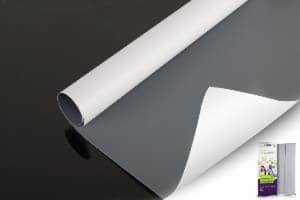
For a booth wall or photographic backdrop, light from behind can weaken the printed design. DSP-BLK-01 Nox uses a white face and black reverse to reduce this interference. It is a useful option when the fabric must help conceal framework, objects, or a busy scene behind it.

Here’s Why It’s Popular:
- Best starting point: Exhibition walls, backdrops, and fitted display systems.
- Model: DSP-BLK-01, 260 g/m².
- Construction: Warp-knitted white/black fabric with slight stretch.
- Printing: Direct or paper-transfer dye sublimation.
- Advantages:
- Helps keep the background from competing with the graphic.
- A white face for printed artwork and a dark reverse.
- A textile alternative for opaque display walls.
The product page lists 5 m maximum width and 100 m rolls, while the category table lists 3.2 m. Confirm the actual supply width and assess opacity on a finished sample.
Explore material specifications
Request a Free Sample4. Double-Sided Hanging Sign Fabric
A soft sign suspended over an aisle may be approached from either direction. DSP-BLK-D Ares has two printable surfaces with a black internal layer. It is designed to provide separate faces, making it an option for hanging signs with different messages or images.

Here’s Why It’s Popular:
- Best starting point: Two-way exhibition signs and suspended promotional graphics.
- Model: DSP-BLK-D; 250 g/m² on the individual product page.
- Roll format: Maximum width 3.2 m; standard length 100 m.
- Printing: Direct or paper-transfer dye sublimation.
- Advantages:
- Supports independently designed front and back artwork.
- An internal dark layer reduces interference between faces.
- Keeps the display in a flexible textile format.
Confirm the current weight because the category table lists 260 g/m². Test both print faces, registration, heating sequence, and the finished sign’s hanging behavior.
Explore material specifications
Request a Free Sample5. Power-Stretch Fabric for Shaped Signs
Soft signage can also follow curved or irregular structures. DSP08-T Venus is a power-stretch fabric containing spandex, with stretch described in two directions. It is a material to evaluate when a straight panel pattern cannot achieve the intended shape.

Here’s Why It’s Popular:
- Best starting point: Geometric graphics and shaped trade-show displays.
- Model: DSP08-T; the product specification lists 250 g/m².
- Roll format: Maximum width 3.2 m; standard length 100 m.
- Printing: Direct or paper-transfer dye sublimation in the model specification.
- Advantages:
- Extension for developing shaped textile graphics.
- A soft surface around compatible curved structures.
- A separate option from slight-stretch display fabric.
Check image distortion and seam tension on a full-shape sample. Confirm the weight, and note that the model page states no available FR option; do not assume it meets a venue’s fire requirements.
Explore material specifications
Request a Free Sample6. Lightweight Flag Fabric
Flags add movement to a soft-signage program and need a lighter construction than many display walls. DSP02 is a warp-knitted flag fabric intended to support color penetration. It can be considered for promotional flags and events where both sides of the moving graphic are visible.

Here’s Why It’s Popular:
- Best starting point: Event flags, promotional flags, and hanging flag graphics.
- Model: DSP02, 110 g/m².
- Roll format: Maximum width 3.2 m; standard length 100 m.
- Printing: Direct or paper-transfer dye sublimation.
- Advantages:
- Light fabric weight for a moving display.
- A structure intended for reverse-side color visibility.
- Roll media that can be cut and finished into several flag formats.
A print-through flag normally shows a mirrored reverse image. Confirm the required viewing direction, hems, pole pockets, and weather-use conditions with the finished flag supplier.
Explore material specifications
Request a Free SampleWhy Choose UNISIGN?
- Several display options: Compare fabrics for illumination, opacity, stretch, and flag applications.
- Clear model references: Discuss weight, width, and print compatibility for the intended graphic.
- Sample-led selection: Assess a printed and finished sample before producing the full display.
UNISIGN supplies soft-signage fabric rolls for print businesses and distributors. Send the display drawing and installation requirements to help select suitable materials for sampling.
Request Factory Prices and Free Samples
Request factory prices and free samples with the display type, printing process, required width, finished size, quantity, destination, and any required fire-performance documentation.