Printable flag fabric brings movement and visibility to event displays, promotional flags, and hanging banners. Selecting the right material means balancing print appearance, reverse-side visibility, fabric movement, and the demands of the finished installation.
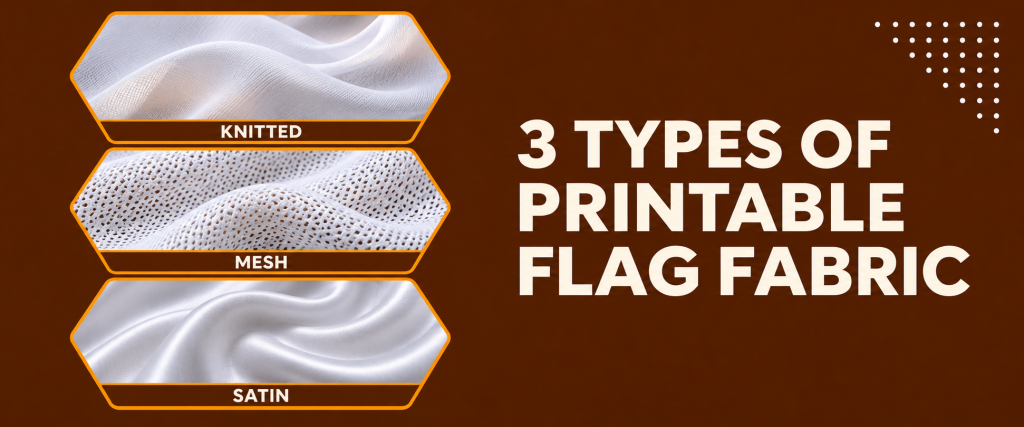
This guide introduces three types of printable flag fabric: knitted, mesh, and satin. The examples below are specific UNISIGN grades. Compare them using printed and finished samples rather than assuming that one construction is best for every flag.
1. Knitted Printable Flag Fabric
Knitted flag fabric is a practical starting point for promotional flags and event graphics that need light weight and movement. DSP02 is a warp-knitted flag grade described as supporting color penetration. It can be evaluated for flags where the printed message is also seen from the reverse.

Here’s Why It’s Popular:
- Model: DSP02 Popular Flag Fabric.
- Weight: 110 g/m².
- Construction: Warp-knitted flag fabric.
- Roll format: Maximum width 3.2 m; standard length 100 m.
- Printing: Direct or paper-transfer dye sublimation.
- Advantages:
- Light textile weight for a flowing flag graphic.
- A structure intended to support reverse-side color visibility.
- A roll material that can be cut and sewn for different flag formats.
Check front and reverse color after the complete print and fixation process. Color penetration depends on the material and production settings; do not assume a fixed result without a printed sample.
A single print-through graphic normally appears mirrored on the reverse. If both sides must read independently, specify a suitable double-sided flag construction with the fabricator.
Explore material specifications
Request a Free Sample2. Mesh Printable Flag Fabric
Mesh flag fabric has an open structure with visible holes. DSP04 provides a different surface and airflow characteristic from a more closed flag knit. It is useful to compare for promotional flags when the fabricator wants to evaluate an open construction alongside the intended artwork and outdoor exposure.

Here’s Why It’s Popular:
- Model: DSP04 Mesh Flag Fabric.
- Weight: 120 g/m².
- Construction: Warp-knitted mesh.
- Roll format: Maximum width 3.2 m; standard length 100 m.
- Printing: Direct or paper-transfer dye sublimation.
- Advantages:
- Open holes allow air to pass through the textile.
- A distinct texture for comparing flag performance and appearance.
- A light roll-media option for approved flag and banner applications.
Assess how the openings affect small text, fine details, and solid color areas at the intended viewing distance. Mesh does not provide the same uninterrupted image surface as satin or a more closed knit.
An open structure does not make a finished flag windproof. Flag size, hems, reinforcement, pole hardware, location, and removal guidance remain part of the installation assessment.
Explore material specifications
Request a Free Sample3. Satin Printable Flag Fabric
Satin flag fabric is selected for a smoother, more lustrous appearance. DSP10 Satin Banner is a woven grade listed for flags and banners. It can be considered when surface sheen and drape are part of the visual brief, such as indoor promotional banners or decorative flag displays.

Here’s Why It’s Popular:
- Model: DSP10 Satin Banner.
- Weight options: 80, 130, and 150 g/m² are listed.
- Construction: Woven fabric with a shiny satin finish.
- Roll format: Maximum width 3.2 m; standard length 100 m.
- Printing: Direct or paper-transfer dye sublimation in the product specification.
- Advantages:
- A lustrous surface for a different presentation from knitted flag fabric.
- Several listed weight options to compare for handling and drape.
- A printable textile choice for flags and hanging banners.
Approve the selected weight and finish under the actual display lighting. Sheen can change the appearance of a graphic as the viewing angle changes.
Confirm reverse visibility, finishing requirements, and the intended indoor or outdoor service conditions for the exact grade. Do not assume all satin weights perform identically.
Explore material specifications
Request a Free SampleWhy Choose UNISIGN?
- Different flag constructions: Compare lightweight knit, open mesh, and woven satin options.
- Model-specific information: Review weight, width, printing compatibility, and finish before ordering.
- Sample-based selection: Evaluate the artwork and completed flag before full production.
UNISIGN supplies printable flag fabric rolls for flag manufacturers, print shops, and distributors. Share the flag design and production process to help identify suitable materials.
Request Factory Prices and Free Samples
Request factory prices and free samples with the flag shape, printing method, required reverse appearance, roll width, quantity, destination, and any venue documentation requirements.