Exhibition display fabric needs to do more than carry a printed logo. It must fit the stand, work with the lighting, arrive in usable condition, and meet the event’s requirements. Selecting materials around each part of the booth makes the finished display easier to plan.
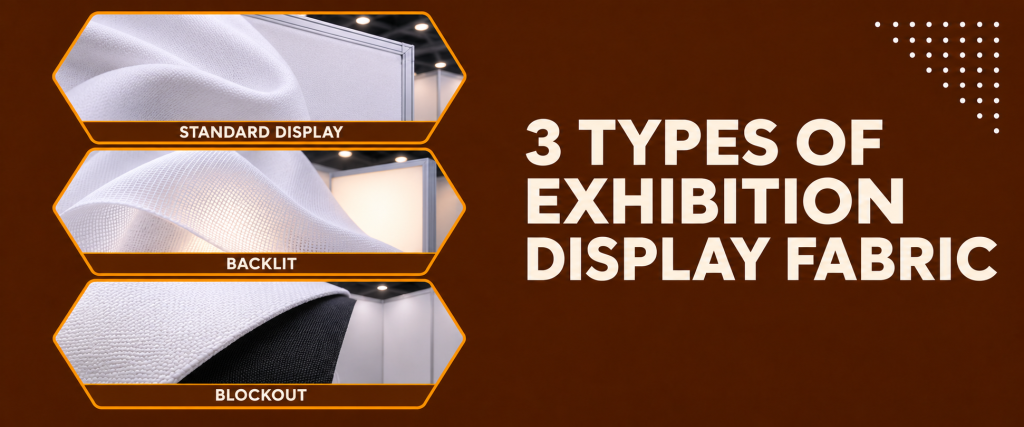
Here are three types of exhibition display fabric for common booth requirements: standard non-lit display fabric, backlit fabric, and blockout backdrop fabric. One stand may use all three, with different materials chosen for different graphic positions.
1. Standard Exhibition Display Fabric
Standard display fabric is used for booth graphics that rely on the venue’s ambient or front lighting. DSP06N Saturn Traditional Display is a warp-knitted textile with slight stretch. It can be considered for framed panels, event graphics, and other indoor displays where the printed face needs a soft textile presentation.

Here’s Why It’s Popular:
- Model: DSP06N Saturn Traditional Display.
- Weight: 230 g/m².
- Roll format: Maximum width 3.2 m; standard length 100 m.
- Printing: Direct or paper-transfer dye sublimation.
- Typical evaluation: Non-lit frame graphics and conventional indoor booth panels.
- Advantages:
- A practical starting point for ordinary exhibition graphics.
- Slight stretch for developing a neat fit on compatible frames.
- A soft surface for large artwork, information panels, and brand imagery.
View the sample against the actual booth structure. If a bright neighboring display or stored equipment remains visible behind the textile, consider a blockout grade.
Agree on the finished dimensions and edge treatment with the stand builder. A printable roll becomes a usable booth graphic only after cutting and finishing have been matched to the hardware.
Explore material specifications
Request a Free Sample2. Backlit Exhibition Display Fabric
Backlit exhibition fabric is selected for booth light boxes that illuminate the image from behind. SDB270 Meteor is a knitted, matte backlit textile with a soft, smooth surface. It gives stand producers an option for testing illuminated graphics alongside the planned frame and LED system.

Here’s Why It’s Popular:
- Model: SDB270 Meteor Backlit Fabric.
- Weight: 270 g/m².
- Roll format: Maximum width 3.2 m; standard length 100 m.
- Printing: Direct or paper-transfer dye sublimation, and latex, are listed.
- Typical evaluation: Booth light boxes and illuminated retail-style exhibition panels.
- Advantages:
- A textile surface for illuminated brand messages.
- A knitted construction for handling and finishing trials.
- Several listed print routes to assess against existing production equipment.
Approve colors with the light box switched on and off. LED layout, frame depth, image density, and fabric tension all affect the finished appearance.
Use the exact booth lighting system for the trial where possible. Check for visible light-source patterns and uneven color before printing every panel in a multi-frame stand.
Explore material specifications
Request a Free Sample3. Blockout Exhibition Backdrop Fabric
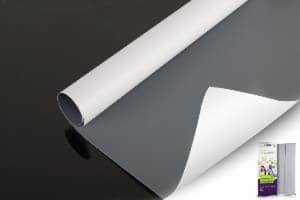
Blockout backdrop fabric helps reduce visual interference from lights, framework, and objects behind a booth wall. DSP-BLK-01 Nox combines a white printable face with a black reverse. It is a useful candidate for presentation walls, photography areas, and exhibition backdrops that need stronger separation from their surroundings.

Here’s Why It’s Popular:
- Model: DSP-BLK-01 Nox.
- Weight: 260 g/m².
- Construction: White/black warp-knitted fabric with slight stretch.
- Printing: Direct or paper-transfer dye sublimation.
- Roll length: Standard length 100 m.
- Advantages:
- Helps keep the background from competing with the printed artwork.
- A dark reverse for non-illuminated opaque display walls.
- A fitted textile option for backdrops and compatible booth systems.
The product page lists up to 5 m width and the category table lists 3.2 m. Confirm the available usable width before designing a seamless wall.
Check the back and edges wherever visitors can see around the stand. If the rear also needs printed artwork, discuss a double-sided printable construction instead of assuming a black-back grade can serve both faces.
Explore material specifications
Request a Free SampleWhy Choose UNISIGN?
- Several display functions: Compare standard, illuminated, and blockout textile options within one material discussion.
- Clear model specifications: Review print compatibility, roll dimensions, and construction for each booth position.
- Sample-led planning: Evaluate the installed graphic before committing to the full exhibition package.
UNISIGN supplies printable textile rolls for exhibition producers, print businesses, and distributors. Send the booth plan and production requirements to help identify suitable materials for sampling.
Request Factory Prices and Free Samples
Request factory prices and free samples with your booth layout, lighting details, printing workflow, finished panel sizes, roll widths, quantity, destination, and event deadline.