Display fabric is used to turn printed artwork into exhibition graphics, promotional walls, fitted panels, and indoor decoration. Choosing it only by weight can miss the features that matter most: how it fits the structure and how it controls the background.
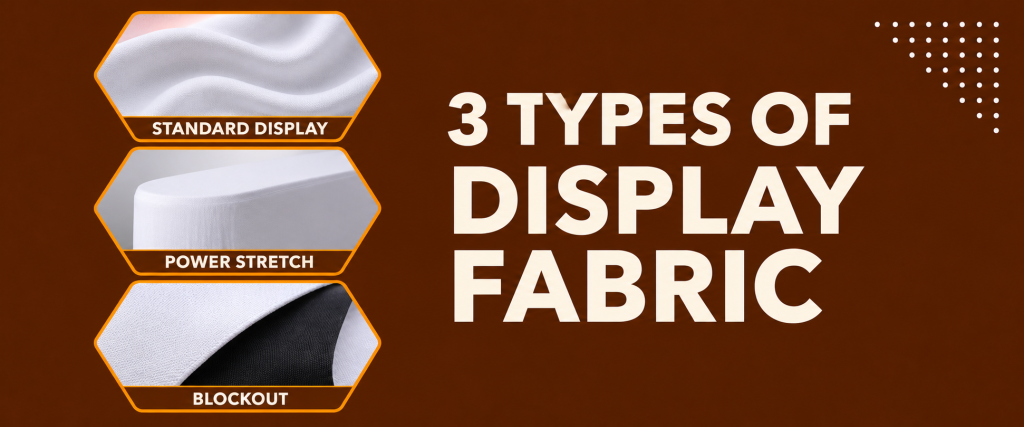
This guide compares three practical types of display fabric: standard display, power-stretch, and blockout. These are selection groups for different requirements, with specific UNISIGN models to help you plan samples and production.
1. Standard Display Fabric
Standard display fabric is a starting point for indoor graphics that need a soft textile appearance on a conventional display system. DSP06N Saturn Traditional Display is a warp-knitted grade with slight stretch. Its listed applications include exhibitions, events, frame systems, indoor decoration, and table coverings.

Here’s Why It’s Popular:
- Model: DSP06N Saturn Traditional Display.
- Weight: 230 g/m².
- Roll format: Maximum width 3.2 m; standard length 100 m.
- Printing: Direct or paper-transfer dye sublimation.
- Construction: Warp-knitted fabric with slight stretch.
- Advantages:
- A general display option for printed textile panels.
- Slight stretch to evaluate for a neat fitted surface.
- A grade that can be sampled across several indoor graphic applications.
Check whether the background or frame shows through under the intended lighting. Standard display fabric should not be treated as a dedicated blockout grade.
Print and finish a representative panel before approving the production pattern. The correct amount of tension depends on the fabric, print process, seams, and display hardware.
Explore material specifications
Request a Free Sample2. Power-Stretch Display Fabric
Power-stretch display fabric is considered when a printed graphic needs to follow a shaped or curved structure. DSP08-T Venus contains spandex and is described as having stretch in two directions. It provides a different starting point from slight-stretch fabric when developing more complex textile forms.

Here’s Why It’s Popular:
- Model: DSP08-T Venus Power Stretch.
- Weight: 250 g/m² on the individual product page.
- Roll format: Maximum width 3.2 m; standard length 100 m.
- Printing: Direct or paper-transfer dye sublimation in the model specification.
- Applications: Shaped promotional graphics and compatible display structures.
- Advantages:
- Extension to help develop fitted graphics around curved forms.
- A soft surface for geometrical exhibition structures.
- A separate option when a conventional panel does not provide the required fit.
The category table lists a different weight, so confirm the current supplied grade. The product page also states no available FR option; do not assume it meets a venue’s fire requirements.
Test artwork distortion and seam loading on the actual shape. Stretch is a design variable, so logos, text, and critical image details need approval after the graphic is installed.
Explore material specifications
Request a Free Sample3. Blockout Display Fabric
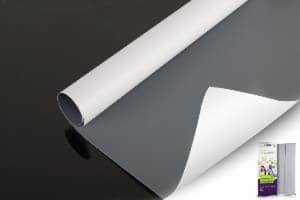
Blockout display fabric adds a light-blocking function when the graphic needs to conceal a structure or background. DSP-BLK-01 Nox has a white image face and a black reverse. It is suitable for evaluation as an opaque textile backdrop or fitted display wall where ordinary display fabric allows too much background influence.

Here’s Why It’s Popular:
- Model: DSP-BLK-01 Nox.
- Weight: 260 g/m².
- Construction: White/black warp-knitted fabric with slight stretch.
- Printing: Direct or paper-transfer dye sublimation.
- Roll length: Standard length 100 m.
- Advantages:
- Helps reduce visual interference from behind the panel.
- A white printing face paired with a dark reverse.
- A fabric option for backdrops, pop-ups, frames, and exhibition systems.
Confirm width before production: the individual model page lists up to 5 m, while the category table lists 3.2 m. Plan around the usable supplied width.
Assess the reverse and exposed edges as well as the front. If both sides require artwork, ask for an explicitly double-sided printable grade instead.
Explore material specifications
Request a Free SampleWhy Choose UNISIGN?
- Several functional options: Compare general display, extra stretch, and blockout materials.
- Defined product references: Discuss weight, width, print compatibility, and the intended display system.
- Practical sampling: Evaluate the complete printed graphic on its structure before ordering production quantities.
UNISIGN supplies display fabric rolls for print businesses, exhibition producers, and distributors. Share the installation details so suitable material options can be considered.
Request Factory Prices and Free Samples
Request factory prices and free samples with your display drawing, printing method, opacity needs, roll width, quantity, destination, and required venue documentation.