


Printable rolls – construction perimeter graphics
Mesh Banner Material for Construction Fences
Construction fence mesh banner material is an open PVC-coated polyester media used for printed job-site screening and perimeter branding. The openings allow some air and light to pass, but they also reduce privacy and print density.
Choose the roll by fence type, required screening, viewing distance, printer setup, finished panel size and a real edge-and-attachment test. The project engineer or site owner must approve the complete fence system.
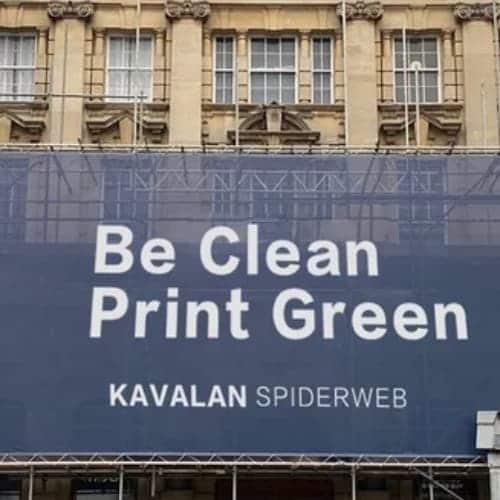
Should a Construction Fence Use Mesh or Solid Banner?
Start with mesh when the graphic is fixed to an open fence and air movement matters. Start with solid banner only when stronger privacy and denser colour matter more, and the supporting system is designed for the added wind load.
| Project need | Better starting point | What must still be checked |
|---|---|---|
| Open chain-link or temporary fence | Mesh banner | Fence stability, open-area data, panel size, edge reinforcement and fixings |
| Maximum visual privacy | Denser mesh or an approved solid system | Backlighting, viewing angle and the structural effect of reduced airflow |
| Fine photos or small text | Denser printable face or solid banner | Actual-distance printed sample and colour approval |
| Long exposed perimeter | Mesh split into planned panels | Gates, corners, seams, access and replacement of one damaged section |
| Solid hoarding wall | Frontlit or blockout may be suitable | Surface, attachment, opacity and local sign rules |
Mesh is not a wind-load rating. A perforated face can pass more air than solid vinyl, but open area alone does not approve the fence, fixings or installation.
Balance Airflow, Privacy and Printed Image
1. Air movement
A more open face can allow more air to pass. Request tested open-area or air-permeability data for the exact SKU instead of guessing from the model name.
2. Visual privacy
Mesh screens a view but is not fully opaque. Privacy changes with hole size, printed colour, viewing angle and the light on each side.
3. Image strength
Openings reduce printable area. Large type, bold shapes and strong contrast normally read better than thin lines or low-contrast photos.
What a Buyer Should Specify
| Field | Why it matters | Evidence to request |
|---|---|---|
| Fence system | Permanent chain-link, temporary panels, scaffolding and barricades carry loads differently. | Site drawing, panel size, posts, bracing, ballast and gate locations |
| Airflow target | More open area can improve airflow but reduce privacy and colour density. | Exact-SKU open-area or air-permeability test method and result |
| Privacy target | Daylight and a bright background can make mesh more transparent. | Printed sample viewed from both sides in comparable light |
| Image target | Small copy and fine detail may disappear in the openings. | Production-profile sample at the real viewing distance |
| Finished panel | Size, seams, hems and attachment points affect handling and edge stress. | Finished sample with the planned weld, hem, eyelet or webbing |
| Structural approval | The material does not approve the fence or installation. | Project engineer, fence supplier or site owner’s assessment and local rules |
UNISIGN Mesh Banner Rolls to Sample
A short product list helps print buyers move from the application to a real sample. Product photos and published specifications are included because they make model comparison faster. Approve the exact labelled roll before production.

M1212NP
- 360 GSM website listing
- With liner; without-liner option listed
- 1-3.2 m and 5 m widths listed
- Good first sample for printer and image checks

M99P
- 340 GSM website listing
- With liner; without-liner option listed
- 1-3.2 m and 5 m widths listed
- Confirm current yarn and open-area data on the TDS

M1812P
- 340 GSM website listing
- With liner; without-liner option listed
- 1-3.2 m and 5 m widths listed
- Compare print density and airflow on a sample

M1212B
- 240 GSM website listing
- Without liner; black back
- 1-3.2 m and 5 m widths listed
- Sample for show-through and printer-feed checks
Public specifications reviewed September 19, 2026. Availability, tolerances, exact 5 m construction, liner configuration, fire-rating scope and test data must be confirmed for the ordered SKU.
Published Mesh Range: Quick Comparison
For a like-for-like cost check, use the PVC banner roll price guide with the same mesh construction, liner status, width, roll length, quantity and Incoterm.
| Model | Construction | Density | Listed GSM | Listed roll widths | Best question to test |
|---|---|---|---|---|---|
| M99P | Coated mesh; liner supplied, linerless option listed | 9 x 9/sq.in | 340 | 1-3.2 m, 5 m | Airflow, image and current yarn data |
| M1212NP | Coated mesh; liner supplied, linerless option listed | 12 x 12/sq.in | 360 | 1-3.2 m, 5 m | Printer feed, print density and liner removal |
| M1812P | Coated mesh; liner supplied, linerless option listed | 18 x 12/sq.in | 340 | 1-3.2 m, 5 m | Viewing-distance image and edge test |
| M189P | Coated mesh; liner option listed | 18 x 9/sq.in | 340 | 1-3.2 m, 5 m | Exact construction and open-area data |
| M1212D | Coated mesh; double-sided printable listing | 10 x 11/sq.in | 400 | 1-3.2 m, 5 m | Two-side image interference and finished weight |
| M1212B | Coated mesh; no liner; black back | 12 x 12/sq.in | 240 | 1-3.2 m, 5 m | Show-through, privacy and mesh-capable printer setup |
Match the Material to the Fence
| Fence or support | Planning focus | Common mistake |
|---|---|---|
| Temporary panel fence | Feet, braces, ballast, panel movement, gates and separate graphic panels | Joining many movable panels with one continuous banner |
| Permanent chain-link | Posts, top rail, fabric tension, corners, gate breaks and even attachment | Fixing only at the corners |
| Scaffolding | Use the building wrap and scaffold mesh material guide for façade-scale panel and seam planning. Complete system approval, access, fire-rule and engineered-fixing checks. | Treating an advertising mesh as approved scaffold containment |
| Barricade or rail | Public clearance, movement, attachment points and the support’s intended use | Covering sight lines or using a support not designed for a graphic |
| Solid hoarding | Surface, opacity, mounting method and close-view image quality | Choosing mesh when airflow is not needed and privacy is the priority |
Design the Graphic for Open Mesh

Use large copy
Set the main message for the real pedestrian or vehicle viewing distance.

Use strong contrast
Keep text and logos clear after the openings reduce visual density.

Plan panel breaks
Keep key copy away from hems, eyelets, seams, gates and fence-post breaks.
- Use one clear message per fence section.
- Repeat contact details on long perimeter runs.
- Avoid very thin lines, small legal copy and low-contrast photographs.
- Approve the print from the expected distance and under comparable daylight.
Approve a Construction Fence Mesh in 8 Steps
- Map the fenceRecord fence type, panels, posts, gates, corners, braces and public clearances.
- Set three prioritiesRank airflow, privacy and image quality for the project.
- Request dataAsk for exact-SKU GSM, width, liner, open-area or permeability data and current TDS.
- Print a sampleUse the planned printer, ink, profile, coverage, drying or curing.
- View both sidesCheck image, show-through and privacy at the real distance and light direction.
- Finish the sampleUse the planned seam, weld, hem, webbing, eyelet and edge spacing.
- Test the edgeCheck pull, peel, flex and tear around the real finished attachment detail.
- Approve the systemHave the responsible project party approve fence, fixings, panel size and inspection plan.
Send These 12 Details for a Useful Quote
- Fence type: temporary, chain-link, scaffold or solid hoarding
- Fence dimensions: height, total run and panel width
- Site exposure: sheltered, open, coastal or elevated
- Priority: airflow, privacy or image quality
- Viewing distance: pedestrian or vehicle route
- Artwork: text, photos, colours and repeated panels
- Printer: make, model and maximum media width
- Ink: solvent, eco-solvent, UV or Latex
- Liner need: lined or mesh-capable printer
- Finishing: hem, weld, webbing, eyelet or other detail
- Roll need: width, length, trial rolls and quantity
- Destination: country, delivery date and project rules
Construction Fence Mesh Banner FAQs
What material is best for a construction fence banner?
Mesh is usually the better starting point on an open fence because it allows some air to pass. Solid banner can give stronger privacy and denser print, but the support system must be designed for its wind load.
Is a mesh banner windproof?
No. Mesh can pass more air than solid vinyl, but the banner, fence, posts, bracing, attachments, size and site exposure still need project approval.
Does mesh provide complete construction-site privacy?
No. It can screen and brand the site, but the open structure remains partly see-through. Privacy depends on open area, colour, viewing angle and the light on each side.
Does a lower mesh count always allow more airflow?
Not necessarily. Yarn size, coating and construction also affect the openings. Use open-area or air-permeability data for the exact SKU.
Will images look as dense as they do on solid vinyl?
Usually not. The openings reduce printable area. Use large type, bold shapes and strong contrast, then approve a printed sample at the real viewing distance.
Should long fence graphics be one continuous banner?
Often it is better to split a long run around fence panels, gates, corners and access points. This can make installation and replacement easier. The project team must approve the panel plan.
Do I need mesh banner with a liner?
Use a liner when the printer cannot safely collect ink that passes through the holes or needs a closed back for feed and vacuum. A printer with an approved mesh kit may use linerless media.
Which inks can print UNISIGN PVC mesh banner?
The current UNISIGN range lists solvent, eco-solvent, UV and Latex compatibility. Run a labelled sample with the exact printer, ink, profile and finishing process.
What should be tested before ordering rolls?
Check feed, tracking, ink or curing, colour, real-distance image, privacy, open-area data, seams, hems, attachments and the complete fence system.
Who approves the fence installation?
The responsible project engineer, fence supplier, installer, site owner or local authority should approve the support and installation. A mesh-material page cannot provide structural approval.
UNISIGN Data Basis
- PVC Mesh Banner Material range: models, weights, widths, ink routes and construction-site applications.
- Mesh banner with liner guide: printer, ink collection, liner and test checks.
- Linerless mesh banner guide: mesh-kit, platen protection and cleaning checks.
Reviewed September 19, 2026. Published model data helps build a shortlist; the current TDS, labelled sample and project assessment control the final order.
Shortlist a Fence Mesh Roll
Send the fence, site, privacy, viewing distance, printer, finishing and roll details. UNISIGN can prepare suitable samples for print and finished-edge testing.