


UNISIGN · UNPRINTED WIDE-FORMAT MESH ROLLS
Mesh Materials for Building Wraps and Scaffold Graphics
UNISIGN supplies unprinted building wrap mesh rolls to wide-format printers, sign makers and material distributors.
Use this page to select printable media for building façades and scaffold graphics. Finished printing, scaffold design and site installation are not products on this page.
What Is Building Wrap Mesh?
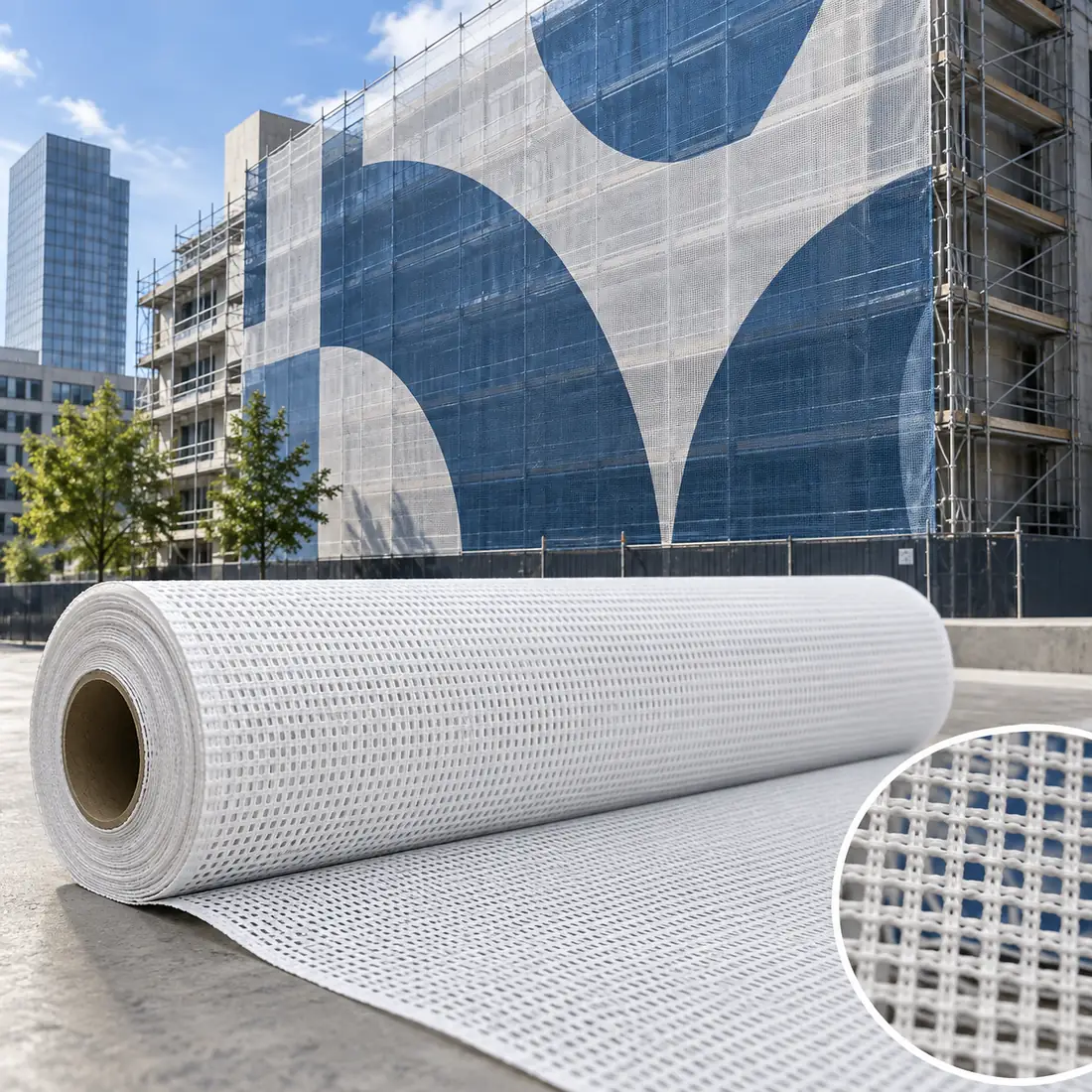
Building wrap mesh is open-structure, wide-format printable media supplied in rolls. Printers convert the rolls into large graphic panels for façades, temporary building covers and scaffold graphics.
The open face passes more air and light than solid PVC banner. It does not define the wind load, fixing design or installed panel limit.
This page covers
- PVC and PVC-free printable mesh rolls
- Lined, linerless, black-back and double-sided formats
- Roll width, panel and seam planning
- Printing, finishing and sample tests
This page does not cover
- Debris or fall-protection netting
- Scaffold engineering
- Finished printed graphics
- Site installation or fixing approval
UNISIGN supplies printable roll media, product data and samples. The project engineer defines the structural system. The installer completes the site work.
Choose the Mesh Format
| Material format | Use it for | Production test |
|---|---|---|
| PVC mesh with liner | Printers that require backing support under open mesh | Feed, vacuum, ink curing and liner removal |
| Linerless PVC mesh | Printers equipped with an open-mesh ink collection and take-up system | Ink collection, platen protection, tracking and take-up |
| Black-back mesh | Graphics that need less visual interference from the scaffold or wall behind | Full-size colour, opacity and feed sample |
| Double-sided printable mesh | Graphics viewed from both sides | Image alignment, show-through, seam and finished weight |
| PVC-free polyester mesh | Project specifications that exclude PVC | UV print, seam, edge and current document set |
For printer-specific details, use the mesh banner with liner guide and the linerless mesh banner guide. For ground-level perimeter graphics, use the construction fence mesh material guide.
Building Wrap Mesh Roll Options
Product images and exact model links help print buyers move from the application to a labelled sample. The signed quotation and current TDS define the ordered roll.

M1212NP
- 360 GSM
- 12 × 12 mesh
- 1–3.2 m and 5 m widths
- 50 m standard length


M1212B
- 240 GSM
- 12 × 12 mesh
- Black back; no liner
- 50 m standard length

M1212-PF/150
- 150 GSM
- 12 × 12 mesh
- 3.2 m and 5 m widths
- 75 m roll; UV printing
Quick Comparison
| Model | Format | Weight | Published width | Length | Printing |
|---|---|---|---|---|---|
| M1212NP | Coated PVC mesh with liner | 360 GSM | 1–3.2 m and 5 m | 50 m | Solvent, eco-solvent, UV, Latex |
| M99P | Coated PVC mesh with liner | 340 GSM | 1–3.2 m and 5 m | 50 m | Solvent, eco-solvent, UV, Latex |
| M1812P | Coated PVC mesh with liner | 340 GSM | 1–3.2 m and 5 m | 50 m | Solvent, eco-solvent, UV, Latex |
| M1212D | Double-sided printable coated mesh | 400 GSM | 1–3.2 m and 5 m | 50 m | Solvent, eco-solvent, UV, Latex |
| M1212B | Linerless black-back mesh | 240 GSM | 1–3.2 m | 50 m | Solvent, eco-solvent, UV, Latex |
| M1212-PF/150 | PVC-free polyester mesh | 150 GSM | 3.2 m and 5 m | 75 m | UV |
See the Material in Its Working Context

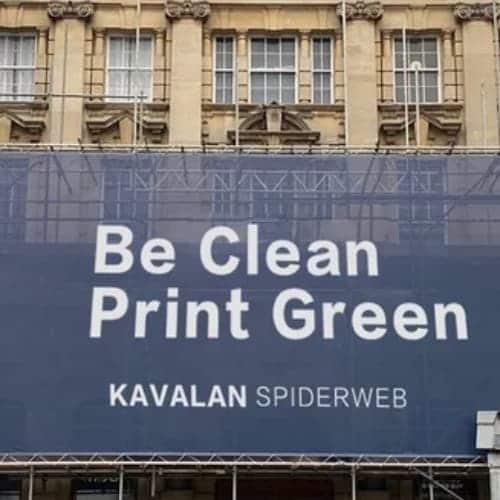
Building and scaffold graphics
Use bold shapes and large copy that stay clear at the real viewing distance.
PVC-free project route
Start with M1212-PF/150 when the material specification excludes PVC.

Artwork for open mesh
Keep faces, logos and small text away from seams, hems and attachment zones.
Plan Panel Widths and Seams Before Printing
Large building graphics use several printed panels. Complete the panel map before artwork output.
Number of panels = finished span ÷ usable printed panel width, rounded up
Use the printer’s usable print width, not the nominal roll width. Calculate material area from every cut panel:
Total material area = sum of all cut panel widths × cut panel lengths
- Record finished sizeWrite the complete graphic width and height.
- Record usable widthUse the printer’s actual printable width.
- Set panel directionChoose roll width, print direction and panel order.
- Place seamsKeep seams away from faces, logos and small text.
- Add finishingUse the fabricator’s hem, overlap, pocket and edge dimensions.
- Mark every panelAdd panel numbers, top marks and print-direction arrows.
- Print a test stripUse the final roll, printer, ink, profile and curing settings.
- Finish one sampleBuild one complete seam-and-edge sample before production.
Keep Adjacent Panels Consistent
- One material batch
- One printer
- One RIP profile
- One ink set
- One print direction
- One curing setting
Print and Finishing Test Plan
Complete every test below before the production run.
| Test | Test piece | Pass condition |
|---|---|---|
| Media transport | Printer-width strip | Straight feeding, stable take-up and no head strike |
| Ink and curing | Final ink and print mode | Dry surface, clean detail and no ink pooling |
| Colour | Full-size image section | Approved colour under the project viewing condition |
| Seam | Final welding or sewing method | Continuous seam with clean image alignment |
| Edge | Final hem, pocket, keder or reinforced edge | Flat edge with no coating separation |
| Panel alignment | Two adjacent printed panels | Matching crop marks, image direction and seam position |
| Packing | One finished sample panel | Visible labels and protected print surface |
Send These 15 Details for Material Selection
- Finished graphic: width and height
- Location: building or scaffold site
- Elevation: installed height
- Printer: brand and model
- Ink: solvent, eco-solvent, UV or Latex
- Usable width: actual printable width
- Material route: PVC or PVC-free
- Backing: liner or linerless
- Printed face: single, black-back or double-sided
- Document: required fire-test standard
- Panel map: direction and seams
- Finishing: seam, hem and edge concept
- Roll width: required width
- Quantity: trial and production rolls
- Delivery: country, port and deadline
UNISIGN uses this project brief to prepare a model shortlist, sample set and roll quotation.
Material Data Is Not Structural Approval
- UNISIGN supplies unprinted roll media, product data and samples.
- The project engineer defines wind action, panel limits, fixing spacing and support-system capacity.
- The installer controls the site survey, access system, hardware, attachment, installation, inspection and maintenance.
- The project specification names the required fire standard.
- The supplied product and its report must carry the same product identity.
- A mesh opening does not replace project wind-load calculations.
- Printable mesh is not fall-protection netting or debris-containment netting.
Do not use a material brochure as structural approval.
Request the Right Sample Set
Material samples
- Two selected mesh models
- Required roll width
- Current product TDS
- Report named by the project specification
Production samples
- Printer-width feeding test
- Full-size colour section
- One finished seam
- One finished edge or attachment sample
Building Wrap Mesh and Scaffold Banner FAQs
What material is used for printed building wraps?
Wide-format building graphics use printable mesh when the design requires an open surface. UNISIGN supplies coated PVC mesh and PVC-free polyester mesh rolls for this production work.
What is the difference between building wrap mesh and construction fence mesh?
Building wrap mesh is planned for large façade or scaffold graphic panels. Construction fence mesh is planned for perimeter fencing close to ground level. The applications use different panel maps, viewing distances, finishing layouts and supporting systems.
What is the maximum published mesh width?
Selected UNISIGN mesh products have widths up to 5 m / 16.4 ft. The printer’s usable width sets the printed panel width.
Which inks work with UNISIGN PVC mesh?
The selected PVC mesh product pages state solvent, eco-solvent, UV and Latex compatibility. M1212-PF/150 PVC-free mesh uses UV printing.
When should I use mesh with a liner?
Use lined mesh when the printer requires backing support under an open material. The liner supports media transport and controls ink that passes through the openings.
When should I use linerless mesh?
Use linerless mesh on equipment fitted with the correct open-mesh ink collection, media transport and take-up system.
Does mesh remove the need for a wind-load calculation?
No. The engineer calculates wind action from the project location, elevation, panel size, open-area data, print coverage, seams, fixing layout, supporting structure and local rules.
Does UNISIGN supply finished printed building wraps?
No. UNISIGN supplies unprinted mesh rolls. Printing, structural design and site installation are separate services.
What should I test before ordering production rolls?
Run a printer-width feeding and curing test. Print a full-size colour section. Produce one seam and one finished edge with the final production method.
UNISIGN Data Basis
- PVC Mesh Banner Material range: models, weights, widths, ink routes and building-wrap applications.
- Mesh banner with liner guide: printer feed, ink collection, liner and sample checks.
- Linerless mesh banner guide: mesh-kit, platen protection and take-up checks.
- PVC-free mesh product data: weight, width, roll length, print method and application.
Reviewed September 20, 2026. The signed quotation and current TDS define the ordered roll.
Get a Building Wrap Mesh Recommendation
Send the printer, project size, target roll width and material route. Receive a 2–3 model shortlist, sample options, current documents and a roll quotation.