Exhibition display materials influence more than the appearance of a booth. They also affect packing, installation time, graphic replacement, and the way a display fits its supporting hardware. A good selection begins with the display format and the event plan.
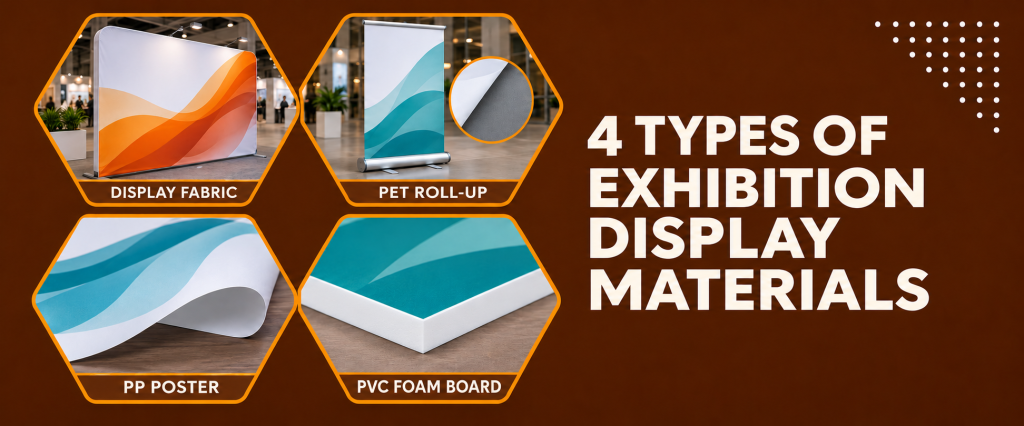
This guide compares four types of exhibition display materials: printable polyester fabric, PET roll-up material, PP poster media, and PVC foam board. Together they cover soft graphics, portable stand graphics, flexible posters, and rigid panels.
1. Printable Polyester Display Fabric
Display fabric is useful for large booth graphics that are packed, transported, and fitted to a compatible frame. DSP06N Saturn is a warp-knitted polyester with slight stretch. Its textile finish offers a different appearance and handling experience from a rigid panel or smooth poster film.

Here’s Why It’s Popular:
- Example: DSP06N Saturn; 230 g/m².
- Printing: Direct or transfer dye sublimation.
- Supply: Listed maximum width 3.2 m; standard length 100 m.
- Display use: Suitable framed graphics, exhibition backdrops, and other approved fabric displays.
- Advantages:
- A textile surface for large branded areas.
- A flexible graphic format that can be separated from reusable hardware.
- Slight stretch for evaluating the intended frame fit.
Check the fabric, pattern allowance, and edge finish with the frame supplier. A material described as display fabric is not automatically compatible with every SEG channel, zipper frame, or tension system.
Explore material specifications
Request a Free Sample2. PET Roll-Up Display Material
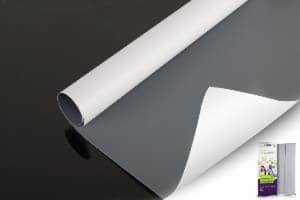
PET roll-up material is intended for a different workflow: the printed panel travels inside or with a portable stand. UPET Grey 330 is a grey-backed PET banner listed for roll-up stands and other displays. The stand mechanism and the finished graphic need to be matched.

Here’s Why It’s Popular:
- Example: UPET Grey 330; 330 g/m².
- Supply: Listed maximum width 1.52 m; standard length 50 m.
- Listed inks: Solvent, eco-solvent, and UV.
- Display use: Roll-up stands, banner displays, and exhibition advertising.
- Advantages:
- A smooth graphic surface for portable display hardware.
- A grey-backed construction to assess for show-through control.
- A model designed around roll-up display enquiries.
Test the finished print for edge curl, stiffness, and reliable retraction in the chosen stand. The page lists no available FR option for this model; confirm venue requirements before selecting it.
Explore material specifications
Request a Free Sample3. PP Poster Display Media
PP synthetic poster media provides a flexible sheet for framed information, promotional graphics, and suitable display systems. UPP190E is a polypropylene synthetic-paper model with matte and glossy surface options. It should be selected for the actual print coating and mounting arrangement.

Here’s Why It’s Popular:
- Example: UPP190E polypropylene synthetic paper.
- Listed specification: 0.19 mm thickness; the table lists 190 ± 5 g/m².
- Supply: Maximum listed width 1.52 m; 30 m or 50 m lengths.
- Display use: Posters, signage, and exhibition information graphics.
- Advantages:
- A flexible poster format for changing campaign messages.
- Matte or glossy finishes to assess under booth lighting.
- Roll supply for multiple smaller graphic panels.
The page lists several ink families. Confirm the supplied coating for the printer and ink in use. Do not assume this synthetic-paper model has an adhesive simply because the category also includes PP stickers.
Explore material specifications
Request a Free Sample4. PVC Foam Board Display Panels
PVC foam board is a rigid sheet option for exhibition panels, directional signs, and fabricated displays. It can carry a printed image or an appropriate mounted graphic. Sheet thickness and density should be chosen around the panel size, support, and expected handling.

Here’s Why It’s Popular:
- Material: Expanded PVC board.
- Published range: Widths 1220–2500 mm; lengths 2440 or 3050 mm; thicknesses 1–30 mm.
- Graphics: The product page offers UV printing; confirm the exact surface and ink process.
- Display use: Exhibition boards, promotional stands, and point-of-purchase panels.
- Advantages:
- A rigid format for flat panels and shaped signs.
- A smooth surface for approved printing or mounting.
- A range of thicknesses to evaluate for fabrication.
Check flatness, support spacing, edge protection, and fixing methods. Broad category claims do not replace the fire-performance documents required by an exhibition organizer.
Explore material specifications
Request a Free SampleWhy Choose UNISIGN?
- Flexible and rigid choices: Compare several display formats within one material enquiry.
- Specific product references: Review sizes, finishes, and compatible print processes.
- Samples before production: Evaluate printing, fitting, and packing with the actual display system.
UNISIGN supplies media for printers, display fabricators, and exhibition contractors. Share the booth layout and hardware details to identify suitable sample options.
Request Factory Prices and Free Samples
Request factory prices and free samples with the display format, dimensions, printer and ink, finish, event requirements, quantity, and destination.