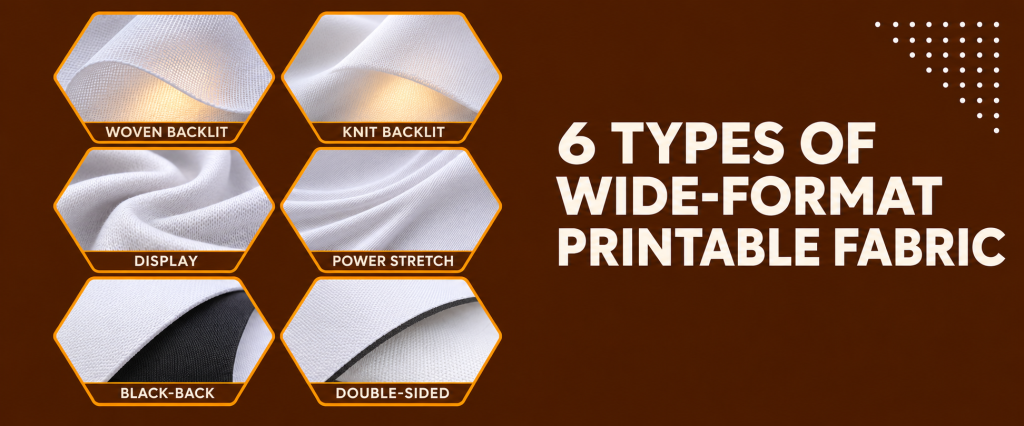
Choosing wide-format printable fabric starts with the panel you need to make. A glowing light-box face, a stretched display wall, and a hanging sign with two printed sides place different demands on the textile. Width matters, but construction, stretch, opacity, and print compatibility matter too.
Here are six wide-format printable fabric options to compare, organized by their construction and display behavior. The examples below help turn a general fabric enquiry into a specific material and finishing discussion.
1. Woven Backlit Fabric
A large illuminated graphic needs a fabric that behaves well both in the printer and inside the frame. Woven backlit fabric is one construction to compare for that job. SDB280 Starlight combines a woven base with a matte finish for light boxes and backlit displays.

Here’s Why It’s Popular:
- Weight: SDB280 is listed at 280 g/m².
- Roll dimensions: Maximum width 3.2 m; standard length 50 m.
- Print routes: Direct dye sublimation, paper-transfer dye sublimation, and latex are listed.
- Selection check: Assess the illuminated image, weave visibility, and panel fit.
- Advantages:
- A woven option for large illuminated panels.
- A matte face for evaluating printed detail.
- Several listed production routes for a suitable print setup.
Judge the finished graphic with the display lights on. A good-looking unlit sample may need a different color profile or ink density for backlit use.
Explore material specifications
Request a Free Sample2. Knitted Backlit Fabric
Knitted backlit fabric offers a different textile structure for illuminated signage. SDB270 Meteor is described as soft and smooth, with a matte finish. Comparing it directly with a woven sample helps identify which surface and handling characteristics suit the intended frame.

Here’s Why It’s Popular:
- Weight: SDB270 is listed at 270 g/m².
- Roll dimensions: Maximum width 3.2 m; standard length 100 m.
- Print routes: Direct or paper-transfer dye sublimation, and latex.
- Typical displays: Light boxes, backlit graphics, backdrops, and pop-ups.
- Advantages:
- A soft knitted alternative within the backlit range.
- A smooth face for large photographic graphics.
- Long standard rolls for planning repeated panels.
Do not derive stretch allowances from the word knitted alone. Measure a printed and heat-treated sample before cutting the final frame graphic.
Explore material specifications
Request a Free Sample3. Slight-Stretch Display Fabric
Non-lit frame graphics need an even surface without relying on light transmission. DSP09 Mars is a warp-knitted display fabric with slight stretch. It provides a useful reference when the job is a pop-up wall, a backdrop, or another fitted indoor display.

Here’s Why It’s Popular:
- Weight: 230 g/m².
- Roll dimensions: Maximum width 3.2 m; standard length 100 m.
- Print routes: Direct or paper-transfer dye sublimation.
- Selection check: Compare opacity, recovery after handling, and fit on the actual hardware.
- Advantages:
- A controlled starting point for fitted textile graphics.
- A soft appearance for indoor display walls.
- Wide rolls for planning panels and seam locations.
Good opacity does not mean complete light blocking. Choose a dedicated blockout construction if the background or rear lighting would otherwise show through.
Explore material specifications
Request a Free Sample4. Power-Stretch Display Fabric
Curved and irregular display shapes may need more extension than a conventional display knit provides. DSP08-T Venus is a spandex-containing power-stretch fabric described as stretching in two directions. The pattern and finishing must be developed around the specific shape.

Here’s Why It’s Popular:
- Weight: The model page lists 250 g/m².
- Roll dimensions: Maximum width 3.2 m; standard length 100 m.
- Print routes: The specification table lists direct or paper-transfer dye sublimation.
- Typical displays: Geometric structures, trade-show shapes, and grand-format graphics.
- Advantages:
- Greater extension for evaluating shaped graphics.
- A dedicated option for irregular display surfaces.
- A fabric construction designed around stretch rather than a rigid panel.
The category table shows a different weight, so confirm the 250 g/m² grade on the order. The model page states “Available FR: No”; do not specify it for a fire-rated installation without a separately documented suitable grade.
Explore material specifications
Request a Free Sample5. Black-Back Blockout Fabric
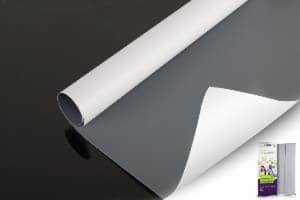
When the view behind the display should disappear, a dark-backed textile is a useful option. DSP-BLK-01 Nox combines a white printing face with a black reverse. Its slight stretch makes it relevant to backdrops and framed exhibition graphics that also need opacity.

Here’s Why It’s Popular:
- Weight: 260 g/m².
- Construction: Warp-knitted white/black structure.
- Print routes: Direct or paper-transfer dye sublimation.
- Roll dimensions: The model page lists up to 5 m wide and 100 m long; confirm width availability against the quotation.
- Advantages:
- Helps conceal the structure or scene behind the graphic.
- Combines opacity with a textile surface.
- An extra-wide listed option for reducing planned joins.
The category table lists 3.2 m, so use a confirmed model specification for extra-wide orders. Print and tension a sample before assessing show-through.
Explore material specifications
Request a Free Sample6. Double-Sided Printable Blockout Fabric
A hanging sign viewed from opposite directions needs two useful print faces. DSP-BLK-D Ares has a black inner layer and white printable surfaces on both sides. It is an option for dual-message displays where the front and reverse artwork must remain distinct.

Here’s Why It’s Popular:
- Weight: The individual model page lists 250 g/m².
- Roll dimensions: Maximum width 3.2 m; standard length 100 m.
- Print routes: Direct or paper-transfer dye sublimation.
- Selection check: Confirm two-sided registration, opacity, and the full heating sequence.
- Advantages:
- Supports different artwork on each face.
- Uses an internal dark layer to reduce image interference.
- Provides a textile option for two-way exhibition graphics.
The category table lists 260 g/m² for this code. Confirm the current grade, then test both sides through the complete print and finishing sequence.
Explore material specifications
Request a Free SampleWhy Choose UNISIGN?
- Different constructions: Compare woven, knitted, slight-stretch, power-stretch, and blockout options.
- Specific roll formats: Use named models to discuss width, length, and production quantities.
- Practical sampling: Evaluate the fabric on your printer and frame before ordering the full job.
UNISIGN supplies textile roll media for wide-format print production. Provide the frame drawing and finishing method with your enquiry so the proposed fabric can be evaluated as part of the complete display.
Request Factory Prices and Free Samples
Request factory prices and free samples with the print system, required roll width, finished dimensions, display lighting, stretch requirements, quantity, and destination.