Adhesive vinyl film is used for printed signs, decorative graphics, window promotions, and vehicle advertising. A typical construction brings together a PVC face film, pressure-sensitive adhesive, and a release liner. Each layer affects how the material prints, handles, and performs after installation.
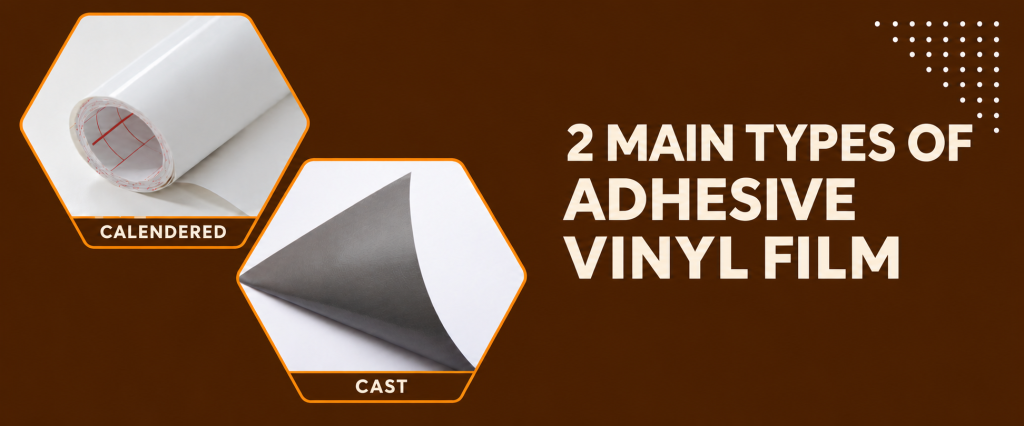
When classifying PVC graphic films by their manufacturing process, the two main types are calendered and cast. This distinction describes the face film. Permanent or removable describes the adhesive, while white or transparent describes a separate visual property.
1. Calendered Adhesive Vinyl Film
Calendered vinyl is formed by passing a heated PVC mixture through rollers to produce a film. It is widely considered for flat signs and other applications that do not require extreme stretching. Monomeric and polymeric are two common formulation choices within this group.

Here’s Why It’s Popular:
- Uses: Suitable flat advertising panels, shop promotions, and approved gently curved surfaces, depending on the model.
- Monomeric example: UV1301 has a 100-micron face film and 140 g/m² paper liner.
- Polymeric example: UV1501 has an 80-micron face film, 140 g/m² paper liner, and a listed bubble-free feature.
- Roll sizes for both examples: Widths of 0.914, 1.07, 1.27, 1.37, and 1.52 m; standard 50 m length.
- Printing: Both model pages list solvent, eco-solvent, UV, and latex inks.
- Advantages:
- A practical film family for everyday signage.
- Different formulations for different project demands.
- Several widths for matching artwork and equipment.
Compare monomeric film for simpler flat promotions and polymeric film when improved dimensional stability matters. A polymeric model may suit approved gentle curves, but the name alone does not establish suitability for a full vehicle wrap. Ask for the permitted shapes and installation instructions.
UV1301 monomeric specifications · UV1501 polymeric specifications
Request a Free Sample2. Cast Adhesive Vinyl Film
Cast vinyl is produced by spreading a liquid formulation onto a casting carrier and passing it through an oven to form the film. This process differs from rolling a heated mixture into shape. Cast films are commonly considered where conformability and dimensional stability are priorities.

Here’s Why It’s Popular:
- Uses: Vehicle advertising, car decoration, and more demanding contours approved for the selected construction.
- UNISIGN example: UV1801G cast vinyl.
- Face-film thickness: 50 microns / 0.05 mm.
- Release liner: 160 g/m² paper with PE coating on both sides.
- Roll sizes: 1.52 m width; 30 m and 50 m listed lengths.
- Printing: Solvent, eco-solvent, UV, and latex inks.
- Advantages:
- A film family used for demanding shaped graphics.
- A thin face-film option for the specified wrap system.
- A listed bubble-free feature to evaluate during installation.
Confirm the exact model’s approved curves, recesses, laminate, and application method. Plan a trial with the final printed construction before a large wrap project. Photos cannot establish manufacturing process; use the model specification and current technical data sheet.
UV1801G cast film specifications
Request a Free SampleWhy Choose UNISIGN?
- Options across both film families: Compare monomeric and polymeric calendered products with a cast alternative.
- Clear model references: Review face-film thickness, liner, roll format, and supported ink families.
- Samples for installation checks: Evaluate printing, adhesion, edge hold, and planned removal on the intended substrate.
Send UNISIGN your surface type, graphic dimensions, expected use period, adhesive needs, and quantity to discuss a suitable adhesive vinyl film.
Request Factory Prices and Free Samples
Request calendered or cast film samples and a current quotation based on your application requirements.