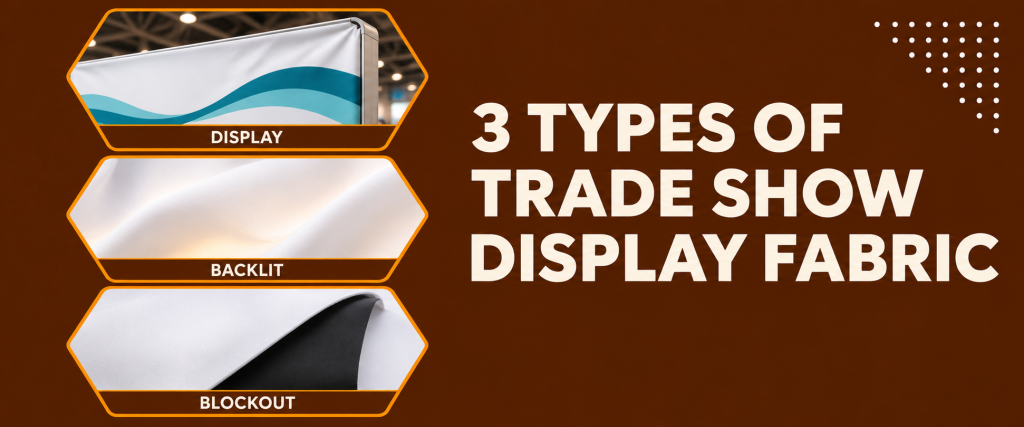
Trade show display fabric should be chosen around the booth lighting and the display system. A graphic that looks effective in a lit frame may be the wrong material for an opaque backdrop, while a standard fabric can be a practical option for a non-illuminated display.
This guide compares three types of trade show display fabric: non-illuminated display, backlit, and blockout backdrop fabric. The aim is to help printers and exhibition contractors match the fabric to the way the finished graphic will be used.
1. Non-Illuminated Display Fabric
Non-illuminated display fabric is used where the booth lighting falls onto the graphic face. DSP06N Saturn is a warp-knitted polyester with slight stretch, suitable for evaluating framed graphics, backdrops, and exhibition display applications. It is a useful starting point for a booth that does not require internal lighting.

Here’s Why It’s Popular:
- Example: DSP06N Saturn; 230 g/m².
- Printing: Direct or transfer dye sublimation.
- Supply: Listed maximum width 3.2 m; standard roll length 100 m.
- Production focus: Image scale, fabric orientation, edge finishing, and fit on the selected frame.
- Advantages:
- A textile finish for large trade-show brand graphics.
- Slight stretch to evaluate against the chosen display system.
- A removable graphic format for hardware that will be reused.
Prepare the artwork using the actual frame and finishing specification. Allowances for sewn edges, silicone strips, or other attachments should come from the fabricator, not from the nominal roll width.
Check the complete printed panel under booth lighting. An ordinary display textile is not necessarily blockout, so strong light or visible objects behind it may require a different construction.
Explore material specifications
Request a Free Sample2. Backlit Trade Show Fabric
Backlit trade show fabric is intended to work with light coming through the graphic. SDB270 Meteor is a knitted lightbox textile with a matte surface. It is a suitable model to evaluate when illuminated walls or counters form part of a booth.

Here’s Why It’s Popular:
- Example: SDB270 Meteor; 270 g/m².
- Printing: The product lists direct dye sublimation, transfer dye sublimation, and latex.
- Supply: Listed maximum width 3.2 m; standard roll length 100 m.
- Production focus: Light transmission, color density, frame tension, and LED arrangement.
- Advantages:
- A fabric option for illuminated brand graphics.
- A matte textile face to assess for the desired finish.
- A named lightbox grade for coordinating print and hardware trials.
Approve the printed fabric inside the intended lightbox. A desktop proof cannot fully show illuminated color, hotspots, diffusion, or the appearance of seams.
If the display uses silicone edge graphics, confirm the edge profile, channel, and cut allowance with the frame supplier. SEG is a finishing and mounting system, rather than a single fabric composition.
Explore material specifications
Request a Free Sample3. Blockout Backdrop Fabric
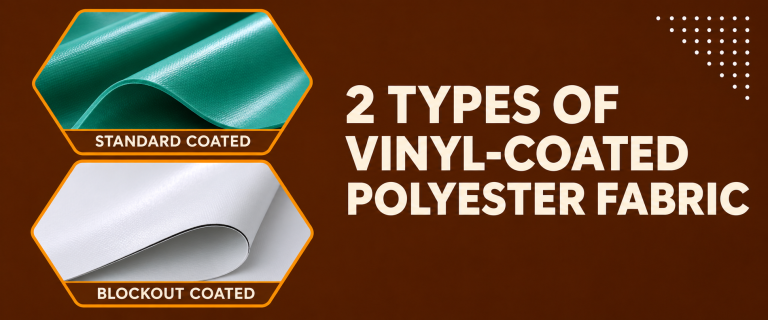
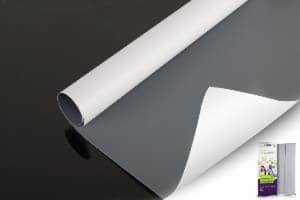
Blockout backdrop fabric is useful where the graphic should conceal light or objects behind it. DSPBLK01 Nox combines a white printable face with a black reverse. This differs from a translucent lightbox textile, which is intended to pass light through the image.

Here’s Why It’s Popular:
- Example: DSPBLK01 Nox; 260 g/m².
- Construction: Warp-knitted fabric with slight stretch, white face, and black reverse.
- Printing: Direct or transfer dye sublimation.
- Supply check: Confirm the current available width; the product and category listings show different maximum widths.
- Advantages:
- A light-blocking construction for evaluating opaque booth backdrops.
- A dark reverse to help conceal the area behind the display.
- A fabric option for separating visible branding from the supporting booth structure.
Approve opacity on a printed sample under representative backlighting. Pay particular attention to seams, panel edges, and attachment details, where the overall display may behave differently from the unjoined fabric.
The black reverse is not an independently printable second graphic face. If visitors will see both sides, specify a suitable double-sided construction and artwork arrangement.
Explore material specifications
Request a Free SampleWhy Choose UNISIGN?
- Different lighting functions: Compare ordinary display, lightbox, and blockout textiles.
- Model-specific information: Review fabric construction, weight, supply width, and print options.
- Sample-based preparation: Evaluate the graphic together with the frame before the event.
UNISIGN supplies printable textiles for sign makers and exhibition contractors. Provide the booth lighting and hardware details so suitable material samples can be shortlisted.
Request Factory Prices and Free Samples
Request factory prices and free samples with the display format, frame dimensions, lighting, print process, finishing method, venue requirements, quantity, and destination.