


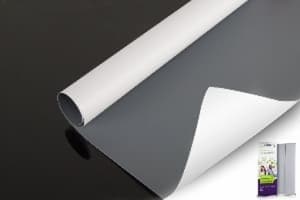
UNISIGN · PVC BANNER BUYER CHECKLIST
PVC Banner Material Testing and Sample Approval Checklist
Identify the roll, test printing and finishing, then record one decision: pass, modify and retest, or reject.
This guide helps print buyers, converters and distributors keep a traceable sample record before a bulk order. UNISIGN supplies unprinted PVC banner rolls, labelled samples and product documents.
- 6 stepsfrom receipt to decision
- 3 decisionspass, retest or reject
- 1 recordkept with the order
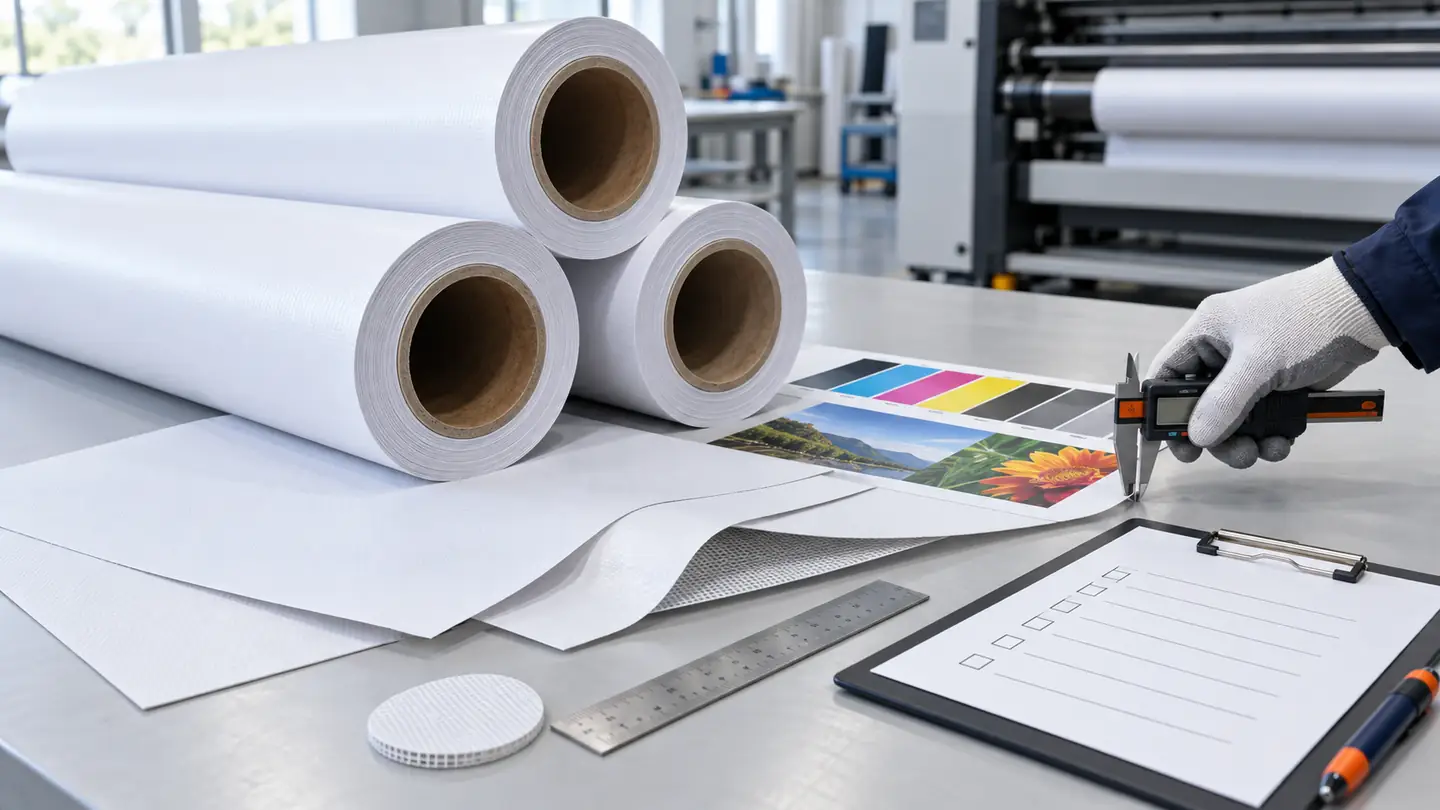
Short answer: Match the sample label to the requested model, inspect the roll, print and finish it on the intended production equipment, compare only the order-defined results with written limits, and retain the sample with a pass, modify-and-retest or reject decision.
Check a PVC Banner Sample in 6 Steps
- Identify the sampleRecord the model, construction, lot, sample ID, roll width and receipt date. Stop if the identity is wrong.
- Inspect the rollPhotograph the packing, core, roll ends, edges and open surface. Record damage, dirt, wrinkles and coating loss.
- Check order dataUse the written method for width, GSM, thickness, length, core and joins. Record the tools and sample positions.
- Run the print testUse the intended printer, ink, RIP, print mode, heat or cure settings and take-up system.
- Run the finishing testMake the planned weld, seam, hem, eyelet, pole pocket or panel join with production equipment.
- Record the decisionMark pass, modify and retest, or reject. Label and retain the unprinted, printed and finished samples.
What Can the Buyer Check On Site?
| Check | Buyer action on site | Write this before using the result for acceptance |
|---|---|---|
| Product identity | Match model, construction, lot, sample ID and documents. | Required product code, construction and document list. |
| Packing and appearance | Inspect core, roll shape, edges, surface, dirt, marks and coating damage. | Lighting, inspection distance, inspected area, sample count and allowed defects. |
| Width, GSM and thickness | Measure with suitable, checked tools. | Conditioning, tool, pressure or sample area, positions, sample count and limits. |
| Printer transport | Check tracking, edge curl, wrinkles, head strikes, curing and take-up. | Printer, ink, speed, tension, heat or cure settings and pass conditions. |
| Printed image | Review solids, gradients, small text, fine lines, neutral grey and the buyer’s artwork. | Test file, RIP, profile, viewing light, reference colour and limits. |
| Rub or scratch screen | Use it as an internal process check. | Waiting time, tool, force, cycles, direction, sample count and limit. |
| Finishing | Make the planned weld, sewn seam, hem, eyelet, pocket or join. | Equipment, settings, sample shape, conditioning, sample count and limit. |
| Backlit, blockout or mesh use | View the sample in its intended light, background or liner workflow. | Light source, background, measurement method, sample count and limit. |
An on-site check is not automatically a contract test. A result controls bulk acceptance only when both parties have written the method, conditions, sample count, limit and lot-decision rule.
Buyer and print shop checks
- Label, model, lot and document match
- Packing, core, edge and surface condition
- Order-listed basic measurements
- Feeding, printing, curing and take-up
- Welding, sewing, hemming and eyelets
- Backlit, blockout or mesh application sample
Defined method or laboratory checks
- Tensile strength and elongation
- Tear strength
- Coating adhesion or peel strength
- Flame testing
- Specified UV or weathering test
- Regulated-substance testing
Hands, eyes and a lighter do not produce a laboratory result. A laboratory report applies to the product identity, construction, method and sample named in that report.
Use Only 3 Sample-Approval Decisions
Pass
The identity is correct. Production-equipment testing is complete. Every order-defined result meets its written limit. Required documents match the sample.
- Sign and date the approved sample.
- Reference its ID in the purchase order.
Modify and Retest
The identity is correct. A recorded print, cure, tension, take-up, liner, packing or finishing setting caused the failed result.
- Change one written variable at a time.
- Give the revised sample a new ID.
- Repeat the failed and affected checks.
Reject
The model or construction is wrong, a mandatory purchase requirement fails, a required document does not match, or the same critical item fails the retest.
- Stop approval of the current model.
- Test a correctly identified alternative.
Test the Property That Matters for Each Banner Type
| Material | First checks | Use the real application setup |
|---|---|---|
| Frontlit | Feed, colour, surface glare, curing, weld and edge | View the print and finished edge under front lighting. |
| Backlit | Light uniformity, black density, pinholes, banding and joins | Inspect the same print with the lightbox off and on. |
| Blockout | Opacity, front-to-back interference, two-side registration and curl | Print both faces and place the sample against its intended background. |
| Mesh | Feed, liner removal, ink passing through openings, image and seam | Use the production printer, ink collection and take-up setup. |
Start With a Clearly Identified UNISIGN Sample
These four models represent frontlit, backlit, blockout and mesh routes. Test the labelled model that will be named in the quotation and order.

CFM11/440
Coated matte frontlit. Published standard roll: 50 m. Published widths: 1–3.2 m and 5 m.
View model data →
LBG55/610
Laminated backlit. Published standard roll: 50 m. Published widths: 1–3.2 m and 5 m.
View model data →
CDM2525/510
Coated blockout with two printable faces. Published standard roll: 50 m. Published widths: 1–3.2 m and 5 m.
View model data →
M1212NP
Coated mesh with liner. Published standard roll: 50 m. Published widths: 1–3.2 m and 5 m.
View model data →Product photographs come from the linked UNISIGN pages. The blockout card uses the coated-blockout series photograph published by UNISIGN. The signed quotation, current TDS and labelled sample define the ordered roll.
Use the PVC banner material selector to choose a starting type, or compare the full PVC banner material range.
Keep One Approval Record With the Order
Download the one-page PDF, or print the record below. Keep it with the labelled unprinted, printed and finished samples.
PVC Banner Sample Approval Record
Record only the sample, method and result actually checked.
Use the print button above to print this record or save it as a PDF.
Checks completed
Decision
This record supports sample screening. Bulk acceptance requires a written method, conditions, sample count, limit, retest rule and lot-decision rule.
Request Test Rolls in 3 Steps
Send six facts first: material type, intended use, printer, ink, roll width and estimated quantity.
Request PVC Banner Test Rolls- Send the use and equipmentProduct type, final use, printer, ink, required width and estimated quantity.
- Receive starting optionsTwo or three model options, sample labels, current product data and an available-document list.
- Test and request the order quoteReturn the decision, written order requirements, quantity and delivery destination.
PVC Banner Sample Testing FAQs
Can an A4 sample complete PVC banner approval?
No. An A4 sample checks only a local surface and print area. Stable feeding, take-up, full-width variation, welding, joins and finished edges require roll material.
Does the correct GSM prove that the material passes?
No. GSM is one order data point. The material must also pass the written printing, transport, curing, finishing and application checks.
Can a TDS or test report replace an actual print test?
No. A document describes product data. A print test checks the material with the buyer’s printer, ink, RIP and finishing process.
Does one approved sample approve every later lot?
No. The retained sample defines the approved target. Each incoming lot follows the inspection, document and acceptance rules written in the purchase order.
Can a lighter flame test prove flame performance?
No. Flame performance requires the named test method and a report for the exact tested material. An open-flame screen in a print shop is not a standard flame test.
Sources and Scope
This page is a buyer sample-approval workflow. It is not a laboratory procedure, a completed test report or a universal acceptance standard. It supplies no invented pass values. The purchase order or quality agreement must state the method, conditions, sample count, limits, retest rule and lot-decision rule.
- UNISIGN CFM11/440 product page
- UNISIGN LBG55/610 product page
- UNISIGN CDM2525/510 product page
- UNISIGN M1212NP product page
- ISO 2286-2 catalogue entry: determination of mass per unit area
- ISO 1421 catalogue entry: tensile strength and elongation at break
- ISO 2411 catalogue entry: coating adhesion
Product pages and source scope reviewed September 27, 2026. UNISIGN supplies unprinted material rolls, samples and product documents. The buyer and named laboratory perform the checks required by the order.
Ready to Test a Labelled Sample?
Send the intended use, material type, printer and ink, roll width, quantity, destination and required checks. UNISIGN will return starting model options and sample information.