


Cold transport · winter installation · outdoor use
PVC Banner Material for Cold-Weather Projects
A useful cold-weather banner specification needs more than one temperature number. State the minimum temperature for transport, installation and service. Then match the roll, test method, printed sample and finished banner to the real job.
UNISIGN can use your project data to prepare a labelled sample and test plan. A roll is described as cold-crack resistant only when the ordered SKU or batch has matching evidence.
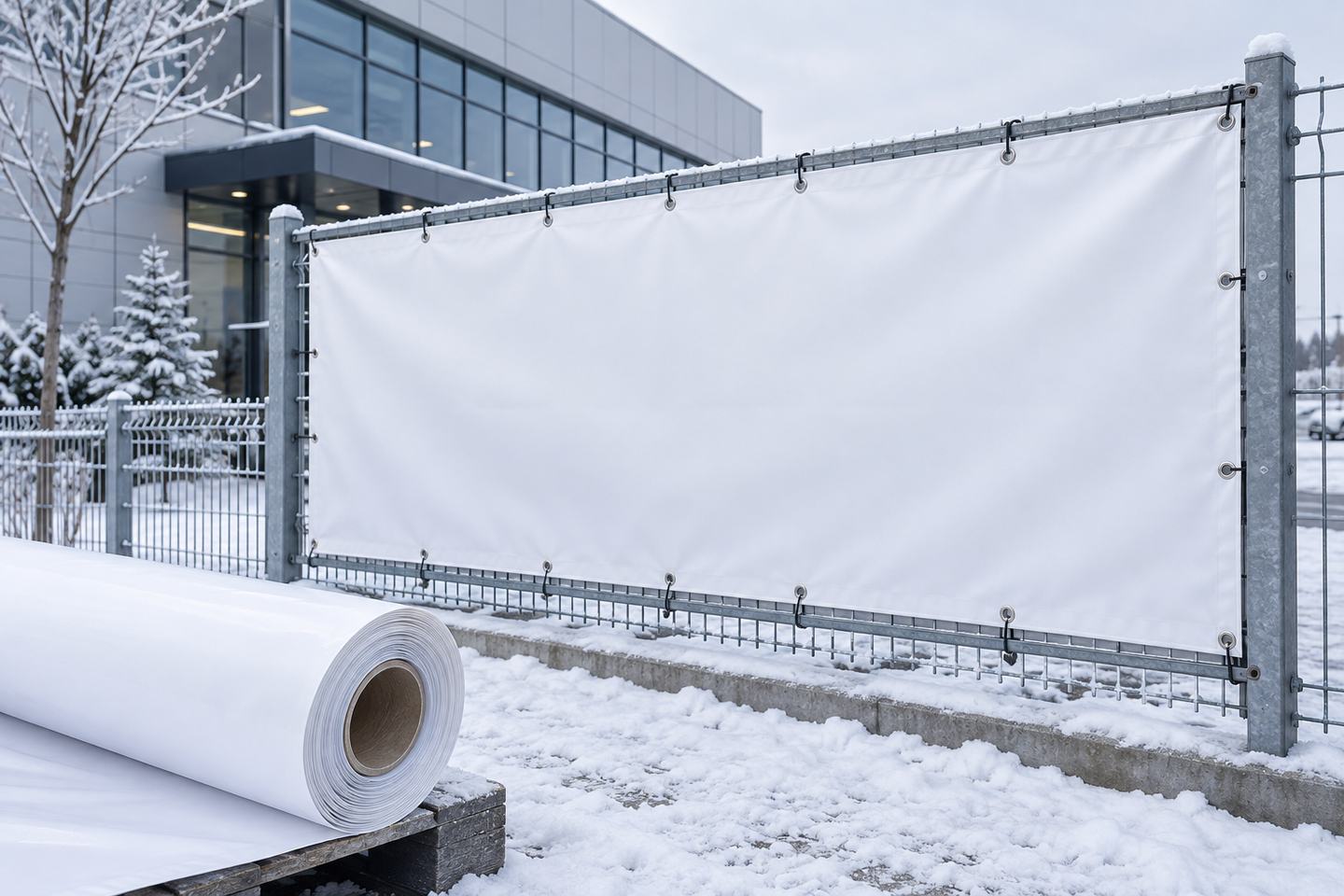
What Should a Buyer Verify for a Cold-Weather Banner?
Ask for the exact SKU, test method, test temperature, sample condition and pass/fail result. Also state whether the banner will stay fixed, be installed while cold, or be folded and rolled at the lowest temperature.
A laboratory bend result is useful, but it is not a universal service-temperature guarantee. The printed ink, hem, weld, eyelets, wind load, ice and repeated movement also affect the finished banner.
Define These 3 Temperatures Before Choosing the Roll
| Temperature field | What it means | Example buyer question | Main risk |
|---|---|---|---|
| 1. Transport and storage | Lowest temperature while the roll or printed banner is packed, shipped or stored. | Will the material stay rolled, or will a finished banner be folded in an unheated truck? | Frozen folds, tight roll radius, pressure marks and print cracking. |
| 2. Installation and handling | Lowest temperature while workers unroll, bend, tension, weld, hem or fit hardware. | Must the banner be installed at -10°C, or can it warm indoors first? | Sharp bends, edge damage, stiff material and grommet stress. |
| 3. Service | Lowest air or contact temperature after installation. | Will the banner remain fixed, flap in wind, roll each day or touch ice and metal? | Repeated flexing, tension change, wind cycling and local cracking. |
Cold-Crack Rating Is Not the Same as Service Temperature
| Term | What it can tell you | What it cannot prove alone |
|---|---|---|
| Low-temperature bend result | Whether a conditioned coated-fabric specimen passes a defined bend at a stated temperature. | Every type of field movement, finished seam, wind load or service life. |
| Low-temperature impact result | How the specimen behaves under a defined cold impact procedure. | Daily rolling, long-term tension or repeated folds at the same temperature. |
| Cold-crack number | A useful comparison point when method, specimen and pass rule are stated. | The lowest safe temperature for all printing, transport, installation and use. |
| Service range | A project-specific operating target for the finished banner system. | A laboratory result unless it is supported by a named test and report. |
ISO 4675:2017 covers low-temperature bending of rubber- or plastics-coated fabrics after defined exposure. ISO states that no general link to service performance can be implied. ASTM D2136 also uses a prescribed bend at an established temperature and says the result does not necessarily identify the lowest use temperature.
Ask for These 10 Fields in the Test Evidence
| Field | What the report should state | Why it matters |
|---|---|---|
| 1. Product identity | SKU, formulation or batch number | Links the result to the roll you buy. |
| 2. Construction | Coated or laminated; frontlit, blockout or mesh | Different constructions can behave differently. |
| 3. Method | ISO 4675, ASTM D2136, ASTM D751 or stated equivalent | Makes the result repeatable and comparable. |
| 4. Method revision | Year or edition used | Avoids mixing old and current procedures. |
| 5. Specimen | Thickness, size, direction and number of pieces | Machine and cross directions may not behave alike. |
| 6. Conditioning | Temperature, time and specimen state | Cold exposure before the action is part of the test. |
| 7. Action | Bend, impact, mandrel, speed or cycle details | Static storage and active handling are not the same. |
| 8. Damage check | Crack depth, length, count, whitening or delamination | “Pass” needs a visible acceptance rule. |
| 9. Result | Temperature and pass/fail for every specimen | A range without specimen results is incomplete. |
| 10. Traceability | Laboratory, report date and approval name | Supports purchasing and repeat orders. |
Coated vs Laminated PVC in Cold Conditions
Coated PVC
- Often selected for higher-duty outdoor banners.
- Metamark’s category guide describes coated PVC as having good resistance to cold conditions.
- Still requires a result for the exact UNISIGN SKU or batch.
Laminated PVC
- Useful and cost-effective for many standard banner jobs.
- Some constructions can become more brittle in cold conditions.
- Do not reject or approve it by construction name alone; test the actual roll.
UNISIGN Roll Families to Start Sample Qualification
These current products cover common cold-weather project formats. They are sample starting points, not published cold-crack ratings. Approve the labelled sample, current TDS and project test before production.

CFM11/510
- 510 GSM website listing
- 1000 × 1000D, 18 × 18/sq.in
- 1–3.2 m and 5 m listed widths
- Single-sided frontlit project route
CFM11/440
- 440 GSM website listing
- 1000 × 1000D, 18 × 18/sq.in
- 1–3.2 m and 5 m listed widths
- Lower transport weight than the 510 GSM route

CDM55/610
- 610 GSM website listing
- 500 × 500D base fabric
- Double-sided printable blockout route
- Starting point for pole and hanging graphics

M1212NP
- 360 GSM website listing
- 1000 × 1000D, 12 × 12/sq.in
- With liner; linerless option listed
- Starting point where wind load is a priority
Choose a Starting Route by Application
| Project | Starting material route | Cold-weather checks | Other checks |
|---|---|---|---|
| Wall or framed single-sided banner | Coated frontlit sample | Bend result, unrolling, hem/weld and installation temperature | Ink, viewing distance, UV and fixing spacing |
| Double-sided or pole banner | Coated blockout sample | Printed fold, edge reinforcement, hardware and cyclic flexing | Opacity, balance, pole bracket and wind engineering |
| Fence, scaffold or exposed site | Mesh sample when the design allows | Mesh coating, liner, cold handling and edge finish | Open area, wind load, print density and support structure |
| Repeated daily rolling or folding | Custom verified cold formulation | Test at movement temperature and planned roll/fold radius | Cycle count, abrasion, seams and storage method |
| Severe sub-zero project | Factory-selected formulation after requirements review | Named method, stated temperature, report and project sample | Wind, ice, hardware, installer method and safety approval |
Cold-Weather Banner Applications

Billboards

Building graphics

Outdoor displays
Qualify the Material in 8 Steps
- Define the three temperaturesRecord transport, installation and service minimums.
- Describe movementState whether the banner stays fixed, flaps, folds or rolls.
- Select candidate SKUsChoose frontlit, blockout or mesh by the real job.
- Request evidenceMatch the SKU, method, temperature and report date.
- Print a labelled sampleUse the planned ink, profile, coverage and curing route.
- Finish the sampleAdd the real hem, weld, eyelets, pockets and reinforcement.
- Condition and testUse the agreed time, temperature, direction and action.
- Approve and recordKeep sample, batch, settings, result and acceptance rule.
Transport, Storage and Installation Rules
| Stage | Practical control | Record for the project |
|---|---|---|
| Roll packing | Use a suitable core and protective packaging; avoid crushed edges. | Core, winding direction, roll diameter and pallet orientation |
| Printed transport | Roll face-out when approved; avoid tight cold folds. | Printed age, roll radius, packing temperature and travel time |
| Cold storage | Keep dry and protect from ice, pressure and rapid handling. | Lowest storage temperature and storage duration |
| Warm-up | Allow the roll or finished banner to reach the approved handling temperature when required. | Warm-up location, time and measured material temperature |
| Installation | Use even tension and suitable flexible hardware; avoid sharp frozen creases. | Air temperature, material temperature, fixing spacing and tension method |
| Inspection | Check edges, eyelets and high-flex points after major temperature or wind changes. | Inspection interval, damage rule and replacement trigger |
Send These 10 Details for a Useful Quote
- Application: billboard, wall, pole, fence or moving system
- Transport minimum: °C or °F
- Installation minimum: °C or °F
- Service minimum: °C or °F
- Movement: fixed, wind flex, fold or roll
- Finished size: width × height and panel seams
- Print route: solvent, eco-solvent, UV or Latex
- Finish: hem, weld, eyelets, pockets or webbing
- Quantity: sample, trial rolls and full order
- Destination: country, delivery date and local weather
Cold-Weather PVC Banner FAQs
What is cold-crack resistance in PVC banner material?
It describes resistance to cracking under a stated low-temperature test. The result is useful only when the SKU, method, temperature, specimen condition and pass rule are known.
Is a -20°C cold-crack result the same as a -20°C service rating?
No. A test result describes the defined specimen and action. Service also includes printing, seams, eyelets, tension, wind, ice and repeated movement.
Which test methods are used for coated fabrics?
ISO 4675 and ASTM D2136 are established low-temperature bend methods for coated fabrics. ASTM D751 also includes low-temperature test procedures. Use the exact method required by the project.
Does higher GSM mean better cold-crack resistance?
Not by itself. GSM describes mass per area. Low-temperature behaviour also depends on the PVC formulation, construction, coating or lamination, reinforcement and finished-banner design.
Is coated PVC always better than laminated PVC in winter?
No universal rule approves every coated roll. Coated PVC is often a stronger starting route for demanding outdoor work, but the exact SKU still needs matching evidence and a project sample.
Can mesh banner solve cold-weather problems?
Mesh can reduce wind load, which may reduce repeated flex stress. It does not prove cold-crack resistance. Test the mesh coating, liner, finished edges and handling temperature.
Should the sample be printed before testing?
Yes when print cracking, curing, folds or finishing matter. Use the planned ink, profile, coverage, drying or curing, and the real hem, weld and hardware.
Should a cold printed banner be folded or rolled?
Use the approved packing method. Rolling usually avoids sharp crease lines, but the roll radius, print direction, temperature and ink system still need validation.
Which UNISIGN banner SKU is cold-crack resistant?
The current public pages do not provide a named printable banner SKU with a complete low-temperature method and result. Send the project temperatures so UNISIGN can select and test a labelled candidate.
What should I request with a production order?
Request the exact SKU, current TDS, low-temperature evidence, batch identity, approved sample, print settings, finishing method and agreed acceptance rule.
Technical Sources and Data Basis
- ISO 4675:2017: low-temperature bend test and its service-performance limitation.
- ASTM D2136-19(2026): prescribed low-temperature bend test and interpretation limit.
- Metamark PVC Banner Technical Glossary: coated versus laminated construction reference.
- Example banner technical data sheet: shows how a product sheet can connect construction, methods and temperature data.
- UNISIGN PVC banner material range: current public product families, widths and applications.
Reviewed: September 16, 2026. External sources explain methods and page structure; they do not prove the cold-weather performance of a UNISIGN SKU. Confirm the ordered product and current test evidence.
Build a Cold-Weather Banner Sample Plan
Send the three temperatures, movement, finished size, ink route, finishing, quantity and destination. UNISIGN can use the data to shortlist a roll and prepare a labelled sample.